 This semester my call to change is focused on changing the
undeserved trust that people give to the internet. In my midterm video, I began
by recapping a normal interaction on the internet; seeing a product, following
a link to a website, reading reviews and then purchasing the project. While
this seems normal and harmless, the fact is that the internet user just
followed an unverified link to a website who’s reviews they blindly trusted and
then gave very personal information, including a personal address and credit
card number, to a company they have no real knowledge of. Basically the reckless
way in which we approach the internet will come back to bite us if we don’t put
measures in place to protect ourselves.
This semester my call to change is focused on changing the
undeserved trust that people give to the internet. In my midterm video, I began
by recapping a normal interaction on the internet; seeing a product, following
a link to a website, reading reviews and then purchasing the project. While
this seems normal and harmless, the fact is that the internet user just
followed an unverified link to a website who’s reviews they blindly trusted and
then gave very personal information, including a personal address and credit
card number, to a company they have no real knowledge of. Basically the reckless
way in which we approach the internet will come back to bite us if we don’t put
measures in place to protect ourselves.
Showing posts with label posted by Jordyn M. Show all posts
Showing posts with label posted by Jordyn M. Show all posts
Monday, April 20, 2015
An Uncertain Source: Why You Should Doubt the Internet
This semester my call to change is focused on changing the
undeserved trust that people give to the internet. In my midterm video, I began
by recapping a normal interaction on the internet; seeing a product, following
a link to a website, reading reviews and then purchasing the project. While
this seems normal and harmless, the fact is that the internet user just
followed an unverified link to a website who’s reviews they blindly trusted and
then gave very personal information, including a personal address and credit
card number, to a company they have no real knowledge of. Basically the reckless
way in which we approach the internet will come back to bite us if we don’t put
measures in place to protect ourselves.
Tuesday, March 24, 2015
The Dead are not Powerless, and Neither is the Chief
“The dead are not altogether powerless”, Chief Seattle
concludes, after outlining the fundamental difference between the white man and
his people. When the white man dies, he says, they go our into the stars and
their ancestors abandon their graves, but the land still hold the dead of his
people, who once numbered as the “the grass of the plains”. Those aiding in the
death of his nation will never be alone, the Chief is saying because the
memories of his people will always be with them.
Tuesday, March 10, 2015
Declaration of the Rights of Man and of the Citizen
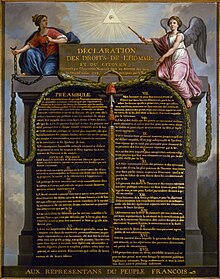 The
year 1789 was an important year for human rights, first producing the Bill of
Rights in the United States constitution, followed a few months later by the
French's own official penning of the rights of the men of their country, titled
The Rights of Man and of the Citizen. It followed the storming of Bastille by
the citizens, and was introduced into the general assembly that only a month
before had abolished feudalism. The document was introduced by Lafayette, and
was greatly influenced by Thomas Jefferson, whom the general had worked with
during the American Revolution.
The
year 1789 was an important year for human rights, first producing the Bill of
Rights in the United States constitution, followed a few months later by the
French's own official penning of the rights of the men of their country, titled
The Rights of Man and of the Citizen. It followed the storming of Bastille by
the citizens, and was introduced into the general assembly that only a month
before had abolished feudalism. The document was introduced by Lafayette, and
was greatly influenced by Thomas Jefferson, whom the general had worked with
during the American Revolution.Tuesday, March 3, 2015
In Regards to the Internet
People give to much authority to information circling the web. We need to start taking more caution in how much trust we put into articles, reviews, and yes, even videos giving us information on the internet.
Friday, February 27, 2015
Not Everything on the Internet is True??
As I browsed various internet articles and their comment
threads regarding the legitimacy of information gathered over the internet and
how to personally verify the source of said information, it struck me as ironic that I was falling
into the mindset I am arguing again by blindly trusting the opinion of
anonymous strangers over the internet. After all, how credible are anonymous opinions about credibility
on the internet?
Tuesday, February 24, 2015
Credibility on the Internet
While the amount of money and time put into shopping sight unseen
had increased with the introduction of internet vendors, the thought behind the
spending has not, and this is a problem. Someone in the late 1800s ordering a
stove from the Sears catalog could depend on the reputation of the company in
a way that someway putting their credit card information into an obscure
website cannot, and yet they make the purchases with the same amount of trust. Studies
have shown that 88% percent of online shoppers will trust a review like they
would trust the recommendation of a friend.
Saturday, February 7, 2015
A Most Eventful Meet
Tuesday, February 3, 2015
Sola Scriptura: How Anyone Can Know God
“If God spare my life, before
very long I shall cause a plough boy to know the scriptures better than
[priests] do!” -- William Tyndale


It can be said that the spirit
of the Renaissance really culminated in the Protestant Reformation, which was a
veritable rebirth of religious spirit and connection with God sparked by the perceived
materialism and of the Catholic Church. Tyndale, who is best known for
translating the bible into English, believed like many that a priest was an
unnecessary intermediary between an individual and God, that what was really necessary
was faith and the scriptures.
Tuesday, January 20, 2015
Scriptures as Evidence
When I was a freshman in high school, an upperclassman on my
swim team started a conversation that left me perplexed, given that she was citing scriptural
reasons why, in her opinion, my faith did not qualify to reside under the
umbrella label of Christianity as hers did. While this particular incident left me hurt
and confused (especially considering my knowledge of the scripture at the time
was more focused on the broad details than the specific) what happened was a
small example of a common theme in Christian history—utilizing the scriptures
to form a personal opinion on how gospel principles should be played out in a
church.
Friday, January 16, 2015
Of Complainers

Montaigne, in his essay Of
the Resemblance of Children to their Father’s, asserts “if [the body] seems
to find the disease evaporate… in making loud outcries… let it roar as it will.”
Tuesday, January 13, 2015
The Fly and the Windshield
Like most teenagers, my main focus in early high school was
getting my driver’s license. Nothing was more important than having that little
piece of plastic that got me off the school bus and gave me freedom to go on
adventures with my friends. Therefore, armed with my permit I took on driver’s
education with vigor. One assignment for driver’s ed was to complete a total of
50 hours of driving, with at least ten hours between the three practice drives.
As I undertook this course during the summer, in one of the stretches of time
between assigned drives my family decided to vacation down on the coast of
Oregon, several hours away from where we lived near Seattle.
Thursday, January 8, 2015
Father of the Spanish Language
The primary difference between the books written
by Cervantes and myself (besides the literary merit, as needless to say nothing
I wrote was near as good as Don Quixote) was that while my words slipped out
memory after a few weeks the words that Cervantes created are not only still
remembered, but are part of a regular Spanish vocabulary. In fact, Cervantes is
to Spanish what Shakespeare is to English, buoying up the vocabulary of the
infant Spanish language like the plays of Shakespeare contributed to the English
language. He might have had even more of an impact, given that his works where
published in the early 1600s, and where therefore in circulation longer. With
the established dictionaries of today words created by an individual are less
likely to catch on, but the brilliance of writers like Cervantes makes it easy
to see why their words have endured and are still used today.
Tuesday, January 6, 2015
Timor Omnis Abesto

The Macnab, by Sir Henry Raeburn (1802)
This lack of fear was unfortunately the downfall of the Scottish
home to the Macnabs, as The Macnab’s heir was unable to handle the high level
of debt, lost the ancestral lands and eventually fled to England and then
Canada. Many clan members followed him to settle the Mcnab territory, and my
family line remained there until my grandfather immigrated to the US in his
early twenties. The lack of fear drove my family to seek new lands, which in
turn led my grandfather to the US where he met my grandmother and joined the
LDS church, and so I believe that the family motto has served us well, even if
we don’t aren’t living as large as The Macnab did in the 1700s.
Subscribe to:
Posts (Atom)