Showing posts with label antecedent/consequence. Show all posts

Monday, March 9, 2015

A Shaper of Revolutions

In his “Discourse on the Origins and Foundations of Inequality among Men,” Rousseau sets in place a way of thinking that will set in motion a new era: the era of Revolutions.


Rousseau in and of himself is not a particularly revolutionary in his writing. He does not call for any specific change or upheaval of governmental regimes. But as an author of the Enlightenment, his writings did revolutionize the way we think.

Saturday, November 1, 2014

Conflict Issues and Special Topics of Invention in Engineering

A Point of Conflict in Engineering
A lot of conflict arises when it comes down to inspections.  Just like a college student during cleaning checks, there can be a lot of tension when an inspector comes to visit a large power plant.  Even small imperfections in some equipment can be costly.  However, some of these imperfections, if left unchecked, can be catastrophic.  Thus, the conflict is between money and level of risk.

Topics of Invention in Engineering
Imagine a small power plant company, called EnergyGive, has a monthly safety inspection performed by one of their engineers, Bob.  EnergyGive has been struggling financially the past year, so it has implemented budget cuts.  Bob is performing one of his inspections one day when he observes some small cracks forming in the base to one of the power generators.  These cracks will cost a lot to repair.  He may say something to this extent to his superiors:

          “We have been under compliance for the past several inspections.  This month I have observed possible issues that can impede future success.  There are small foundational cracks forming at the base of Generator D.  In order to remain under compliance, these cracks need to be addressed as soon as possible.  If nothing is done, these cracks can propagate and cause equipment failure.  I have investigated the reparation costs, and it would be prudent to address this issue in a timely manner before those costs increase.”

Analysis:

Bob made sure that his superiors understood the advantages of repairing the cracks.  In this context, it was crucial that he present himself in a deliberative manner to help encourage action.  He emphasized the future problems that could arise using an antecedent/ consequence common topic of invention.  Additionally, he refers to compliance, which is following prescribed standards set by governmental agencies, in connotation to law.

Friday, October 31, 2014

Conflict Issues and Special Topics of Invention in Elementary Education

A point of conflict in Elementary Education
Politics and Elementary Education frequently come into conflict and one point is that of classroom size.  The schools aren't receiving enough funding from the government to hire more teachers and some schools are even letting go of teachers.  This leads to fewer teachers and more students so class sizes are increasing rapidly.  

Topics of invention in Elementary Education
Speaking a community forum a teacher or group of teachers may try to address the need for smaller class sizes to benefit the learning of the individual students and help funding for this to occur. A teacher could say something of the following:
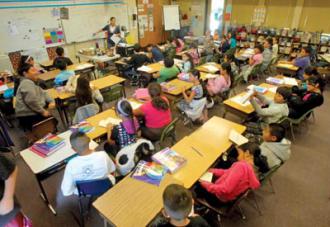
A crowded classroom in California
"We are here to discuss the future of our children, our community and our country.  Have you ever been in a large group and something had been discussed that you didn't quite understand but because of the size of the group you felt your voice had been lost?  Children today are getting lost in these large class sizes.  They are entering a different community with different rules and often they get lost and left behind.  Isn't this contradictory with the No Child Left Behind Policy?  Your children and community need your help.  It is possible to make a difference in our community by donating and helping to fund the schools so that class sizes can be smaller and your children can have their voice heard and their needs met.  This is how real learning will occur.  The benefits are enormous for not only your family, but also our community and country.  Please stop and think of the future and make a difference today."

Analysis
A special topic of invention that was used is that of The Advantageous/The Disadvantageous where the disadvantages of large classroom size was emphasized and the advantages of small classroom was also emphasized.  The teacher wants to move the community to action so he/she will use the special topics of invention for a deliberative speech.  Some other common topics of invention can be used like Law (No Child Left Behind), Antecedent and Consequence (consequences of large classroom size), and the Possible/Impossible (show the difference that is possible when action is taken).  

Tuesday, October 7, 2014

Words

baby proof 1Picture this: a cute little baby looking up at you. What is the first thing young parents try to teach this little person? It comes before walking or potty training . . . the answer is words. Babies start the process of word formation with phonation, then cooing and gooing, which leads to babbling, and finally morphemes and lexicons (words) [whole/ parts]. Why is it that such an emphasis is put on learning words? Words are really just a combination of sounds that carry meaning only to those familiar with the sound combination [definition]. But these unique sound combinations make possible the expression of an infinite amount of topics via various different modes of transmission [possible/ Impossible]. Some words are just unforgettable, like: "I love you," "I do," "It's a boy," "mama," "I hate you," or any degree of name calling. The point is, words can be used to reach positive, uplifting ends . . . or not so positive and destructive ends [Contradictions]. But ultimately, words are going to be learned from reliable sources like dictionaries and teachers, or not such trustworthy sources such as friends and T.V. shows [Contradictions]. Therefore, if a parent understands that "the pen is mightier than the sword" [Maxims and Proverbs], then, they recognize their superior role in helping their children learn to effectively and properly use words [Antecedent and Consequences]. The most important understanding we can reach in regards to words are their varying degrees of permanence. Those words whispered to oneself in a reflection or absentmindedly written on a misplaced sticky note may not last a lifetime; but, others that are shouted into a camera, thrust onto the internet, or tattooed on the body itself can last just that long [Degree]. The emotion that charges those words can lead to enhancing its permanence [Cause and Effect]. The moral of the story is, regardless of how effectively or ineffectively you have used your words in the past, you can choose to use them more purposefully and knowledgeably looking forward [Past Fact/ Future Fact].

Answering the Arbitrary and Ancient

What is love?  This is my love!  
Building off of a similar theme as Katie, the all too commonly heard question delivered by Haddaway [Witness, Authority?] must be asked: "What is love?" [Maxims and Proverbs].  Men and women are both vastly different creatures, quarreling oft at any given turn, yet  are more or less dependent on one another for both survival and life fulfillment through "love" [Contradiction].  Both sides share a common interest in one another, but are still opposite in nature and demeanor from one another [Similarity / Difference].  So, why is it that this concept, defined by Merriam-Webster in one instance as "a feeling of strong or constant affection for a person" [Definition], so very difficult to understand?  Why has this age-old predicament been the topic of discussion since forever, and why will it continue to be so [Past Fact / Future Fact]? 

To begin answering the unanswerable (or unsatisfactorily answerable) question, the concept of love must first be broken down into its various components [Whole / Parts].  Of love, there is a mental/emotional sphere, a physical/sexual sphere, and a spiritual/supernatural sphere.  Some of these aspects are more cut-and-dried than the others, but some are just the way they are for reasons unexplainable [The Supernatural].  Perhaps it is this very dilemma of having so many factors in it that makes love humanity's great enigma [Cause / Effect].  Needless to say, one may take all of the logic and reasoning behind definitions and examples, trying to fit the pieces together for an ultimate truth, but at the end of the day there is always a sense of mystery and unknowing.  Many things in life can be spelled out plainly, but love cannot be fully done so, especially by all-encompassing terminology [Possible / Impossible]. 


There are varying levels of love, various definitions and nuances, and various displays of love [Degree] according to each individual and couple, so it is only natural that the topic of definition continues to be debated today [Antecedent / Consequence].  It could be that this longwinded post served nothing but to confuse, but what do you think love is?  

Ode to the Sandwich

Many people do not think about how they could improve their culinary satisfaction by changing the way they eat simple foods. Take an ordinary sandwich for example. Sandwiches are usually a quick meal for when you are in a hurry and they are usually not very remarkable, unless they are prepared properly. A properly prepared sandwich is one that is assembled and then cut in half diagonally so as to ensure the most delicious eating experience [Definition]. You may think this is ridiculous, since the uncut and cut sandwiches should have the same flavor due to being composed of the same ingredients. However, if the sandwich is cut in half then the flavors are much better distributed [Antecedent/Consequence]. Sometimes an uncut sandwich allows toppings to fall out of the opposite side of the bread; virtually a sandwich disaster!

When you eat a sandwich the ideal situation is to get a piece of tender meat, succulent cheese, crispy lettuce, and juicy tomato in each bite, or else the experience of the sandwich is not complete [Whole/parts]. The timing of the sandwich eating process is also important. Cutting the sandwich in half allows for the eater to enjoy the soft, inside bread while still in the beginning stages of eating and leaves the crust for when the eater has already begun to take the sustenance for granted [Cause/Effect]. If eating an uncut sandwich is plain and ordinary then eating a sandwich cut in half is fun and exciting [Contraries]! After all, eating an uncut sandwich is like drinking a cup of hot cocoa. It tastes good, but it is much better if a little more effort was put it, either in the form of adding whipped cream or simply cutting it in half [Similarity/Difference]. Now, you may be hesitant to go out of your way and try to make a properly prepared sandwich, but after you try one you will be cutting all of your sandwiches in half [Past Fact/Future Fact]. Don’t be tempted to get lazy and say that an uncut sandwich is good enough because a properly prepared sandwich is infinitely better [Degrees]. I’m just saying that there is a reason that Subway cuts all of their sandwiches in half [Authority], but don’t take my word for it. Go with your gut instinct and try it for yourself, cut your next sandwich in half before you eat it [Supernatural]!