Showing posts with label possible/impossible. Show all posts

Tuesday, October 6, 2015

The Best Place to Start is the Beginning

Of all the talks, Elder Larry R. Lawrence’s, of the Seventy, was understated and simple, and only after I looked at my notes again did I realize how powerful his message was. I want to focus on the arrangement of his talk and how it ties in with the possible/impossible topic of invention.

Elder Lawrence began the body of his message with one of the Lord’s commandments: “Be ye therefore perfect, even as your father which is in heaven is perfect.” Elder Lawrence then remarks about how discipleship isn’t easy. He uses the story in the Bible of the rich young ruler who was humble enough to ask the Lord what more he could do, but not humble enough to act on the Lord’s advice. At this point in the talk, discipleship seems impossible. Elder Lawrence makes it seem like a gauntlet of hardship and upward drudgery, with no end in sight, acknowledging that we’ll have to wait for perfection in the next life. But Elder Lawrence set up the rest of his talk perfectly. As soon as he had his audience wondering about whether or not they’d be up for the task, he surprises them with small, simple stories of where they can start.


The seemingly insignificant anecdotes, reminiscent of the Spirit’s still small voice, act as the “possible” part of his talk. In these stories, the Holy Ghost whispered to those that had asked these bits of advice: “stop complaining”; “clean up your language”; “don’t interrupt people”; “keep the Sabbath day holy”; and in stunning simplicity, “clean up your room.” With each successive story, Elder Lawrence’s implicit message becomes clearer: the best place to start is at the beginning. It is possible to walk the strait and narrow. In contrast to his earlier anecdotes, discipleship becomes a possible task. With such an arrangement, Elder Lawrence is able to amplify the topic of invention of possible, and encourage and lift others to the task of discipleship.

Friday, October 31, 2014

Conflict Issues and Special Topics of Invention in Elementary Education

A point of conflict in Elementary Education
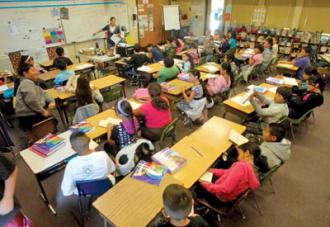
Politics and Elementary Education frequently come into conflict and one point is that of classroom size.  The schools aren't receiving enough funding from the government to hire more teachers and some schools are even letting go of teachers.  This leads to fewer teachers and more students so class sizes are increasing rapidly.  

Topics of invention in Elementary Education
Speaking a community forum a teacher or group of teachers may try to address the need for smaller class sizes to benefit the learning of the individual students and help funding for this to occur. A teacher could say something of the following:
A crowded classroom in California
"We are here to discuss the future of our children, our community and our country.  Have you ever been in a large group and something had been discussed that you didn't quite understand but because of the size of the group you felt your voice had been lost?  Children today are getting lost in these large class sizes.  They are entering a different community with different rules and often they get lost and left behind.  Isn't this contradictory with the No Child Left Behind Policy?  Your children and community need your help.  It is possible to make a difference in our community by donating and helping to fund the schools so that class sizes can be smaller and your children can have their voice heard and their needs met.  This is how real learning will occur.  The benefits are enormous for not only your family, but also our community and country.  Please stop and think of the future and make a difference today."

Analysis
A special topic of invention that was used is that of The Advantageous/The Disadvantageous where the disadvantages of large classroom size was emphasized and the advantages of small classroom was also emphasized.  The teacher wants to move the community to action so he/she will use the special topics of invention for a deliberative speech.  Some other common topics of invention can be used like Law (No Child Left Behind), Antecedent and Consequence (consequences of large classroom size), and the Possible/Impossible (show the difference that is possible when action is taken).  

Tuesday, October 7, 2014

Words

baby proof 1Picture this: a cute little baby looking up at you. What is the first thing young parents try to teach this little person? It comes before walking or potty training . . . the answer is words. Babies start the process of word formation with phonation, then cooing and gooing, which leads to babbling, and finally morphemes and lexicons (words) [whole/ parts]. Why is it that such an emphasis is put on learning words? Words are really just a combination of sounds that carry meaning only to those familiar with the sound combination [definition]. But these unique sound combinations make possible the expression of an infinite amount of topics via various different modes of transmission [possible/ Impossible]. Some words are just unforgettable, like: "I love you," "I do," "It's a boy," "mama," "I hate you," or any degree of name calling. The point is, words can be used to reach positive, uplifting ends . . . or not so positive and destructive ends [Contradictions]. But ultimately, words are going to be learned from reliable sources like dictionaries and teachers, or not such trustworthy sources such as friends and T.V. shows [Contradictions]. Therefore, if a parent understands that "the pen is mightier than the sword" [Maxims and Proverbs], then, they recognize their superior role in helping their children learn to effectively and properly use words [Antecedent and Consequences]. The most important understanding we can reach in regards to words are their varying degrees of permanence. Those words whispered to oneself in a reflection or absentmindedly written on a misplaced sticky note may not last a lifetime; but, others that are shouted into a camera, thrust onto the internet, or tattooed on the body itself can last just that long [Degree]. The emotion that charges those words can lead to enhancing its permanence [Cause and Effect]. The moral of the story is, regardless of how effectively or ineffectively you have used your words in the past, you can choose to use them more purposefully and knowledgeably looking forward [Past Fact/ Future Fact].

Answering the Arbitrary and Ancient

What is love?  This is my love!  
Building off of a similar theme as Katie, the all too commonly heard question delivered by Haddaway [Witness, Authority?] must be asked: "What is love?" [Maxims and Proverbs].  Men and women are both vastly different creatures, quarreling oft at any given turn, yet  are more or less dependent on one another for both survival and life fulfillment through "love" [Contradiction].  Both sides share a common interest in one another, but are still opposite in nature and demeanor from one another [Similarity / Difference].  So, why is it that this concept, defined by Merriam-Webster in one instance as "a feeling of strong or constant affection for a person" [Definition], so very difficult to understand?  Why has this age-old predicament been the topic of discussion since forever, and why will it continue to be so [Past Fact / Future Fact]? 

To begin answering the unanswerable (or unsatisfactorily answerable) question, the concept of love must first be broken down into its various components [Whole / Parts].  Of love, there is a mental/emotional sphere, a physical/sexual sphere, and a spiritual/supernatural sphere.  Some of these aspects are more cut-and-dried than the others, but some are just the way they are for reasons unexplainable [The Supernatural].  Perhaps it is this very dilemma of having so many factors in it that makes love humanity's great enigma [Cause / Effect].  Needless to say, one may take all of the logic and reasoning behind definitions and examples, trying to fit the pieces together for an ultimate truth, but at the end of the day there is always a sense of mystery and unknowing.  Many things in life can be spelled out plainly, but love cannot be fully done so, especially by all-encompassing terminology [Possible / Impossible]. 


There are varying levels of love, various definitions and nuances, and various displays of love [Degree] according to each individual and couple, so it is only natural that the topic of definition continues to be debated today [Antecedent / Consequence].  It could be that this longwinded post served nothing but to confuse, but what do you think love is?