Showing posts with label ancient greece. Show all posts

Tuesday, September 1, 2015

Sick Over the Centuries

Me, not in Greece, not sick, eating wild blueberries. Take it or leave it.
Malaria.  HIV.  West Nile.  In the last ten years Greece has had outbreaks of all of these diseases.  But cooler yet, at least to a Microbiology major like me, is that in ancient Greece, there were diseases known and treated, some of which have been connected to maladies that continue on into our time.

Hippocrates and his fellow researchers were some of the first to observe, document, and attempt to treat diseases.  One of the texts written at Hippocrates' pseudo medical school even contained a description of asthma, one of my future research focuses.  We even still use some of their "home remedies," such as honey for acne and desensitization for allergy treatments.  Though our technological advances have allowed us to make discoveries at a larger scale in a shorter amount of time, perhaps it was upon their foundation of medical learning that we built.

Thursday, December 4, 2014

Money, money, money!

       Trading and bartering has been an essential part of comfortable living and society in general since the beginning of time. As we all know, there were heavy amounts of trade throughout the entire history of ancient Greece. There were many techniques to both create and increase profits as the ancient greeks put taxes on items and sold to each other their different goods. The greeks were specifically known for making fine wines and spectacular pottery and selling them to other parts of the world. They knew that if they could create something that had value in the eyes and hearts of others, they could get something in exchange for that product. It was the most basic mindset that was and always will be absolutely crucial to great sales. For example, women among the earlier civilizations realized that perfumes and even jewelry were highly in demand as they created a whole new image in their social life. So they would sell all of these things and make their own income. 


In the world today, we continue to use trading or in other words “financial negotiations”, similar to the previously mentioned ancient Greek civilization. Sales on the corporate level are extremely comparable to the trading that happened many centuries ago. Corporate salesman think of great and creative ideas, present offers and promotions to a number of possible clients or buyers, and then don’t stop pitching their offers until they find a successful transaction taking place right in front of their eyes. Recently, as a response to the multiple stock market crashes, the thousands of foreclosures, and the numerous businesses that have folded under pressure, the sales and business world as a whole has been flipped upside down. Specifically, in the United States, the past decade has been mentioned by multiple politicians as “the closest thing to the next Great depression”. General Motors, one of the most enormous global sales vehicle organizations, shocked the world as they announced bankruptcy in 2009. Businesses all throughout Europe, with the main exception of Germany, took drastic hits and falls as both inflation and deflation made selling a whole new game. When it all comes down to it though, in both the ancient past and the recent past, selling is always going to be imperative as people find value for others and offer it to them for a price which in turn makes them a living. 


Sources:

“Corporate Finance”. Interview with Logan Kelly. 30 November 2014.

Fasulo, David F. "Life as a Tradesman or Merchant in Ancient Greece." EBSCOhost (2011): 1. EBSCOhost. Web. <http://connection.ebscohost.com/c/articles/51202102/life-as-tradesman-merchant-ancient-greece>.


Wednesday, December 3, 2014

Biology and Medicine Within the History of Civilization

The Distant Past
            As James mentioned, ancient Greek and Roman medicine were not as practical nor pragmatic as modern medicine.  True, diagnosis was not fully bereft of logic, but there was a decent amount of superstition as well.  The human body was the pinnacle of perfection, particularly the athletic body.  Blending religion into the mix, seeing as gods were to be of human form, creating monuments of giant, human figure and exercising came to be forms of worship.  Due to this, the study of the human body and all of its intricacies took heightened precedence.  Medicine and health were crucial topics of interest. 
            Hygiene was not entirely one of these important topics, though bathing held its own significance.  Even with the detriment of poor hygiene holding back greater progress in health and medicine, the ancient Roman refiners borrowed and expounded upon the knowledge of the ancient Greeks, improving public health tremendously.  Still, at the base of it all, the head of each household was in charge of knowing the most basic of remedies, including proper application of wine, vinegar, poppy juice, unwashed wool, herbs, and honey, to name a few.  This, coupled with skill in bandaging and stitching formed a solid basis to set as a standard for those of olden times. 
            Even more practical than knowing basic first aid was preventative care—something that is highly conflicted against itself in modern times.  Though the ancient Romans did not possess the immunizations and cautions of today, much more emphasis was placed on exercise and personal fitness.  Social norms and culture regulated and enforced this healthy practice, arguably to an extent even greater than the present day.  While the ancient Romans drained swamps to prevent breeding of malaria-ridden mosquitoes and maintained rigorous exercise to ward against injury and disease, this, combined with basic cleansing practices, was not enough to provide the protection of the here and now.  Yet, oddly enough, it is not disease or hygiene that threatens the general public of today, but the neglect of old practices of fitness and diet that bring the danger. 


The Recent Past
            Stepping back to hygiene and general wellness, it is thought by some that the people of today are actually a little too clean and a little too careful.  Of note, antibiotics, though intended to prevent sickness, are actually in some cases fueling our modern plagues.  Humanity has been evolving and progressing since before the ancient Greek and Roman times, and the current human status has more or less become stable with the microbiome.  Cleanliness is good, but anything in excess can prove to be detrimental.  Such is the case with the people of today.  One instance of this pertains to overuse of antibiotics, which kill both harmful and helpful strains of bacteria in the gut.  Excessively killing harmful bacteria via repeated use of antibiotics (and also other related practices) causes the immune system to become lax.  Killing beneficial bacteria is obviously not beneficial.  Problems abound at both ends of the spectrum. 

Blaser, Martin J., MD. "Modern Medicine May Not Be Doing Your Microbiome Any Favors." Interview by Joe Raedle. NPR Books. NPR Books, 14 Apr. 2014. Web. 1 Dec. 2014. <http://www.npr.org/2014/04/14/302899093/modern-medicine-may-not-be-doing-your-microbiome-any-favors>.

"Medicine in Ancient Rome". HistoryLearningSite.co.uk. 2014. Web.

Elementary Education in the History of Civilization

Where in the world would you be without your elementary education?  You certainly wouldn’t be here at BYU working on your post-secondary education.  Education for children is at the basis of civilization.  Without it there are no doctors, business men, artisans, teachers and so on.  In any civilization, recent or ancient, you can see there was a certain education system.  I’d like to focus on elementary education and its changes in recent history and in ancient Greece. 

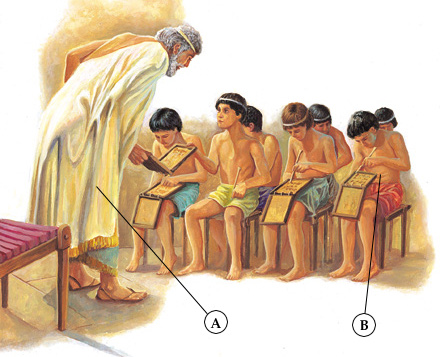
In Greece, children started their elementary education around seven years of age.  It was divided between formal and informal education.  Formal education was for those families who had the money to pay for a pedagogue, or a private instructor, to teach their children.  The pedagogue would teach in the family’s home and would teach basic skills like reading, writing, and basic morals.  Writing was done with a stylus onto a board that was covered in wax.   We can see that although our education system has evolved it is quite similar to this.


There have been recent changes in the world that have affected the education system.  I talked to Lucelia Albernaz, a retired Elementary School principal, to learn more about these changes.  She said that the major factor in the recent history of education has been the technological development that has occurred.  I remember going to the computer lab during the school week in Elementary School and having to practice typing.  Now technology has become an even bigger part in the education of our children.  It is how grades are given, communication between the teacher and parent is done and now there are even classes that are flipped or use blended learning where the students watch video lectures at home and then problems and homework is done in the classroom with the help and guidance of the teacher.  This helps children to work at their own pace and to have more individualized time with the teacher in the classroom.  Writing is now done through technology so there is no more use for a stylus and wax board.  There has been a recent change from chalk boards to white boards and now to over-head projectors.  Lucelia also talked about the change in what is permitted to be spoken of like the use of drugs, homosexual marriage, religion, and the conception of children. 
So with all these changes is our children’s’ education improving?

Works Cited

Albernaz, Lucelia, Personal Interview, December 3, 2014.


Ed. Sienkewicz, “Education and Training,” Ancient Greece (New Jersey: Salem Press, Inc., 2007), 245.

A Pirates Dream

       From the beginning, people have procured means to improve the quality of their earthly sojourn.  Many products of today have origins that go back to even before the days of ancient Greece and Rome.  I am a biomechanical engineer, and understanding the engineering techniques from millennia ago helps us to create new devices that can enable the physically handicapped today.  I want to draw your attention to the improvement of prosthetic limbs over the years. 
              
         It is easy to imagine a pirate walking around with his peg leg, but how about the King of Egypt, or a Roman general?  One of the earliest known examples of a prosthetic device can be observed in the Cairo Museum where the prosthetic toe of Amenhotep II is preserved.  The Greek historian Herodotus recorded an instance in 484 BC where a prisoner escaped by cutting off his leg and hobbled off on a wooden leg.   The Roman general Marcus Sergius led his troops into battle with an iron prosthetic hand in 218 BC.  His left hand wielded a sword while his fake hand was adorned with a shield. (Thurston)
              
     During the medieval ages, prosthetic limbs were generally crude devices.  Picture the pirate on his wooden peg leg with leather straps and his hook for a hand.  Most of the advances in the quality and fabrication of these devices were brought about during war times.  Better materials were developed, functionality was improved, such as joints and flexibility, and also medical procedures became available. 
              
          Fast forwarding to modern times, there has been tremendous research performed in recent years which has exponentially helped progress the development of prosthetic limbs.  For example, within the past 20 years methods have been developed where prostheses can be attached directly to amputees’ bones.  In addition, electrodes attached to nerves and muscles offers amputees neuromuscular control of the prostheses. (Pitkin)


               There are still many issues with current prosthetic standards that need to be addressed.  Some areas of future research concern the longevity of the devices, identifying materials that are safe for implanting, and improving the mechanics to more closely resemble regular human motion.  Prosthetic devices are also expensive and many amputees cannot afford the luxury of purchasing one.  As a member of the BYU 2ftProsthetics Club, I work with others in making inexpensive prosthetic legs that we can distribute to developing countries.   Prosthetics have come a long ways, but there are still many advances to be made.

References

Thurston A, Thurston. Parã and prosthetics: The early history of artificial limbs. ANZ J Surg. 2007; 77(12):1114-9.

Pitkin M. Design features of implants for direct skeletal attachment of limb prostheses. Journal of biomedical materials research. Part A2013; 101(11):3339-3348. doi:10.1002/jbm.a.34606.


Tuesday, September 9, 2014

From 750 B.C. to 2000 A.D. and back to the 1860s

I looked up ancient Greek culture and several of the first few things that I found mentioned slaves, social cues, fashion, and games. 
Of course, that made me think of the 1860s and of my role as a “Southern Belle” at the Civil War reenactments back home. For several summers, I played the role of a southern slave-owning lady with the intricate outfits. There were a lot of social, fashion, and cultural cues that were strictly held to (in both the 1860s and in ancient Greece) that I got to abide by as a re-enactor.

Architecture!


My family and I lived in Japan for a few years while I was in high school. The architecture there was amazing! The utility of all of the ancient temples and homes was amazingly advanced, but were very elegant and intricate. Similarly, ancient Greeks sought to make beautiful edifices that reflected their refined culture. Isn't cool how you can look at the two different buildings above and tell me almost exactly from what area of the world and culture they come from? Architecture historically was such a defining characteristic of a civilizations culture.


Monday, September 8, 2014

Darlin’ it’s Better, Down Where it’s Greeker


About to Scuba Dive in Mexico!  Coral Reefs
were growing on an underwater sculpture museum.

Take it from me.  I love SCUBA diving, and I have been a PADI certified diver since 2011.  Like me, ancient Greeks enjoyed exploring the “Big Blue.”  


The beautiful Hanauma Bay in  Oahu, Hawaii.  A choice
spot for snorkelers or SCUBA divers alike.  I snorkeled there
2 years ago.


Around 360 BC, Aristotle recorded divers using diving bells, which were essentially weighted barrels to hold air.  These mechanisms allowed divers to breath air from the barrel without surfacing because air was trapped in the barrel.  Supposedly, Alexander the Great also loved diving and even used the diving bells at the siege of Tyre.   

The Garibaldi are a friendly fish that live in Kelp forests off the
coast of Southern California.  These kelp forests are some of
my favorite places to SCUBA dive because of the amount of
sea-life there.


Thanks to the Greeks, we can now be devotin’ full time to floatin’ under the sea!!


Want more information on ancient scuba diving and to find out where I got my info?  Check out this Link!!!!