Showing posts with label technology. Show all posts

Saturday, April 18, 2015

What inspired my call for change?

There is a strong need for us to reform education. There are many aspects that need to be eliminated, reformed or implemented. My main focus has been incorporating technology in education. I am not simply talking about using Power Points in the classroom, but really allowing kids to embrace technology, and use it to learn about the world around them. I have explored this idea is previous blog posts, which you can check out at:


What inspired me to investigate this topic were some Ted Talks that I happened to stumble upon. Sir Kenneth Robinson and Sugata Mitra have some great ideas about education. Those videos got me thinking about my own personal experiences in school. I used to struggle in school and still do. It is something that has never come easy to me. I have learned to deal with my struggles and have become a decent student, but it was a very different story when I was young. I can be a bit of a perfectionist at times, so when I didn't understand my homework I would throw a tantrum as if the world were about to end. I felt so dumb and I didn't know how to deal with it.

Tuesday, March 3, 2015

Education and Technology


When I was young some of my teachers assumed that I had a learning disability until. Although that all changed in 5th grade with Mr. Ellefson. He made education fun and exciting. He worked with me and helped me see that I could learn. One of my favorite projects from his class was my state report. We spent much time preparing for the presentation of our projects by walking as a class to a nearby computer lab. We were given the freedom to use the internet to find information on our state and put it together in a power point presentation. I always looked forward to going to the computer lab and I felt as though I learned so much from that project. This was my first real use of the internet to help me in my school work. Technology has changed a lot since then and is even more helpful yet we aren't taking full advantage of all it has to offer. With proper structure, guidance and protection I believe that kids can and should be allowed to take full advantage of technology to help them learn. Here are some more of my thoughts on the matter:

Friday, January 16, 2015

Of Technology and Professionalism


We shall find few persons in those republics who have pushed their fortunes to any great degree of eminence without the assistance of eloquence. – Montaigne, “Of the Vanity of Words”

Montaigne’s quote is as true now as it was then: we seldom find people of fortune who aren’t good communicators. Communicating is necessary to get ideas across, but the modes of communication and the accepted forms of communication are changing. There was a time in elementary school, for example, where my teacher told me to get used to writing in cursive because that’s how I’d be required to write the rest of my life. Well, that didn’t happen.

Thursday, January 8, 2015

The Unsung Hero of the Renaissance

When one speaks of the renaissance we picture the art, music, and architecture that are so familiar to us. From the Mona Lisa, Creation of Adam, and other famous pieces of art to the soaring buttresses that support the great cathedrals of Europe. We're well aware of Leonardo's fantastic machines and Machiavelli's Machiavellian views. But we often overlook the strides made in the field that has come to dominate our society today.  

Technology.
  
Not just mechanical, but logical, educational, and theoretical breakthroughs would serve as springboards for giants like Newton, Descartes, and Cotes.  

The arrival of the Hindu-Arabic numbering system in the High Middle Ages, coupled with the invention of the printing press and relative freedom to reexamine the familiar would set the stage for breakthroughs in mathematics, astronomy, chemistry and anatomy- as well as the first western attempts at formal computation.  

The works of men like Galileo, Copernicus, and Da Vinci would help establish what we know of as the scientific method. The resurgence of humanism and realism in art lead to learning from observation, precluding the great advances of the following centuries.  

When I am asked why I choose to study theoretical computer science, rather than something that can be applied to 'actually do something' I think of these men. Most of the luxuries of life that we enjoy today can be traced to theoretical methods developed during the renaissance. Imagine if Copernicus had not published his work because it wasn't practical. I study theoretical sciences because somewhere, someday, someone will be grateful that we figured out what seems like a useless piece of knowledge. Just like we are for the Cartesian Coordinate System, or the Heliocentric Model, or countless other scientific and technological advances that resulted from the Renaissance.  

Wednesday, December 3, 2014

Elementary Education in the History of Civilization

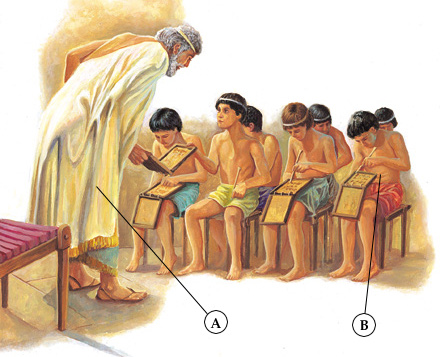
Where in the world would you be without your elementary education?  You certainly wouldn’t be here at BYU working on your post-secondary education.  Education for children is at the basis of civilization.  Without it there are no doctors, business men, artisans, teachers and so on.  In any civilization, recent or ancient, you can see there was a certain education system.  I’d like to focus on elementary education and its changes in recent history and in ancient Greece. 

In Greece, children started their elementary education around seven years of age.  It was divided between formal and informal education.  Formal education was for those families who had the money to pay for a pedagogue, or a private instructor, to teach their children.  The pedagogue would teach in the family’s home and would teach basic skills like reading, writing, and basic morals.  Writing was done with a stylus onto a board that was covered in wax.   We can see that although our education system has evolved it is quite similar to this.


There have been recent changes in the world that have affected the education system.  I talked to Lucelia Albernaz, a retired Elementary School principal, to learn more about these changes.  She said that the major factor in the recent history of education has been the technological development that has occurred.  I remember going to the computer lab during the school week in Elementary School and having to practice typing.  Now technology has become an even bigger part in the education of our children.  It is how grades are given, communication between the teacher and parent is done and now there are even classes that are flipped or use blended learning where the students watch video lectures at home and then problems and homework is done in the classroom with the help and guidance of the teacher.  This helps children to work at their own pace and to have more individualized time with the teacher in the classroom.  Writing is now done through technology so there is no more use for a stylus and wax board.  There has been a recent change from chalk boards to white boards and now to over-head projectors.  Lucelia also talked about the change in what is permitted to be spoken of like the use of drugs, homosexual marriage, religion, and the conception of children. 
So with all these changes is our children’s’ education improving?

Works Cited

Albernaz, Lucelia, Personal Interview, December 3, 2014.


Ed. Sienkewicz, “Education and Training,” Ancient Greece (New Jersey: Salem Press, Inc., 2007), 245.