Showing posts with label deliberative. Show all posts

Tuesday, September 15, 2015

You Become What You Say You Are


Thucydides’ understood the power of oratory.  I go along with Ryan R. who stated his belief that he felt as though Thucydides' speech was not a deliberative speech, but an epideictic speech; however, I would have to take it a step further and say that it is both.
    
Epideictic: We, as humans (and I can personally attest to this by looking at the contents of my last blog on the power of praise) are motivated by praise and expectations.  It is a bit ridiculous the praise that he is giving to the people- not necessarily the soldiers- even in such a moment when people are looking to grasp any words of comfort.  With a phrase like “They have blotted out evil with good, and done more service to the commonwealth than they ever did harm in their private lives” he is focusing on what the people want to hear in the present (nice use of Kairos).  The encomium is so forceful that it hits the heart of his audience in a deliberative way.

Deliberative: Thucydides' endless compliments to Athens and his people are more of a call to action rather than a soothing of the soul.  He could have just chosen to compliment the fallen Pericles, but instead he appeals to their pathos by helping them recognize that if they do not live up to the great potential of Athens, all of their fighting, and all of their deaths will be in vain.  He is looking to the future, although speaking of the past lives of these men.  These people can be a benefit to Athens if they decide to stand up and unite.  But what are his reasons for such a way of speech?

There are many reasons as to why Thucydides’ wrote his speech the way he did.  I would like to add on to that list and throw in the possibility that his praise and honor are a way for him to encourage the men to fight- only that he himself will not have to and will be able to remain in a comfortable Athens.  As sad as it is to say, too often have I seen personal motives drive a person to apply encomium in his or her speech.  In conclusion I’d say Thucydides’ praises the men and Athens, while deliberately calling for future action in an effort to protect himself.     


Saturday, November 1, 2014

Conflict Issues and Special Topics of Invention in Actuarial Science


Points of Conflict

There are two main situations in which conflict arises in the life of an actuary. The first of these situations is with clients. Clients need to feel like the work they are having done for them is valuable and being done at a competitive level. They need to have no reason to feel like they should doubt the actuaries’ abilities. When they do, conflict arises and it is the actuaries’ job to persuade the client to believe that the services they are receiving form the actuaries’ respective firm are the best that they can get. The second situation is when fellow actuaries or team members disagree on a process of a project or any other type of work being done at the workplace. Such conflicts arise often and usually end with a negotiation between team members, both having to make exceptions to let both people continue working in harmony.

Topics of Invention

                An example of the first of the two situations discussed above is given below.

Client: “I have seen that there are other actuarial firms offering similar work for less pay, I am  thinking about switching to them because I have heard that their services are quite similar to      yours…”

Actuary: “I see. If I had heard that same thing and was in your shoes, I too would be questioning who  I was paying to analyze my risk. However, I can assure you that ____ services are not only more  efficient, but that the quality of work that is done throughout the whole company at ____ is far  superior to ___. Not only would it be a mistake to switch, but because of how sought after our  services are it might be too hard for you to come back to ___ if you do decide to leave. It would be  wise to stay with ___ where your work is done at a higher standard and you are able to know  personally the people working with your company’s risk.  

Analysis


This actuary defends himself as well as his company well in this example using deliberative oratory. The special topics of invention of the advantageous vs the disadvantageous are show within his brief comparison between himself and the competition. He makes a clear statement and testimony that the client would be wise to stay with the actuaries’ company. 

Conflict Issues and Special Topics of Invention in Engineering

A Point of Conflict in Engineering
A lot of conflict arises when it comes down to inspections.  Just like a college student during cleaning checks, there can be a lot of tension when an inspector comes to visit a large power plant.  Even small imperfections in some equipment can be costly.  However, some of these imperfections, if left unchecked, can be catastrophic.  Thus, the conflict is between money and level of risk.

Topics of Invention in Engineering
Imagine a small power plant company, called EnergyGive, has a monthly safety inspection performed by one of their engineers, Bob.  EnergyGive has been struggling financially the past year, so it has implemented budget cuts.  Bob is performing one of his inspections one day when he observes some small cracks forming in the base to one of the power generators.  These cracks will cost a lot to repair.  He may say something to this extent to his superiors:

          “We have been under compliance for the past several inspections.  This month I have observed possible issues that can impede future success.  There are small foundational cracks forming at the base of Generator D.  In order to remain under compliance, these cracks need to be addressed as soon as possible.  If nothing is done, these cracks can propagate and cause equipment failure.  I have investigated the reparation costs, and it would be prudent to address this issue in a timely manner before those costs increase.”

Analysis:

Bob made sure that his superiors understood the advantages of repairing the cracks.  In this context, it was crucial that he present himself in a deliberative manner to help encourage action.  He emphasized the future problems that could arise using an antecedent/ consequence common topic of invention.  Additionally, he refers to compliance, which is following prescribed standards set by governmental agencies, in connotation to law.

Friday, October 31, 2014

Form vs. Function: a Central Conflict in Architecture


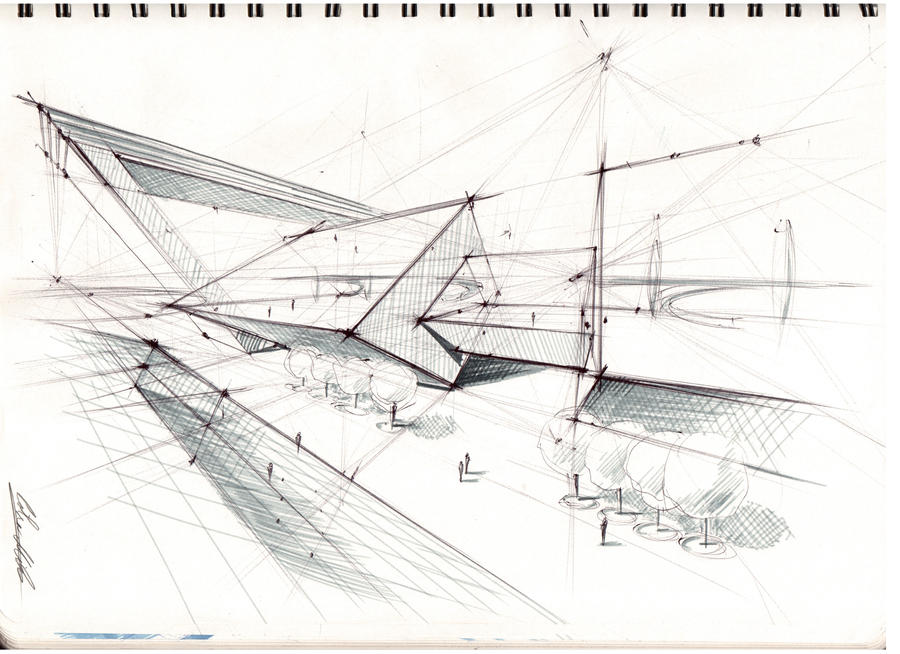
Sample Sketch-work
There seems to be a governing problem in most fields, especially some of the fields previously talked about by other students, that is a scarcity resources. The scarcity of resources present in all professions and in all of our lives manifests itself in architecture through a central conflict I've heard called "form vs. function".

A client comes to a meeting with the team of architects from the firm he contracted with in order to hear and see a design proposal; he likes what he sees a lot, he doesn't understand most of what he sees in the models and sketches and computer renderings, but it all looks really cool. He's excited and ready to get going with construction, then he's reminded of something he understands very well that brings his mind down to reality, numbers and dollar signs. It all depends on the client from that point on and the convincing ability of the architects, the architects would respond by talking about the reputation and purpose of the building and the client and his company, they would refer to the precedent set by architectural works done in the past and what those buildings have inspired in people, it seems like simultaneously the architects would use definition, division, and comparison in order to explain further the need for the designs they've come up with and why the price tag would be worth it.

One of Frank Gehry's sketches of Disney Hall. Due to
this architects reputation, most clients go to him
expecting something grand, so they expect to pay
the price. Unfortunately it's not like that for all Architects.
In the end, the architects' main argument would be how the form would influence the functionality (productivity of employees, appeal to costumers, etc.) in a positive way, thus appealing the main goal of most any company: increased profits. Mostly this appeals to the special topic of invention called deliberative (specifically referring to advantageous/disadvantageous) and also the common topic of cause and effect.

Finished Disney Hall, it's kind of cool to see a thought become
a reality, huh? 

Thursday, October 23, 2014

Communication and Persuasion in Elementary Education

Take a moment and remember the times when you would get a break from school to play on the playground, when you could sit on the carpet in a circle with your classmates, and when you could bring your animals in for show and tell.  This was the beginning of your educational process.  This is where you learned to read, write, and analyze – skills that you are using currently while reading this blogpost.  This is elementary education. 

An elementary teacher has the privilege to communicate on many levels.  One is given instructions and guidelines from political leaders and administrators, must communicate the needs of individual students, discuss the best ways to teach the necessary curriculum, help children to understand basic concepts and assist parents in the teaching of their children.  Believe it or not persuasion has everything to do with teaching.  Most communication is done face to face but emails can be passed on and phone calls to parents are common.

A teacher must be able to analyze his/her audience and adapt to effectively communicate.  When speaking in the community or with administrators the needs of the children should be the focus and how to improve on what is already being done in the classroom.  Colloquially language should be avoided.  When communicating with a child the teacher must take great care in teaching in a way that is comprehensible to every child in the classroom.  The children’s interests and backgrounds should be taken into consideration to provide better understanding.  When communicating with parents the teacher must show love for their child and his/her specific needs.  One must show sincere concern for each child and his/her home life. 

Most communication in the field of education is deliberative.  Usually there is a goal of changing something in education and promoting action.  This is seen in community forums with the politics of education, in teams of teachers for the best way to teach and even in parent-teacher conferences to encourage the progress of the student.  Teachers want to encourage children to progress, want to change how the community views education and want to inspire parents to help their children better learn. 


I found out most of this information by talking with those who are currently in the education field and teaching.  I first became interested in teaching when I was in Elementary School and saw the difference that an effective teacher had in my own life.  I want to have the same effect on my future students and help them to see their potential.

Wednesday, October 1, 2014

Everyday Conversation to Convince a Crowd

In the Funeral Oration of Pericles, many different forms of rhetoric are employed. I didn't recognize most of them when I first read it, as I was mostly focused on form and the classic appeals. After reading “Rhetoric” by Aristotle, I was able to point out a lot of other devices.
One of the devices that I found used was enthymeme. I didn't realize how incredibly common it was in normal speech! Trying to find examples of this in the text, I found some examples where major premises are kept and where they have been omitted. Take, for example, this line from Pericles: “To me it seems that the consummation which has overtaken these men shows us the meaning of manliness in its first revelation and in its final proof.” Here, the premise that courage and gallantry (which was stated several sentences previous and in a different context) is manly.

Reading this text again, I also noticed the very epideictic as well as deliberative aspects of the speech. It is epideictic in the sense that Pericles is talking to a large crowd and praising the men who fought. It is deliberative in the fact that he is exhorting future measures. He is calling the families of these
men to action- either calling to the mothers to have more children or calling to the children and men to stand up and show pride in their city by fighting as well.


Pericles also uses his own testimony to add credibility. In the first few lines he speaks about having a first-hand witness or reliable second-hand testimony of the accounts of battle. Pericles says “I have described nothing but what I either saw myself, or learned from others of whom I made careful and particular inquiry.” If this isn't a direct proof of testimony displayed, I don’t know what is!

Well Which One Is it?

In reading the many posts already on display, I saw two very distinct opinions in regards to Pericles’ Funeral Oration. In one corner, the opinion that the oration was based upon deliberative branch of oratory while in the other corner we have the champion of funeral orations…. (Drum roll please) the epideictic branch!

In the post, “The Master of Disguise” Hailee Richards goes so far to as to “classify Pericles’ Funeral Oration as a deliberative piece…” (Also see “Things Not as They Appear”). Others on the other hand seem sure that this speech is one of epideictic oratory.

So… Which one is it?
Could it be… both?


In an earlier post by Macey Richardson (“HPR: How Pericles Rhetoricized”) she expressed that on occasion Pericles used elements of deliberative rhetoric to persuade the Athenians to build up their great city. With this attitude in mind I desire to briefly dissect how both branches of oratory and how their coined methods can be a powerful combination.

As clearly noted within his speech Pericles praises his city after which he praises the warriors of the city. Within this praise, Pericles essentially states, “Athenian City is the best (accompanied with examples) and we have grown up in this city, therefore we are also the best.” This being said, he never claims that the people of the city are the best but it is so obvious that there is no need to do so. This is a powerful method to prove a point that we know as enthymeme.

This being said, Pericles does not remain in the present but continues to speak of what is good and unworthy as well as what is advantageous and disadvantageous in the future. Let’s see an example of this transition. Pericles states, “This, then, is the kind of city for which these men, who could not bear the thought of losing her, nobly fought and nobly died (praise). It is only natural that every one of us who survive them should be willing to undergo hardships in her service (good and advantageous).”


Brilliantly done to persuade his audience, Pericles deserves credit for such mastery of each branch of oratory and elements. In closing, I believe although epideictic in nature, his speech contains all three branches of oratory. Possibly a better question than “which one is it?” may be, “how does each branch work together to persuade an audience?”

The Master of Disguise

Was Pericles’ funeral oration really an epideictic masterpiece?  The first time I read the piece I thought it odd for a funeral speech; although there was praise I found it more to be praise of Athens rather than praise of the soldiers.  While reading Aristotle’s Rhetoric I found some interesting insights to help categorize the type of rhetoric Pericles used in his funeral oration.

Aristotle, when speaking of advisory rhetoric or deliberative, states that the orator needs to give advice on what is advantageous and good.  He goes into further detail by describing what makes something considered “good”.  He includes courage and honor in the definition.  He states that “if be cowards is the most advantageous thing for one’s enemies, it is evident that courage is the most beneficial thing for the citizens” (Aristotle Rhetoric, page 152).  Pericles goes into great detail to emphasize the importance of courage in the citizens of Athens.  We may consider this praise but with Aristotle’s insight we can view it in the light that Pericles was exhorting them to continue to be courageous in war. 
Was Pericles a master of disguise?

When speaking of deliberative rhetoric Aristotle quotes Pericles’ funeral oration (Aristotle Rhetoric, page 158).  He then goes on to the importance of one who is advising or warning to “grasp all forms of government” so that one may know the things that are advantageous to them in order to preserve the form of government (Aristotle Rhetoric, page 159).  Pericles goes into great deal praising the democracy in Athens.  As a political leader this was important to him and he wanted to preserve it.  I feel that instead of praising the soldiers who had died, Pericles used the opportunity to encourage the people to continue to fight for the form of government that they had established which was superior in his viewpoint.  He even encouraged the women to have more children which could eventually become soldiers and protect the magnificent Athens. 


In my understanding from Aristotle’s Rhetoric, I would classify Pericles’ Funeral Oration as a deliberative piece although the setting seemed appropriate for an epideictic speech.