Showing posts with label Aristotle. Show all posts

Monday, October 13, 2014

Figuring Out Exams About Language

Tropes about exams:

1. Metaphor
  • "An exam is a prison sentence."
  • This metaphor shows that an exam can make one feel the same dark, sad, ominous feelings that a prison sentence evokes. 
2.  Paronomasia
  • "I finished my trigonometry exam without a secant to lose."
  • I really couldn't think of any ways to play with the word exam, or words that sounds like it, but I did enjoy googling "puns about exams" and that is how I found the quotation above.  Secant sounds like "second," and "without a second to lose" is a common phrase that means that time was running out, but really a secant is 1/cosine of a triangle, which is part of trigonometry. 
3. Anthimeria
  • "I've got a date with Mr. Exam."
  • I changed the word exam from a noun to a proper noun.  If it's a Friday and you finally finish studying for an exam in the afternoon but you need to go to the testing center to take it that night, you could make fun of your situation by saying this. 
4. Hyperbole
  • "That exam had a million multiple choice questions and a thousand free response!"
  • Strong emotions often cause people to exaggerate, even to blowing things way out of proportion.  If someone finished a long and challenging exam, they might be heard to say this even though it is not likely that their exam was actually that lengthy.
5.  Oxymoron
  • "Hey that's an awfully good grade for that MCOM grammar exam!"
  • "awfully" and "good" are placed right next to each other but they are opposites. This is an oxymoron because both of those opposite words are used to describe the same thing, the "grade."

Schemes about exams:

1. Parallelism
  • "Your exam will include matching, free response, and multiple choice questions."
  • The parallel parts are "matching," "free response," and "multiple choice."  Even though each part increases in syllable length, the parts are parallel because they are each equal parts of the list.
2. Anastrophe
  • "Exams, you will take three."
  • Normally, when addressing a person, he or she (the word "you") will be the subject of the sentence and the first word. By putting the exams first, the focus of the sentence is on them. 
3. Ellipsis
  • "My husband doesn't have any exams this week, but I three!"
  • Obviously I have three exams this week, but of the implied phrase "have three exams," only "three" is included in the statement.  
4. Alliteration
  • "I have been examining the examples in Excel, but I'm not exactly excited for the exam."
  • Lots of ex- words up in here!

Figurative Language about Facebook

Tropes:
Metaphor
o   “Facebook is a sewer filled with the waste of others”
o   Facebook is not literally a sewer. But by comparing it to a sewer, which is filled with unwanted things from other people, the reader is able to say “you know, there are a ton of things on here from other people that I don’t want”. Like a sewer, there are a lot of things on there that you just don’t care to see.
 Paronomasia
o   “One of the consequences of gazing at your feed, is that soon you are grazing without any need”
o   Gazing refers to looking, grazing to eating. Once one looks at Facebook, Food comes calling. One interesting way of reading this is to view grazing as eating up what you see in your feed, bringing you in, when you have no need to be looking at it. This causes a reflection, do I do that?
Anthimeria
o   “Facebook has interneted our friendships too much”
o   Changing the internet into a verb shows that our friendships have become too online and not enough in person.
Hyperbole
o   “Each day everyone logs on Facebook and complain about every bad thing that happened that day, and post a thousand pictures of every good thing that happened that day.”
o   This has tons and tons of hyperboles in it. Not everyone logs on Facebook every day, not everyone posts something that is complaining, not everyone posts pictures of something good. But when the reader thinks about all the posts they see, they see that there is some truth in the statement.
Oxymoron
o   “Facebook will take you into a land of virtual reality”
o   Virtual reality has become what we associate with online interactions. And there is a reason for that, virtual is the antonym of real. Since fake is the opposite of real, virtual reality is fake reality. People will consider that what happens on Facebook is not what happens in real life, just as we can take on a persona in virtual reality, we can take on a persona on facebook.
Schemes:

Parallelism
o   “Logging on to Facebook means logging off of life”
o   The idea of logging into or out of something is repeated. It causes one to think about if they do “log off” of their real lives when they are on Facebook.
Anastrophe
o   “Seized, there is a world out there to be”
o   By having first, the natural order is changed giving the impression that seized is very important, causing a search for what is important to be seized.
Ellipsis
o   “Under the right circumstances Facebook can be used for good, and under the wrong, bad.”
o   By not stating “circumstances Facebook can be used for” again there is a greater proximity between good and bad, which does a better job of showing the range of impact it can have.
Alliteration
o   “Go use your gifts to gladden a heart”

o   The repetition of the “G” sound gives it a sense to go and do, to motivate to action.

Tuesday, October 7, 2014

Music & The Mind

               Over the last few semesters of my college career I have come to notice that if I listen to peaceful music as I study I am able to focus for longer periods of time [Cause/Effect]. While some of my friends and acquaintances have mentioned they agree that music helps them study in their study experience [Witnesses] others have found no such correlation [Contradictions].

Many people wear these; few people listen to him.
                According to studies done at Oxford University [Authorities] there is evidence supporting the idea that music helps to create an enhanced experience while studying. This enhanced experience was shown while subjects listened to Mozart and studied, which led to improvement of certain types of mental procedures referred to as “spatial-temporal reasoning” [Definition]. Although this seems to be a little different than what I have experienced [Division], I agree that the overall study experience is improved with music. I wonder if it was more common knowledge that by listening to music during studying you could achieve better marks in school if more people would listen to study enhancing music during their studies. Dr. Charles Eloit’s (former Harvard University president) famous saying that "Music rightly is the best mind trainer"[Maxims and Proverbs] might be enough evidence for some to be sold on the effects of music on the mind. 


                As for myself I have now found that when I don’t listen to music it actually hinders my studying ability. Because of this I plan to make music a regular part of all my studies from here on out [Past Fact/Future Fact]. Even though my love for music can almost be distracting at times [Contraries], overall music helps me in my learning process. For those reading this that might have never tried listening to some mind enhancing music, I would invite you to try it out. If you don’t you may be missing out on some better scores on exams, and more invigorating personal studies [Antecedent/Consequence].

Lazy Student

As compared to the motivated student, the Lazy Student is one who, via errors of omission, seeks to actually receive less value out of the money spent on education (Similarity/ Difference &Contradiction). Why would a person pay money and then drag his feet along, begrudgingly doing the minimum amount of work possible? Perhaps, his funds are not his own (Cause/Effect). People who purchase things on the funds of another rarely value the purchased item (Genus/Species). Even worse, perhaps laziness has been eingrainedinto his character, as evidence by examples of a childhood filled with countless hours in front of the TV with minimal intellectual engagement (Past Fact/Future). Can we help him? Can we save the lazy student? Yes, after we identify him. First, we must approach his professors (Authority). As experts in the fields of education, they will be able to differentiate the lazy from inept. Second, with a list of viable candidates, we can poll the friends (witnesses). Those closest will be able to give accurate account of his character and disposition. Finally, we can study his work (Documents). A review of his fruits will confirm or deny the validity of the claims made by his teachers and friends. As countless cases of past students have proven, little effort combined with above average work denotes genius, while little effort combined with expected mediocre output indicates laziness (Precedent). With the Lazy Student identified, we can now help him. The approach is two-fold. Firstly, we motivate him to exert himself and see the fruits of the results, then repeat the process until it becomes self-perpetuating. As the Russians say, повторение мать учения (repetition is the mother of learning)(Maxims/Proverbs). Secondly, we appeal to heaven for divine intervention because at the end of the day some Lazy Students will only change by an act of God (Supernatural).

Words

baby proof 1Picture this: a cute little baby looking up at you. What is the first thing young parents try to teach this little person? It comes before walking or potty training . . . the answer is words. Babies start the process of word formation with phonation, then cooing and gooing, which leads to babbling, and finally morphemes and lexicons (words) [whole/ parts]. Why is it that such an emphasis is put on learning words? Words are really just a combination of sounds that carry meaning only to those familiar with the sound combination [definition]. But these unique sound combinations make possible the expression of an infinite amount of topics via various different modes of transmission [possible/ Impossible]. Some words are just unforgettable, like: "I love you," "I do," "It's a boy," "mama," "I hate you," or any degree of name calling. The point is, words can be used to reach positive, uplifting ends . . . or not so positive and destructive ends [Contradictions]. But ultimately, words are going to be learned from reliable sources like dictionaries and teachers, or not such trustworthy sources such as friends and T.V. shows [Contradictions]. Therefore, if a parent understands that "the pen is mightier than the sword" [Maxims and Proverbs], then, they recognize their superior role in helping their children learn to effectively and properly use words [Antecedent and Consequences]. The most important understanding we can reach in regards to words are their varying degrees of permanence. Those words whispered to oneself in a reflection or absentmindedly written on a misplaced sticky note may not last a lifetime; but, others that are shouted into a camera, thrust onto the internet, or tattooed on the body itself can last just that long [Degree]. The emotion that charges those words can lead to enhancing its permanence [Cause and Effect]. The moral of the story is, regardless of how effectively or ineffectively you have used your words in the past, you can choose to use them more purposefully and knowledgeably looking forward [Past Fact/ Future Fact].

Silly rabbit, Trix are for kids!

We have heard many times that “Trix are for kids” but how exactly would you define what a kid is?  A man is as old as he feels and a woman is as old as she looks, they say.  So is age relevant?  [Maxims and Proverbs]  Age is difficult to understand, but can be comprehended. [Contradiction]

According to dictionary.com [Authority], a kid is a young person or child and a child is a person between birth and full growth.  [Definition]  Every adult was once a kid so we can be assured that every kid will become an adult [Past Fact/Future Fact] and by doing so grown out of Trix. [Enthymeme]  However much an adult or rabbit desires to eat Trix, we know that it is impossible because it would be “silly” to do such a thing thus making an adult childish. [Possible/Impossible]  The only adult that would eat Trix would be acting as if he were a child and not an adult.

Many adults go through a middle-aged crisis in which they try to trick themselves into feeling younger, but are Trix really the answer? [Notation and Conjugates]  If adults eat highly sugared treats, then their health will suffer. [Antecedent and Consequence]  A doctor would not advice the elderly to eat a cereal with more than 46% sugar, so if you are elderly you should avoid Trix at all costs. [Degree] And if you are rabbit you should avoid Trix even more so, as veterinarians would not encourage this behavior even if all the kids you know are eating Trix. [Degree]


When it all comes down to it, we should let kids, who need energy and sugars to grow, eat Trix.  If you are not a kid and want to eat Trix, take a second thought and remember “Trix are for kids.”

Down With Facebook!

The world would be better without Facebook. Just look at how many hours people spend gazing at their feed. If so much time is invested here, then it can’t be invested in more productive pursuits [Antecedent and Consequence]. “But you are throwing out the baby with the bathwater!” [Maxim/Proverb] some protest. Yes, I am. The bathwater has become as dirty as a sewer, filled with the waste of others [Similarity]. Just look at your Facebook wall. I know someone who had a post on their wall that said that they ran out of toilet paper [Witness], making the sewage analogy quite fitting. Not all aspects of it are bad [Contradiction], you can keep in touch with those who are important to you even when you live miles away. But this has become a small part of what Facebook is today. Most of it is aimless ramblings [Whole/Parts]. It would be impossible to find a way to filter only those things that keep us in touch, without going overboard [Possible/Impossible]. 
This poor guy spent all
his time on Facebook.
This phenomenon has even attracted the attention of the leaders of the LDS church. “I invite us to identify the time-wasting distractions in our lives that may need to be figuratively ground into dust” came the call from General Conference recently [Authority]. Perhaps if we put our “face” in a “book” [Notation and Conjugates] we could make more of ourselves, and humanity as a whole. Just like when the phone gave us new ways to communicate and has stuck around, Facebook will likely stick around for a long while [Genus/Species]. But for us as individuals, just as we swore off that bad habit before, we can swear off endlessly Facebooking! [Past Fact/ Future Fact]

Monday, October 6, 2014

Assignment: The Fishing Holes of Rhetoric: Aristotle and the Topics of Invention

I'm not a fisherman but I get the concept of fishing holes. Some spots are reliable for finding the little swimmers, and it's better to go where you can count on there being something. This is the idea behind the topoi, literally "places" within rhetorical invention ("invention" being the process of finding stuff to talk about).

I want my students to see what Aristotle said about these topics of invention, and then to try use these concepts in a little exercise.

(This is the third in a series of assignments associated with Aristotle's Rhetoric. See the first, the second).

First, my students are to use the reading guide below to go through their study of a number of chapters from Aristotle's Rhetoric (Book II).

Then, I want them to review a few topics of invention not explicitly covered by Aristotle in those chapters (listed at the end of the reading guide). After that, I'd like them to demonstrate they can use these common topics to generate content in a "mini-essay" (instructions and an example follow the reading guide).


Thursday, October 2, 2014

Profile for Persuasion: The Provo All Stars

Main characteristics and values

This depiction is sadly true. But quite comical.
                Utah County has around 60 to 70 thousand college students living in close proximity of each other at any given time during the college year. One segment of this large community of students has made quite a name for themselves and are often referred to as the “Provo All Stars”. Provo All Stars are male’s ages 18-30 living in and around the Provo area that have served or returned from LDS missions and are not actively seeking marriage or other responsibilities. They often participate in Summer Sales jobs, wear tank tops and “snapback” hats, and spend much of their time at the gym. Most of these supposed “all stars” are typically known for their self-centered natured, and at often times degrading attitude towards others. They tend to be occupied on hooking up with girls and making sure their muscles look good. Looking around through social media there seems to be a pretty clear cut line as to how people in their community feel about them: All Stars like other All Stars, but everyone else tends to associate the name and those who call themselves Provo All Stars with a negative connotation.

Likely/Unlikely to persuade   

The Provo All Star symbol
                Provo All Stars tend to be the type that don’t listen to anyone but themselves. They are all about having a good time and, to quote their words exactly, “living the life”. They are likely to be persuaded if there is something in it for them, as in money, women, or something that will help them live the “dream”. Provo All Stars flock together and are likely to be persuaded if you are or at least know another All Star. They are unlikely to be persuaded by anyone else, and do to anything that they don’t personally like or have interest in.

Test case: Provo All Stars & attending a play
                This would give me a great laugh. This is the last type of person I ever see going to a play, and I would find it extremely hard to persuade a Provo All Star to attend any type of play. Perhaps one of the few ways that might work in convincing an All Star to attend a play is by showing how by going to a play he could relate to more women who are into plays and those types of arts.

Profile for Persuasion: The Hipster

Main characteristics and values: The hipster is an American subculture that includes both men and women usually in the age range of 20-40. They are usually characterized by their obsession with fashion and clothing.  They often wear vintage inspired fashion and sport a usually androgynous appearance.  They often wear thick-rimmed glasses and clothing that the main culture would not wear.  They shop at stores like American Apparel and Urban Outfitters.  They are ordinarily well educated with various creative interests in the arts and music. They value independent thinking, counter-culture, intelligence, and wit. They are usually of a liberal political mindset.  Feminism and equality form large parts of their beliefs.  All hipsters reject mainstream culture as corrupted, unequal, sexist, racist, and wrong.  They are pioneers and leaders of cultural trends and ideals including clothing and music.  They value cultural awareness while at the same time, they reject much of the common culture.  They will not tolerate inequality, sexism, or racism.  They love to celebrate non-traditional or non-western cultures.
Likely / unlikely to persuade
Hipsters are likely to be persuaded to pay attention to new or obscure internet, cultural, or technological phenomena.  They can be persuaded to do anything that would increase their intelligence or cultural prowess.  They are likely to protest inequality, racism, or sexism in public.  Hipsters are unlikely to be drawn into belief of traditional values.  They would be unlikely to fall into traditional male and female roles, like being athletic and male or submissive and female.  Hipsters would likely reject anything that ties them to traditional society.
Test case: attending a play 

Hipsters could be convinced to watch a play pretty easily as it is obviously a unique, cultural experience, and hipsters love unique culture.  If the play explored intriguing, deep, and controversial themes, they will be sure to attend.  If the play supports traditional western values, however, hipsters might not want to see the play.  If the play was at all cliché, hipsters would probably not want to attend; however, if it was deep, atypical, or ironic, it would definitely appeal to hipsters

Wednesday, October 1, 2014

Parts Make the Whole

        I agree with what Hailee said in her post about Pericles’ funeral oration being deliberative in nature. I want to add to that by showing how his advisory speech flows with the use topics of invention.  Specifically, I want to show the use of division.
        Just as Aristotle breaks down happiness into its parts, Pericles’ oration emphasizes the parts that make up civilization.  He attributes their success and greatness to “the spirit in which [they] faced [their] trials and also [their] constitution and the way of life which has made [them] great.”  He emphasizes their courage in battle, freedom and equality due to democracy, and recreation as an escape valve for the pressures of life.   
        Amazingly, Pericles puts an interesting twist on his description of Athens.  He proudly declares that “each single one of our citizens… is able to show himself the rightful lord and owner of his own person.”  He goes on to accredit the power of their city to the individual.  This use of division of the whole into parts is very powerful and persuasive.

Memeology

To respond to Courtney's and Adam's posts:

Courtney, your examples of cause and effect are also great representations of the almighty enthymeme, which I had no idea happened so often in oratory, writing, and everyday life. Let's take a look at a couple that are different from the ones you mentioned:

1) In paragraph three, Gorgias says that
  • Helen's father "was in fact the god...Zeus"
so she
  • "was the foremost of the foremost men and women." 

Because everyone in ancient Greek society held the view that the gods were greater than man, and Gorgias knew that, he leaves out the premise "gods are the foremost of, or better than, all mankind" (in this case, the middle premise).

2) In paragraphs 18 and 19, Gorgias discusses how

  • perfect bodies are "a pleasant sight to the eyes"
and
  • Helen "[took] pleasure" in seeing Alexander.
Again, because Gorgias understands the knowledge his audience has--about the story of Helen in general--he need not add "Alexander had perfect abs" or whatever he would have added (also the middle premise).

Now, as Adam says, we're not really persuaded by this stuff. Gorgias unfortunately didn't have any knowledge about US, about this new and different audience, and our feelings and views. Because of this, he couldn't tailor his enthymemes to appeal to us (kind of going into the topic for the next post). Gorgias was, however, incredibly aware of his audience of ancient Greeks. Thus, his speech would have been more (though maybe not entirely) persuasive to them. Interestingly enough, we still understand the enthymemes Gorgias uses because the story of Helen and the ways of ancient Greeks are still known topics today. Plus, it's easy to determine the middle premises because enthymemes are so familiar to us anyway. (So familiar that we hardly notice them).

Even the Weak are Strong. Even the Ugly are Pretty.

Before I get deep into this post, I would like to preface my post by addressing the fact that I am looking to take a different twist on these two excerpts. I am going to make a brief analysis of a connection between Pericles’ funeral oration and book one of Aristotle.

In chapter 9, Aristotle states that “for purposes of praise and blame, the thing to do is to take attributes that approximate the ones that are present as being the same things….. And each person is always to be taken as having what is best from among the attributes that go together.” He gives us various examples like the arrogant person being symbolized as a great, extraordinary person and the wasteful person as a generous person. With that being said, we know that the form of oratory that is typically utilized to give praise or blame is the epideictic oratory. Though Hailee Richards made great points in debating that Pericles’ oratory was a deliberative one, I would argue that this validates the fact that it was an epideictic oration through and through.


Pericles knows exactly what he is doing. We have background knowledge that he is the leading statesman in Athens and has great influence among the people. I think that as he speaks, it is clear that he is trying to magnify the good things of Athens to make them seem overall better than what they really are. He obviously gives lots of praise to the soldiers and every time he mentions them he takes more of a “sacred” tone, now that they have passed away. However, I find it interesting that he uses Aristotle's take as a way to not only motivate the people but build their self esteem. I would go as far as to argue that building their self esteem is going to take a hit at the pathos appeal because everyone feels good when they are being praised. 

Topics of Invention prove Helen's Innocence

From the beginning of the "encomium of Helen" Gorgais uses the comparison topic of invention, specifically the similarity and difference subtopic.  Gorigas explains compares a well-manned city to a beautiful body, a soul full of wisdom, and an excellent deed. By using these  comparisons, we the audience can get a glimpse into the what the Greeks valued and thought were of a higher value. It also shows us the thought process and the reasoning behind his argument that Helen is innocent; he first states common truths that society would accept.

Bringing up her heritage and naming her parents, Tyndareus and Zeus, tied in the testimony topic of invention, especially the supernatural subtopic. Calling upon gods or deity is exactly what this topic of invention id defined as. It looks past reasoning and uses the existence of an all-powerful being to explain the discourse of events. Gorgias uses Helen's parents and their power and beauty, that was then passed onto her, as a reasoning behind her infidelity. She could not help it if men looked to her with absolute beauty and lust, she was born with it and there is nothing that shoe could have done differently that would have changed the outcome of the situation.

In conclusion, Gorgais uses these topics of invention to help defend Helen and make it known that she was not to blame. This is the exact objective of the judicial oratory which is clearly evident in this encomium. Gorgias is looking to past events in order to defend Helen's case. Although Helen was not alive at the time that Gorgias wrote his encomium, he is making an effort to avenge her, and bring justice to her name by pleading her casse to the public, and persuading them to believe that she is innocent and should not be blames for the Trojan War.

Helen: the in-depth perspective

Considering that few people in our class seem to have enjoyed Gorgias' "Encomium of Helen", I decided to give it another chance, now that I have a better understanding of rhetoric in general.

Recognizing first that Gorgias is a sophist - skilled in the ways of persuasion, I recognized that he used several of the skills that Aristotle pointed out. He defends Helen using judicial oratory as the story of her fate occurred centuries before him. He sets it up like a court case, and makes an interesting point in that it is needed to visit this subject, as we humans seldom learn from the past and thereby repeat our mistakes.

"For if all people possessed memory concerning all things past, and awareness of all things present, and foreknowledge of all things to come, discourse would not be similarly similar; hence it is not now easy to remember the past or consider the present or foretell the future;"


Gorgias use of hyperbole to magnify her tragic life may be
impressive, but it doesn't convince many.
Gorgias then uses a common but classic combination in his argument. He uses amplification for each of his points to Helen's alleged innocence, but adds hyperbole with them, exaggerating Helen with finesse to convince for his cause. He describes her as a goddess on earth, who could woo all men with the same skill as Aphrodite. He dramatizes the event of her betrayal and victimizes her, each time elaborating on another use of rhetoric that Courtney described in her post: Cause and effect.

From this, I conclude that the man was indeed skilled in understanding the many underlying powers that rhetoric possesses - even before a time when they were catagorized, which does add a bit of credibility in my eyes. Sadly, his work fails to bring up any kairos and there is also a significant lack of ethos which fail once again to convince me of her innocence.

The Master of Disguise

Was Pericles’ funeral oration really an epideictic masterpiece?  The first time I read the piece I thought it odd for a funeral speech; although there was praise I found it more to be praise of Athens rather than praise of the soldiers.  While reading Aristotle’s Rhetoric I found some interesting insights to help categorize the type of rhetoric Pericles used in his funeral oration.

Aristotle, when speaking of advisory rhetoric or deliberative, states that the orator needs to give advice on what is advantageous and good.  He goes into further detail by describing what makes something considered “good”.  He includes courage and honor in the definition.  He states that “if be cowards is the most advantageous thing for one’s enemies, it is evident that courage is the most beneficial thing for the citizens” (Aristotle Rhetoric, page 152).  Pericles goes into great detail to emphasize the importance of courage in the citizens of Athens.  We may consider this praise but with Aristotle’s insight we can view it in the light that Pericles was exhorting them to continue to be courageous in war. 
Was Pericles a master of disguise?

When speaking of deliberative rhetoric Aristotle quotes Pericles’ funeral oration (Aristotle Rhetoric, page 158).  He then goes on to the importance of one who is advising or warning to “grasp all forms of government” so that one may know the things that are advantageous to them in order to preserve the form of government (Aristotle Rhetoric, page 159).  Pericles goes into great deal praising the democracy in Athens.  As a political leader this was important to him and he wanted to preserve it.  I feel that instead of praising the soldiers who had died, Pericles used the opportunity to encourage the people to continue to fight for the form of government that they had established which was superior in his viewpoint.  He even encouraged the women to have more children which could eventually become soldiers and protect the magnificent Athens. 


In my understanding from Aristotle’s Rhetoric, I would classify Pericles’ Funeral Oration as a deliberative piece although the setting seemed appropriate for an epideictic speech.  

Reaching Pleasant Conclusions

While I was reading the Aristotle text, a section that really stood out to me was his theology regarding pleasantness of activities. Aristotle said, “there are many things that are not pleasant by nature that people do with pleasure because they are so accustomed to them” (170). True to sophist style, he truly noted the dualism of experiences. I was especially intrigued when he noted how bad events could have good memories thus making the experience pleasant because it is no longer being endured. “It is truly pleasant to remember troubles after one is saved from them” (172).  

This was extremely prevalent in The Funeral Oration of Pericles. The timing of this speech is evidence of the accuracy of Aristotle’s words aforementioned. The speech was given several days after the conclusion of the first battles of the Peloponnesian War. In a sense, the peoples’ “troubles” were momentarily over; thus, making it easy for Pericles to be so optimistic in his manner of presentation. In hindsight, it was easy to say that those who had fallen fell because they had a true understanding of patriotism and wanted to die for their country. However, I personally don’t believe this. I think it is much more likely that those fallen soldiers were not entirely sure what is was they were dying for. They didn’t know their last battles would actually be the first of many in a war. Maybe they showed up because of their understanding of gender roles, maybe all those in their immediate circle supported the war efforts, or maybe in fact they had an understanding of glory and honor if they died and they excitedly sought such an end. Whatever the true intentions were, Pericles at the conclusion of those troubles was able to paint a picture of good, pleasant, and noble causes which motivated them to die.

We are guilty of this today. We do it when we write in journals, retell stories, and give talks in church. Even if our initial motives are not noble at all, we often seek to connect and claim righteous motives and outlooks so that even bad events have an empowering spiritual context. Contemplation of events and time to ponder them lead to such conclusions.

Things not as they appear

After reading Aristotle’s Book 1 on Rhetoric I found some new insight by rereading Pericles’ Funeral Oration. One might look at this ceremonial speech as a tribute to those who had fallen, but based on some historical background discussed our class and guided by Aristotle’s Rhetoric, we might see that things aren’t always as they seem. While it might have seemed to the Athenians that Pericles was honoring the fallen warriors, I believe that Pericles was using the ceremony as an opportunity to promote his own desires.
A typical epideictic speech focuses on displaying, singling out, and praising specific virtues of an individual such as courage, honor, charity, or strength as shown by Pericles as he discusses the sacrifice of the warriors.  What was interesting to me was the virtues that Pericles singled out and praised were the very virtues he hoped to see in the Athenians that would help promote his dream of establishing an empire.

I’m not stating that this is a wrong or evil thing for him to do, but I was surprised by how my opinion of his speech changed after reading Aristotle’s Rhetoric. What I once viewed as words of praise and honor, I began to see as words of persuasion; persuasion to become the type of people Pericles was describing. I have no doubt that the fallen Greek warriors had many attributes, some favorable, others not as favorable, it is also possible that those fallen didn’t die as heroic a death as he described, yet he chose to focus the minds of the audience on a grand idea, “Beautiful Athens, something worth dying for”. We have no idea if this was the cause that these warriors were fighting for or not. For all we know they could have been mindless fighting machines merely following Pericles command, yet the way it is portrayed is to paint the picture of a glorious cause surrounded by all the virtues we admire.  

Tuesday, September 30, 2014

What is beauty? Why does it matter?

This entree will largely agree and coincide with the two previous entrees written by Jessie and Joseph. I was struck by Aristotle's discussion concerning the definition of beauty, and that largely the purpose of epideictic oratory as a rhetorical form was to give form or point out what was beautiful around them by praising virtue or to do the same with the opposite; vice. Aristotle describes that which is beautiful as beautiful simply because it is. He provides many examples of noble characteristics that we may or may not possess as things of beauty; he describes them as things of beauty because they benefit the community at large. The virtue that I feel is the most powerful that he mentions he describes as "Greatness of soul..." which he says inspires men and women to do other virtuous things that uplift others.

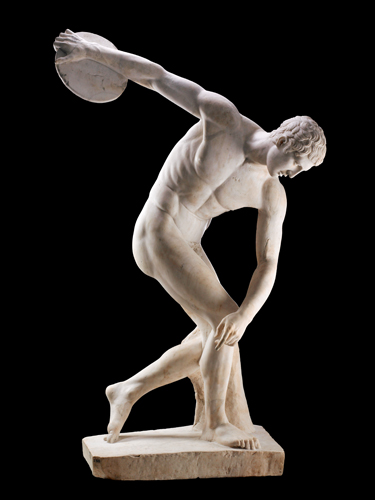
What use was this thing? You can't really make
anything with it or grow food on it, why did
the Greeks love stuff like this so much? Simply
because it's beautiful!
I feel that the purpose of Peracles' oration was to lift the people he was addressing to a higher "greatness of soul", so that they would be inspired to do more virtuous or beautiful things. As Jessie and Joseph discussed, Peracles used wonderful epideictic oratory in order to praise Athens and the men who fell defending her; he employed masterfully the special topic of invention that Aristotle classified as virtue, or that which he believed to be beauty. Fortunately history provides us with perspective, and as Professor Burton pointed out in class, all of the things that Peracles stated became realities which have come to define the ancient Greek civilization. Aristotle, in this case, was right; a man who was known and trusted by his audience employed epideictic oratory in order to praise and inspire, and the people were inspired. This wasn't the only speech that inspired that ancient civilization, but it is a typifying example of one. If people trust you enough they'll believe what you say, your beliefs are your reality, a man who is trusted like Peracles can alter reality through rhetoric. (I don't know how sound that syllogism is, but I tried...) 


Pericles, Epideictic Excellence

Epideictic Oratory:

Rereading this speech has helped me understand so much about what epideictic oratory actually is. The biggest goal of it is to praise (or blame, but in the case of Pericles and Athens to praise). He even says at the beginning that people may become jealous of all the praise heaped upon the dead, recognizing that such exaggeration is an important part of this branch of speaking.

  • He praises their fathers who created Athens, praises them for their “courage and virtues”.
  • He exaggerates the power of their army, stating that others always say they fought the entire Athenian army.
  • He states that all Athenians show exceptional grace and exceptional versatility.
  • He praises all the positive aspects of the men who fought and downplays the negatives that they have done. For example, “[the soldiers have] done more service to the commonwealth than they ever did harm in their private lives”.

By doing such praise he is also setting up a bigger enthymeme. Not one that is said in a sentence or two, but his message as a whole.

Enthymemes:

The minor premise he says is: These men fought for Athens.
The conclusion he draws is: Therefore Athens is great.
The missing major premise he is inferring us to realize is: Those men who fight for something, make it great.

In addition to this overarching Enthymeme, he uses many smaller ones throughout his speech.
  • Page 73, line 24-26: He assumes that which is appropriate is advantageous.
  • Page 76, line 1-4: He assumes that we must fight the cause of those who sacrifice for us.
  • Page 76, line 29: He indicates that it takes doing great things to be worthy of Athens.
This last one, about being worthy of Athens, is such a brilliant microcosm of this speech as a whole. He is trying to get everyone there to realize their need to sacrifice for Athens, and the enthymemes he uses do a good job of accomplishing that.