Showing posts with label epideictic. Show all posts

Wednesday, October 1, 2014

Everyday Conversation to Convince a Crowd

In the Funeral Oration of Pericles, many different forms of rhetoric are employed. I didn't recognize most of them when I first read it, as I was mostly focused on form and the classic appeals. After reading “Rhetoric” by Aristotle, I was able to point out a lot of other devices.
One of the devices that I found used was enthymeme. I didn't realize how incredibly common it was in normal speech! Trying to find examples of this in the text, I found some examples where major premises are kept and where they have been omitted. Take, for example, this line from Pericles: “To me it seems that the consummation which has overtaken these men shows us the meaning of manliness in its first revelation and in its final proof.” Here, the premise that courage and gallantry (which was stated several sentences previous and in a different context) is manly.

Reading this text again, I also noticed the very epideictic as well as deliberative aspects of the speech. It is epideictic in the sense that Pericles is talking to a large crowd and praising the men who fought. It is deliberative in the fact that he is exhorting future measures. He is calling the families of these
men to action- either calling to the mothers to have more children or calling to the children and men to stand up and show pride in their city by fighting as well.


Pericles also uses his own testimony to add credibility. In the first few lines he speaks about having a first-hand witness or reliable second-hand testimony of the accounts of battle. Pericles says “I have described nothing but what I either saw myself, or learned from others of whom I made careful and particular inquiry.” If this isn't a direct proof of testimony displayed, I don’t know what is!

Well Which One Is it?

In reading the many posts already on display, I saw two very distinct opinions in regards to Pericles’ Funeral Oration. In one corner, the opinion that the oration was based upon deliberative branch of oratory while in the other corner we have the champion of funeral orations…. (Drum roll please) the epideictic branch!

In the post, “The Master of Disguise” Hailee Richards goes so far to as to “classify Pericles’ Funeral Oration as a deliberative piece…” (Also see “Things Not as They Appear”). Others on the other hand seem sure that this speech is one of epideictic oratory.

So… Which one is it?
Could it be… both?


In an earlier post by Macey Richardson (“HPR: How Pericles Rhetoricized”) she expressed that on occasion Pericles used elements of deliberative rhetoric to persuade the Athenians to build up their great city. With this attitude in mind I desire to briefly dissect how both branches of oratory and how their coined methods can be a powerful combination.

As clearly noted within his speech Pericles praises his city after which he praises the warriors of the city. Within this praise, Pericles essentially states, “Athenian City is the best (accompanied with examples) and we have grown up in this city, therefore we are also the best.” This being said, he never claims that the people of the city are the best but it is so obvious that there is no need to do so. This is a powerful method to prove a point that we know as enthymeme.

This being said, Pericles does not remain in the present but continues to speak of what is good and unworthy as well as what is advantageous and disadvantageous in the future. Let’s see an example of this transition. Pericles states, “This, then, is the kind of city for which these men, who could not bear the thought of losing her, nobly fought and nobly died (praise). It is only natural that every one of us who survive them should be willing to undergo hardships in her service (good and advantageous).”


Brilliantly done to persuade his audience, Pericles deserves credit for such mastery of each branch of oratory and elements. In closing, I believe although epideictic in nature, his speech contains all three branches of oratory. Possibly a better question than “which one is it?” may be, “how does each branch work together to persuade an audience?”

Even the Weak are Strong. Even the Ugly are Pretty.

Before I get deep into this post, I would like to preface my post by addressing the fact that I am looking to take a different twist on these two excerpts. I am going to make a brief analysis of a connection between Pericles’ funeral oration and book one of Aristotle.

In chapter 9, Aristotle states that “for purposes of praise and blame, the thing to do is to take attributes that approximate the ones that are present as being the same things….. And each person is always to be taken as having what is best from among the attributes that go together.” He gives us various examples like the arrogant person being symbolized as a great, extraordinary person and the wasteful person as a generous person. With that being said, we know that the form of oratory that is typically utilized to give praise or blame is the epideictic oratory. Though Hailee Richards made great points in debating that Pericles’ oratory was a deliberative one, I would argue that this validates the fact that it was an epideictic oration through and through.


Pericles knows exactly what he is doing. We have background knowledge that he is the leading statesman in Athens and has great influence among the people. I think that as he speaks, it is clear that he is trying to magnify the good things of Athens to make them seem overall better than what they really are. He obviously gives lots of praise to the soldiers and every time he mentions them he takes more of a “sacred” tone, now that they have passed away. However, I find it interesting that he uses Aristotle's take as a way to not only motivate the people but build their self esteem. I would go as far as to argue that building their self esteem is going to take a hit at the pathos appeal because everyone feels good when they are being praised. 

The Master of Disguise

Was Pericles’ funeral oration really an epideictic masterpiece?  The first time I read the piece I thought it odd for a funeral speech; although there was praise I found it more to be praise of Athens rather than praise of the soldiers.  While reading Aristotle’s Rhetoric I found some interesting insights to help categorize the type of rhetoric Pericles used in his funeral oration.

Aristotle, when speaking of advisory rhetoric or deliberative, states that the orator needs to give advice on what is advantageous and good.  He goes into further detail by describing what makes something considered “good”.  He includes courage and honor in the definition.  He states that “if be cowards is the most advantageous thing for one’s enemies, it is evident that courage is the most beneficial thing for the citizens” (Aristotle Rhetoric, page 152).  Pericles goes into great detail to emphasize the importance of courage in the citizens of Athens.  We may consider this praise but with Aristotle’s insight we can view it in the light that Pericles was exhorting them to continue to be courageous in war. 
Was Pericles a master of disguise?

When speaking of deliberative rhetoric Aristotle quotes Pericles’ funeral oration (Aristotle Rhetoric, page 158).  He then goes on to the importance of one who is advising or warning to “grasp all forms of government” so that one may know the things that are advantageous to them in order to preserve the form of government (Aristotle Rhetoric, page 159).  Pericles goes into great deal praising the democracy in Athens.  As a political leader this was important to him and he wanted to preserve it.  I feel that instead of praising the soldiers who had died, Pericles used the opportunity to encourage the people to continue to fight for the form of government that they had established which was superior in his viewpoint.  He even encouraged the women to have more children which could eventually become soldiers and protect the magnificent Athens. 


In my understanding from Aristotle’s Rhetoric, I would classify Pericles’ Funeral Oration as a deliberative piece although the setting seemed appropriate for an epideictic speech.  

Things not as they appear

After reading Aristotle’s Book 1 on Rhetoric I found some new insight by rereading Pericles’ Funeral Oration. One might look at this ceremonial speech as a tribute to those who had fallen, but based on some historical background discussed our class and guided by Aristotle’s Rhetoric, we might see that things aren’t always as they seem. While it might have seemed to the Athenians that Pericles was honoring the fallen warriors, I believe that Pericles was using the ceremony as an opportunity to promote his own desires.
A typical epideictic speech focuses on displaying, singling out, and praising specific virtues of an individual such as courage, honor, charity, or strength as shown by Pericles as he discusses the sacrifice of the warriors.  What was interesting to me was the virtues that Pericles singled out and praised were the very virtues he hoped to see in the Athenians that would help promote his dream of establishing an empire.

I’m not stating that this is a wrong or evil thing for him to do, but I was surprised by how my opinion of his speech changed after reading Aristotle’s Rhetoric. What I once viewed as words of praise and honor, I began to see as words of persuasion; persuasion to become the type of people Pericles was describing. I have no doubt that the fallen Greek warriors had many attributes, some favorable, others not as favorable, it is also possible that those fallen didn’t die as heroic a death as he described, yet he chose to focus the minds of the audience on a grand idea, “Beautiful Athens, something worth dying for”. We have no idea if this was the cause that these warriors were fighting for or not. For all we know they could have been mindless fighting machines merely following Pericles command, yet the way it is portrayed is to paint the picture of a glorious cause surrounded by all the virtues we admire.  

Tuesday, September 30, 2014

What is beauty? Why does it matter?

This entree will largely agree and coincide with the two previous entrees written by Jessie and Joseph. I was struck by Aristotle's discussion concerning the definition of beauty, and that largely the purpose of epideictic oratory as a rhetorical form was to give form or point out what was beautiful around them by praising virtue or to do the same with the opposite; vice. Aristotle describes that which is beautiful as beautiful simply because it is. He provides many examples of noble characteristics that we may or may not possess as things of beauty; he describes them as things of beauty because they benefit the community at large. The virtue that I feel is the most powerful that he mentions he describes as "Greatness of soul..." which he says inspires men and women to do other virtuous things that uplift others.

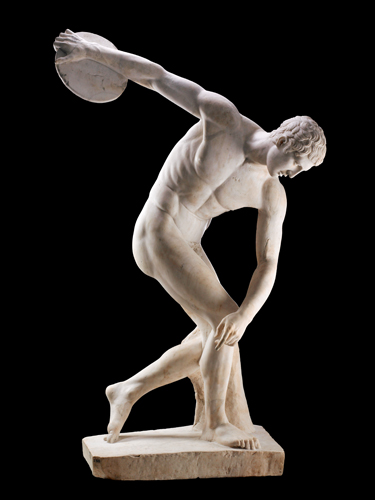
What use was this thing? You can't really make
anything with it or grow food on it, why did
the Greeks love stuff like this so much? Simply
because it's beautiful!
I feel that the purpose of Peracles' oration was to lift the people he was addressing to a higher "greatness of soul", so that they would be inspired to do more virtuous or beautiful things. As Jessie and Joseph discussed, Peracles used wonderful epideictic oratory in order to praise Athens and the men who fell defending her; he employed masterfully the special topic of invention that Aristotle classified as virtue, or that which he believed to be beauty. Fortunately history provides us with perspective, and as Professor Burton pointed out in class, all of the things that Peracles stated became realities which have come to define the ancient Greek civilization. Aristotle, in this case, was right; a man who was known and trusted by his audience employed epideictic oratory in order to praise and inspire, and the people were inspired. This wasn't the only speech that inspired that ancient civilization, but it is a typifying example of one. If people trust you enough they'll believe what you say, your beliefs are your reality, a man who is trusted like Peracles can alter reality through rhetoric. (I don't know how sound that syllogism is, but I tried...) 


Rhetoric in a Epideictic Funeral Oration

Aristotle's Rhetoric teaches about key concepts of rhetoric and provides explanations and examples for them.  I will highlight an aspect of one of these key concepts that can be found in Pericles' Funeral Oration.

Epideictic Exaggeration: 
Throughout his Oration, Pericles talks about "our city," "our belief," "our empire," "our state," "our power," "our constitution," "our system of government," "our being a model to others," "our deep respect," "our obedience," and "our own real courage and loyalty."  I find this to be an exaggeration of unity in his civilization.  He assumes that everyone in the audience (he is definitely having an epideictic monologue) shares his Greek pride and agrees with him that Greece is the best civilization around.

When I read about epideictic oratory in chapter 9 of Aristotle's Rhetoric, the following passage reminded me of the exaggeration in the Oration.  "...exaggeration is always best suited to speeches for display, since they take up actions that are agreed about, so what remains is to adorn them with magnitude and beauty" (page 166 line 1368a 27).  It is clear that Pericles was in a position to deliver an artful display of words.  He magnified many aspects of the great Greek Empire by highlighting all that the Greeks share.

Not only does Pericles exaggerate how amazing Greece is, he establishes that he knows what he is trying to accomplish in doing so.  Before he really begins honoring the soldiers, he explains to his audience, "Praise of other people is tolerable only up to a certain point, the point where one still believes that one could do oneself some of the things one is hearing about."  Pericles establishes that he and all the Greeks agree that they are great, that they could fight nobly if they need to, because they all believe in the great principles of the Greek Civilization that motivated the dead warriors. 


"This, then, is the kind of city for which these men, who could not bear the thought of losing her, nobly fought and nobly died." - Pericles

Friday, September 26, 2014

Assignment: Analysis of Pericles' Funeral Oration

Pericles led Athens at the height of its classical glory, and from the funeral oration he gave, as recorded by Thucydides, we get a sense of how the Athenians thought of themselves, as well as the role that public speaking played in their culture.

I'd like my students to read the funeral oration of Pericles and analyze this as history, as rhetoric, and as philosophy. In a blog post of about 300-400 words, they are to spend about 100-150 words commenting on each of these three areas.

To encourage learning from one another, as well as the avoidance of duplication, each post should make explicit reference to and link to at least one other student's analysis. Rather than seeing multiple students make very similar points, I'd like to see students refining or even challenging one another's analyses. (Whoever posts earliest has some advantage, but they might also need to return and update what they say so that they can also refer to others' posts).

1. History
Consider any of the following approaches in doing a brief historical analysis.

  • What does this speech reveal about Greek civilization? For example, in the picture above one can see a sculptor pausing from his work to listen to Pericles. From this one can infer the value of the arts to the Greeks. What can be inferred from the "picture" given of Greek life by Pericles in his speech? 
  • What does this document reveal in terms of history as a genre of writing at that time? What was worth recording, and why do you think Thucydides chose the methods he used?
  • Consider history as a genre of rhetoric, and analyze Thucydides' rhetoric (audience, intention, kairos, style, arrangement, etc.)
  • Do some brief research on 5th century Athens or on the Peloponnesian war. Use this to give a better setting or sense of kairos for the next category of analysis: rhetoric.
2. Rhetoric
Use any of the following in doing a brief rhetorical analysis
  • Picking up off the last suggestion from history, how does the additional historical information you researched help us better understand the kairos for Pericles' oration?
  • Analyze Pericles' speech as epideictic oratory.
  • Analyze the arrangement of his speech. What significance is there to the order in which the ideas were given? 
  • How does Pericles establish his ethos within the speech?
  • What are some of the topics of invention he uses. Are these what you'd expect for the occasion?
  • Can you point to any schemes or tropes or any specific figures of speech (see the right column of Silva Rhetoricae) in his oration and say what their effect is?

3. Philosophy
We have recently reviewed basic ideas from three groups of philosophers in ancient Greece: the Pre-Socratics, the Socratics, and the Sophists. Review your notes, and then consider the following: How can one relate any of those philosophical schools, or the individual concepts of specific philosophers, to the speech by Pericles? Consider any of these approaches:

  • How does Thucydides' history or Pericles' speech (or both) represent Greek rationality?
  • Argue that Pericles would meet with the approval or disapproval of one of these three groups of philosophers, or of any one philosopher whose ideas we have covered.
  • Use an aspect of the speech as a way of illustrating one of the ideas of one of these philosophers.
  • How might one of the philosophers we reviewed have approached the speaking task differently than did Pericles? (or approached the historical task differently than did Thucydides)?
  • If you don't feel you have enough of a grasp on these philosophical schools or concepts, then as an alternative, consider Pericles' speech in light of Greek drama. Is Pericles an actor, using the tools or approach of the theater? If Euripides transformed the speech into a play, how might this be approached? 
Be sure to divide your post into three sections corresponding to these instructions, and to limit the overall length to 300-400 words.

Friday, September 12, 2014

I AM SO LIVID RIGHT NOW!!!!


“I am so livid and angry right now.” 


Now, looking back, I could have calmly made that statement jokingly, with a smile on my face or I could have yelled it with fury as I simultaneously punched my neighbor in the arm. What both Elder Bednar and Socrates understand is that the way one communicates his or herself is crucial. I cannot help but grin as I imagine Gorgias trying to be clever and rhetorical, yet getting circles ran around him by Socrates who knows how to use rhetoric to prove that rhetoric isn’t everything! It’s pure irony and the key is that Socrates knows how to communicate himself. He points at the little things that Gorgias gets tripped up on and exploits them. He is a powerful rhetorician. It’s incredible the way he uses that and ironically enough, it seems to me, he is building ethos there. He is proving himself to be a worthy source who knows what he’s talking about. I would even consider the fact that he is demonstrating kairos because of his impeccable timing and sense of the “when” to communicate himself as he breaks down certain concepts, similar to what Mindee Sharp said. 

Elder Bednar is extremely similar in multiple ways. First, this is a terrific example of epideictic rhetoric as he stands before millions of viewers. One of the first things he says is “I pray that the Holy Ghost will teach and edify us…” as if he is literally calling down the powers of heaven. I believe that this statement has multiple rhetorical appeals, however I think more than anything he understands the setting which is a form of kairos. Also, right off the bat he breaks his speech down to simple concepts which demonstrates logos. He is an overall powerful speaker and though it’s already been said in past posts, I too think that if Elder Bednar and Socrates teamed up, they would be explosive. 

Go forth and serve...some rhetoric!

In trying to motivate us to do something, Elder Bednar employs epideictic oratory talking about the virtues of communication. He breaks his message down into various parts and then uses testimony of others to highlight his points.
  • He used the testimony of past prophets to give authority to his message.
  • He used the examples of the church to show that this is not just something he is asking us to do, but to show that the church itself is getting involved.
  • Elder Bednar, leading the troops in the digital age.
    (you know you thought the same as you watched)
  • He used the ideas of church members to highlight that anyone of us can use social media; it need not be hard or time consuming.

Perhaps what impressed me the most was that even though I was watching this for an assignment, by the end of the video I was excited to get out there and start posting things online. He had the authority, he had the logic, then he plead for us to take it from a slow trickle to be a flood, if that didn’t get you excited for battle with the adversary, I don’t know what will.

Contrast this to Socrates who uses judicial oratory to show the injustice and wrongness of the study of persuasion. Socrates knows that he has an audience, and he wants to tear down rhetoric to show that it is not fit for the use of man. He works hard to use logical arguments to catch a master sophist off guard. He shows the crowd that Gorgias goes back and forth on the justice and injustice of rhetoric and thereby tries to show that it is not a techne and as such deserves no place.


I think Elder Bednar would disagree with Socrates about the goodness of rhetoric. From Elder Bednar’s perspective, Socrates is throwing out the baby with the bath water.