In his
treatise De Oratore, Cicero claims that in order to master oratory
first you need to learn the rules, then to practice. There is a very
noticeable application of this statement when you notice the notice the
difference between this treatise and Cicero’s former, De Inventione. In
his early life, Cicero focused on simply stating and learning the rules for
delivery and memory, but it becomes apparent that after years of experience and
his use of dialogue he masters the art of eloquence (169). This same
observation was made by Hailee,
who feels more enlightened by the dialogue approach given in De Oratore than
the list of concepts given in De Inventione.
Showing posts with label De Oratore. Show all posts
Showing posts with label De Oratore. Show all posts
Wednesday, October 29, 2014
Dialogue is less boring

Seek ye knowledge
Spencer 's post touched on the knowledge that Cicero attained during the thirty years between his composition of De Inventione and De Oratore. An orator, such as Cicero, can gain knowledge in the rhetorical field over time and through experience. This is essential to his skill and power in persuasion. But what about his knowledge about his subject matter? Should a rhetorician be well-informed in the fields about which he speaks?
Socrates adamantly refused that Gorgias could speak about anything, anytime, anywhere without having a true understanding of that 'thing'. Cicero supports Socrates by saying, "The orator must know the facts of his case. If he doesn't then he must learn them" (168). Through Crassus, Cicero explains that a rhetorician cannot ignore the necessity of obtaining basic knowledge about his topic. This is in line with Socrates's argument against Gorgias that skillful rhetoric cannot take the place of expertise in a given field.
I find it interesting that while Cicero and Socrates agree about the need for specified knowledge, Socrates believes that a specialist will speak more eloquently about his subject than the rhetorician ever could. Cicero disagrees, saying that once the orator learns a subject, he "will present this material better than the specialist could" (168). I think the competition would come down to how skilled the orator is and how much he learns about the topic. Unless the specialist has absolutely no public speaking skills at all, then it would be an easy bet. What do you think?
Cicero states that, "Knowledge of the rules [of rhetoric] is the first step towards oratory" (169), and it seems to me that another step is acquiring knowledge about the subject so as to intelligently approach the argument.
Socrates adamantly refused that Gorgias could speak about anything, anytime, anywhere without having a true understanding of that 'thing'. Cicero supports Socrates by saying, "The orator must know the facts of his case. If he doesn't then he must learn them" (168). Through Crassus, Cicero explains that a rhetorician cannot ignore the necessity of obtaining basic knowledge about his topic. This is in line with Socrates's argument against Gorgias that skillful rhetoric cannot take the place of expertise in a given field.
I find it interesting that while Cicero and Socrates agree about the need for specified knowledge, Socrates believes that a specialist will speak more eloquently about his subject than the rhetorician ever could. Cicero disagrees, saying that once the orator learns a subject, he "will present this material better than the specialist could" (168). I think the competition would come down to how skilled the orator is and how much he learns about the topic. Unless the specialist has absolutely no public speaking skills at all, then it would be an easy bet. What do you think?
 |
| Kirby, the rhetorician, knew nothing about cooking until he needed to write an argument about it. Now he has quite the big mouth! |
Cicero states that, "Knowledge of the rules [of rhetoric] is the first step towards oratory" (169), and it seems to me that another step is acquiring knowledge about the subject so as to intelligently approach the argument.
Cicero and two ways he expressed his ideas about rhetoric
What advantage do I see in Cicero's use of dialogue form to address ideas about rhetoric in De oratore compared to his use of an explanatory form in De inventione?
I see that when Cicero writes in dialogue form, his ideas are easier to understand, the piece is more entertaining, and it is easier to read.
 Advantages that Cicero maybe saw in addressing ideas about rhetoric in dialogue form rather than in the regimented form that he uses in De inventione include that he has greater artistic expression, and that by writing in a narrative format he can express the inner creativity of his soul. Through dialogue form, Cicero is able to takes something that he previously approached from a scientific and factual angle and make it far more human and tangible.
Courtney has identified that in De oratore, Cicero effectively uses his new tool of pathos.
Thomas noted that Cicero does not refer to himself in De oratore like he did in De inventione. This enables him to add a layer of depth to his understanding of rhetorical principles because he creates characters who discuss rhetoric.
Hailee focused on the ability of Cicero's use of dialogue form to help the reader feel comfortable with the rhetorical concepts and see how they can be applied in real world settings.
I see that when Cicero writes in dialogue form, his ideas are easier to understand, the piece is more entertaining, and it is easier to read.
_-_frontespizio.jpeg) Advantages that Cicero maybe saw in addressing ideas about rhetoric in dialogue form rather than in the regimented form that he uses in De inventione include that he has greater artistic expression, and that by writing in a narrative format he can express the inner creativity of his soul. Through dialogue form, Cicero is able to takes something that he previously approached from a scientific and factual angle and make it far more human and tangible.
Advantages that Cicero maybe saw in addressing ideas about rhetoric in dialogue form rather than in the regimented form that he uses in De inventione include that he has greater artistic expression, and that by writing in a narrative format he can express the inner creativity of his soul. Through dialogue form, Cicero is able to takes something that he previously approached from a scientific and factual angle and make it far more human and tangible.Courtney has identified that in De oratore, Cicero effectively uses his new tool of pathos.
Thomas noted that Cicero does not refer to himself in De oratore like he did in De inventione. This enables him to add a layer of depth to his understanding of rhetorical principles because he creates characters who discuss rhetoric.
Hailee focused on the ability of Cicero's use of dialogue form to help the reader feel comfortable with the rhetorical concepts and see how they can be applied in real world settings.
Greek Grandma and the Extension of the Bicycle
 So before I get started on my main point, I would like to comment on the fact that reading excerpts from Roman rhetorical conversations is very interesting when compared to Greek debate because the Greeks were laying the foundation of what rhetoric would become, without any history to go back on. The Romans kept referring to their rhetorical schooling and had the Greek rhetorical background. There were many times when the Romans referenced the Greeks in their debate, and it almost seemed like an insult. "Your views are like those of the Greek philosophers" (167). That's like us saying, "you talk like my grandma!"
 Anyway, comparing De Inventione to De Oratore was much like a coming of age thing, as so many people have mentioned before (I think Spencer had a great take on this.). However, I think I will branch out a little bit and build off of those who posted before me. People have commented that it seems like Cicero had more life experience when he wrote so De Oratore, and I agree, but would ask, why does it seem that way? My answer: emotion and pathos. Before Cicero got into the "real world," or took off his training wheels, his writing read like a dictionary. However, once he learned a little more about rhetoric he realized how important it was to engage the listener in more pathetic appeals. Humor, style, and emotion were emphasized in De Oratore much more than they ever would have been if it had been written by the Cicero who wrote De Inventione.
  |
| I've actually had to read this textbook for a class last year. Wasn't that bad... |
Tuesday, October 28, 2014
Cicero vs Plato
It’s honestly nothing new when I say that the differences are very distinct between the literary elements and rhetoric of Cicero’s De oratore and Plato’s Gorgias. Plato does a pristine job of utilizing dialogue to completely destroy rhetoric and make Socrates look completely different than what he really was. Cicero utilized his speech to exploit different aspects of the rhetorical ideas and I would agree with Hailee’s post that it was very insightful.
The main point that initially came to my mind was similar to the same points that Joseph made in his post. He discusses the differences in morality between Cicero and Plato. We can clearly see that Plato’s ethics and morals aren’t very sound. I feel like he doesn’t give others the opportunity to make rebuttals nor speak in general. We can see that Cicero does a much better job at adding a moral value to his own oratory. He is more open minded and is willing to scrutinize various points of a given topic.

I also really liked Brooke’s point about De Oratore’s arrangement. For whatever reason, I felt like it was set up in a peculiar way and it was different than the other readings that we have been assigned. It absolutely was in a very clear, organized way so that the reader can see clearly that the points Cicero makes are demonstrated in his own writings. Irony.
"Silence is Golden"
 The idea of knowledge and understanding as
explained in Spencer's blog caught my attention. This principle had been taught
many'a'times by my father in the walls of the place I call home. With this in
mind I desire to take the invitation presented by Thomas and add on to the
comments found in Macey's post in regards to comparing the De Oratore and
Gorgias.
The idea of knowledge and understanding as
explained in Spencer's blog caught my attention. This principle had been taught
many'a'times by my father in the walls of the place I call home. With this in
mind I desire to take the invitation presented by Thomas and add on to the
comments found in Macey's post in regards to comparing the De Oratore and
Gorgias.
Although similar in some ways, ultimately
both dialogues are extremely different in nature and purpose. Plato's Gorgias
has a very clear purpose; to prove that Plato (as well as his mentor Socrates)
are correct in their logic and ultimately have the moral truth.
On the other hand Cicero allows both
sides of the argument to be heard as he creates the dialogue between Antonius
and Crassus, thus producing an environment of exploration and deeper
understanding of the principles of rhetoric. This could be interpreted as a
sophist ideology.
Plato claimed that orators have no
specific skill and intellect but rather a broad understanding of many things
(which in my mind seems immoral or more amoral) while it is apparent that
Cicero believes that, “the orator must know the facts of his case.” This adds a
level of morality and truth to his definition of rhetoric.
 The final point I wish to make is the most
significant I have to offer. Yes, Plato was able to trump his foe in Gorgias
but did he truly come away as victor? In reality, Cicero's ability to use
rhetoric has swayed our class to trust his interpretation of rhetoric over
Plato's. How? The answer is found in Proverbs 29:11, "A fool uttereth all
his mind: but a wise man keepeth it in till afterwards." Cisero recognized
that to persuade requires trust in the persuader and gained that trust through
allowing Crassus hear out the angle of Antonius. Plato failed to understand
that mere logos is not enough to persuade when we don’t have all the facts in
this life.
The final point I wish to make is the most
significant I have to offer. Yes, Plato was able to trump his foe in Gorgias
but did he truly come away as victor? In reality, Cicero's ability to use
rhetoric has swayed our class to trust his interpretation of rhetoric over
Plato's. How? The answer is found in Proverbs 29:11, "A fool uttereth all
his mind: but a wise man keepeth it in till afterwards." Cisero recognized
that to persuade requires trust in the persuader and gained that trust through
allowing Crassus hear out the angle of Antonius. Plato failed to understand
that mere logos is not enough to persuade when we don’t have all the facts in
this life.Be real!
I don't feel I could make a better comparison between Plato's Gorgias and Cicero's De oratore than has already been made by Macey Richardson in her post. I agree with all of the points that she made and even found greater insight of how the two treatises relate by reading her post.
In the closing paragraphs of De oratore Cicero narrates the dialogue of Crassus, who is discussing style. But he finishes powerfully by declaring that "...delivery is the supreme factor in successful oratory." and then goes on to say that the emotions and the delivery used in oratory cannot be faked. He says that artificiality is easily and quickly detected. Many of the previous blog posts have aligned Cicero with the Sophists, which I mostly agree with. But in the dialogue between Socrates and Gorgias in Plato's Gorgias one of the common points brought up by Socrates his belief that it would be better for the masters of any given subject to speak about their subject instead of a professional orator, because it is more genuine. In De oratore Cicero seems to bridge a disconnect fabricated by Socrates; good rhetoric and oratory does need genuine deliverers, but just because someone isn't a specialist in a given subject doesn't mean he or she isn't passionate about it. (However, having more knowledge about a subject definitely makes it easier to talk about that subject; notice how much shorter this blog post is than my posts about architecture... I usually have to cut stuff out of those posts because they're too long.)
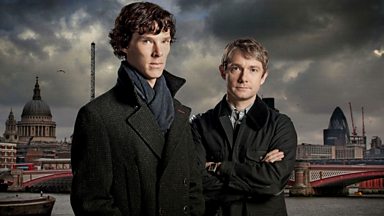 |
| I don't know if any of you have seen the BBC series Sherlock, but I like it enough to watch it, which is saying a lot... I'm a fan of Benedict Cumberbatch, who plays Sherlock Holmes in the series. I think I'm a fan because the actor has become Sherlock, he has taken on his emotions, his personality, everything that is Sherlock Holmes, so that I actually believe him when he's acting, he's genuine because in a way what he feels when he acts as this fictional character is probably what the writers felt as they created that character. |
It's very interesting to see Cicero draw his knowledge from so many different sources of learning, I think that is a part of what Macey was talking about in her post about the difference in the dialogue in De oratore versus the dialogue in Gorgias; the dialogue was much less biased and more open, or as Macey put it; "mature".
 |
| My nephew!!! Isn't he cute? He's so happy in this picture because he's doing his favorite thing, dipping things and then eating them. He's passionate about it and you can tell, so the emotion is contagious! |
Cicero's Farewell and Homecoming
Macey’s concept that Cicero’s De
Inventione was more related because of the similarity in age I found
intriguing. Although I found it
insightful, I disagree that De inventione was “more helpful in developing one’s
own cognitive reasoning” about the art of rhetoric. I found De oratore to be much more insightful
and because it was formed out a dialogue it showed that anyone can add to it
and help establish the concept whereas in De inventione Cicero only stated what
was to be understood as correct.
 In De inventione,
Cicero discussed terms and their uses in the legal court. He was studying to be a lawyer so this
information was best understood by those in that field. In De oratore, Cicero, after much experience
in the field, uses a dialogue format to discuss when it is appropriate to use
such terms. It reminded me a lot of
serving a mission. In the MTC we
discussed ideas for teaching and inviting the Spirit. You think you understand a lot about
missionary work, until you go into the mission field. It is in the mission field that you really
become to understand the practical uses rather than the hypothetical or
supposed uses of these techniques. I can’t
speak for others but I felt that I was just becoming to understand missionary
work when I was ending my mission.
In De inventione,
Cicero discussed terms and their uses in the legal court. He was studying to be a lawyer so this
information was best understood by those in that field. In De oratore, Cicero, after much experience
in the field, uses a dialogue format to discuss when it is appropriate to use
such terms. It reminded me a lot of
serving a mission. In the MTC we
discussed ideas for teaching and inviting the Spirit. You think you understand a lot about
missionary work, until you go into the mission field. It is in the mission field that you really
become to understand the practical uses rather than the hypothetical or
supposed uses of these techniques. I can’t
speak for others but I felt that I was just becoming to understand missionary
work when I was ending my mission.  I think
this can be seen in Cicero’s De inventione and De oratore. He knew the potential uses of the rhetorical
devices but after years of practicing law he could expound upon them and give
examples for when certain terms were to be used. I thought it was interesting how he expanded
upon his idea of stasis. He wrote of the
importance of stasis in De inventione and discusses the conjectural stasis in
the question of whether or not something occurred. In De oratore he expounds by discussing the
questions asked to decide which type of stasis is being discussed, “Conjecture
involves four questions: What exists? What is its origin? What is its
cause? What can change?” I think that Cicero’s experience served him
well in explaining rhetorical terms and how they should be used.
I think
this can be seen in Cicero’s De inventione and De oratore. He knew the potential uses of the rhetorical
devices but after years of practicing law he could expound upon them and give
examples for when certain terms were to be used. I thought it was interesting how he expanded
upon his idea of stasis. He wrote of the
importance of stasis in De inventione and discusses the conjectural stasis in
the question of whether or not something occurred. In De oratore he expounds by discussing the
questions asked to decide which type of stasis is being discussed, “Conjecture
involves four questions: What exists? What is its origin? What is its
cause? What can change?” I think that Cicero’s experience served him
well in explaining rhetorical terms and how they should be used.Cicero, the Sophist
Macey R has done a great job introducing the differences between Cicero’s De oratore and
Plato’s Gorgias. She pointed out how
they approach truth. In short, Cicero uses dialogue to explore all the
different facets of rhetoric. Whereas Plato uses dialogue to praise Socrates,
and belittle Rhetoric.
As such, it would appear that Cicero
uses a moral aspect to his oratory, whereas Plato is not very moral, at least
not by our standards. Analyzing the form of his speech (we will set aside the
content for a moment) he allows various characters to discuss, question, and
elaborate on their points of view. This is something that is very fair to both
sides, and that which is fair is moral (do you see the enthymeme there? :) He is striving to show his audience that he has approached
this from a fair perspective.
 As for content, he speaks of the need
for someone to be very well versed in all the different categories so that he
can then make the right choice when orating. Thus what is right in one situation
will be different then what is right in another. Each time it is right, but
time to time it is different. Thus the sophists would welcome Cicero into their
camp.
As for content, he speaks of the need
for someone to be very well versed in all the different categories so that he
can then make the right choice when orating. Thus what is right in one situation
will be different then what is right in another. Each time it is right, but
time to time it is different. Thus the sophists would welcome Cicero into their
camp.Empowering the Reader
 While I read the De oratore, I reached very similar conclusions to those made by Katie and Thomas. I really loved both of their explanations of this progression. Katie compared the two works to a bicycle with training wheels and a regular bike, suggesting that there is a same basic idea, but a different style applied. Thomas noted how "growing up" may have helped Cicero's opinion deepen and expand. I appreciated both of these explanations. While reading, what stood out to me the most was that the topics were more evolved than those expressed in De inventione in that he relied more heavily upon a different topic of invention; testimony (specifically that of authority figures). In reading other student's posts, most readers seem to have appreciated this alteration. However, I definitely agree with the comment Brooke made on Thomas' post. I like the concise, direct manner in which the De inventione was given. This helped me to focus on what was being said but also empowered me as a reader to apply those techniques of rhetoric in my own way rather than being spoon fed the "right" application by the professionals. I felt like the name dropping in De oratore was distracting and in the end, I felt like I had no freedom in application. Perhaps though, this feeling of limitation is due to the fact that there is an age difference between the Cicero who wrote the oratore and the Macey who read it. The Cicero who wrote the inventione had the advantage of being the same age as the Macey who read it. Thus, while I read, I got the sense that I was reading a text by someone who was more on my level and I didn't feel forced to believe he was right. However, in the oratore, I had the feeling throughout that I was listening to an adult who believed they had a perfect understanding of the subject matter, and who cared more about me believing as they do, independent of any thinking on my own, rather than helping me develop my own cognitive reasoning. (Has anyone else had a past experience with a professor in college who was like that? I know I have.) As a result, I think I was less receptive. Who knows, maybe the Macey 20 years down the road will be more receptive to the style of the De oratore.
Knowledge vs Understanding
The comparison of Cicero’s De Inventione and De Oratore
really struck home with me in something that has been on my mind quite a bit
recently. This time of the year here at BYU is the time where a lot of
companies are recruiting for internships in my field, and I hear so many of my
fellow students say that they “know” they want to pursue a certain type of work
in my field. In asking these fellow students of mine why they feel so strongly
about a certain discipline of our future field they rarely respond with a sensible
or logical answer, to provide any reason to their decision. I see this concept
mirrored in Cicero’s writing, as it is an easy comparison to make because Cicero
wrote De Inventione as a “graduating”
student himself.
 In De Inventione Cicero
expresses much of what any student would express if asked about their studies:
basically a recitation of their text books, and the knowledge of what was
originally learned by professionals in that subject. Cicero more or less
repeats what we learn from Aristotle’s systemization of rhetoric with some of
his own thoughts and take always, which does show that he truly understands the
material. However, just because we understand something doesn’t mean that we
may be necessarily good at it or like the material we know so well. At this
point, Oratory has yet to be proven in Cicero’s own life. This is where De Oratre comes in.
In De Inventione Cicero
expresses much of what any student would express if asked about their studies:
basically a recitation of their text books, and the knowledge of what was
originally learned by professionals in that subject. Cicero more or less
repeats what we learn from Aristotle’s systemization of rhetoric with some of
his own thoughts and take always, which does show that he truly understands the
material. However, just because we understand something doesn’t mean that we
may be necessarily good at it or like the material we know so well. At this
point, Oratory has yet to be proven in Cicero’s own life. This is where De Oratre comes in. Has Cicero changed or developed his ideas after 30 years of
legal & political experience? De
Oratre shows that the answer to this question is that Cicero has applied
his knowledge and developed not only a reinforced knowledge of oratory through
experience, but his own conclusions about oratory in practice. “Yet no
discipline yields greater rewards or has done more for civilization than
oratory” is one of the many clear statements that Cicero makes that shows he now
understands rhetoric at a level in which he is able to teach rhetorical theory
of his own. De Oratre is evidence
that even Cicero, a genius in the art of rhetoric, needed experience applying
his knowledge in order to come to a full understanding of it.
Has Cicero changed or developed his ideas after 30 years of
legal & political experience? De
Oratre shows that the answer to this question is that Cicero has applied
his knowledge and developed not only a reinforced knowledge of oratory through
experience, but his own conclusions about oratory in practice. “Yet no
discipline yields greater rewards or has done more for civilization than
oratory” is one of the many clear statements that Cicero makes that shows he now
understands rhetoric at a level in which he is able to teach rhetorical theory
of his own. De Oratre is evidence
that even Cicero, a genius in the art of rhetoric, needed experience applying
his knowledge in order to come to a full understanding of it.My, what a Gorgeous Oration!
Let's talk dialogue.
 So, in Cicero's De oratore, we've got this group of buds hanging out at their friend's house, having a chat about oratory (you would think there would be more to talk about in ancient Rome, but hey, whatever floats their boat). There's a very productive, respectful discussion about what oratory has done, what oratory requires, and how to become a great orator. All parties who speak are equally heard--and even when disagreements arise, all turns out well in the end. This is especially true because Antonius was just arguing with Crassus for the fun of it (p. 172). Everyone's opinions and experiences balance out and puzzle piece into each other quite nicely.
Now rewind your brains to when we read Plato's Gorgias. I don't think you need to be reminded what happened in this dialogue. With Socrates' loyal student at the reins, things went a little differently for Gorgias than for Antonius and Crassus. The dialogue could've looked something like this:

Not as nice and friendly, huh? So why such a big difference?
Let's look at Plato again. Well, he was Socrates' student. He was probably less experienced (like the young Cicero that James talked about). He did have a lot of respect for Socrates. And he did subscribe to his views. Naturally, he wanted Socrates to look like the tough guy in the dialogue--to create a masterful persona in his work to honor his teacher (and beat up the sophists while he was at it).
We oughta note that Cicero, too, included his tutor as a character in De oratore. Crassus represents Cicero's own views in the dialogue. Instead of making Crassus "win," though, Cicero lets Antonius and the other friends have a turn. Crassus doesn't smash them into the ground, but listens as they explain their views and even admits his own faults as an orator and rhetorician. Cicero thus uses his characters in a more mature way: to explore the different ideas about rhetoric and oratory.
Plato was more interested in proving his point than exploring other ones. He wanted to show how good Socrates was as well as how right he was, and he does a pretty good job of it. If we looked at who Gorgias was and how he spoke, though, we might find that his portrayal in Gorgias is a little skewed.
Cicero, on the other hand, provides a pretty accurate depiction of the theories of his characters' actual counterparts. We can tell because of the brief history included on page 166: Antonius, though playing the opposition in De oratore, actually held the more popular view of rhetoric at that time.
Now rewind your brains to when we read Plato's Gorgias. I don't think you need to be reminded what happened in this dialogue. With Socrates' loyal student at the reins, things went a little differently for Gorgias than for Antonius and Crassus. The dialogue could've looked something like this:
Not as nice and friendly, huh? So why such a big difference?
Let's look at Plato again. Well, he was Socrates' student. He was probably less experienced (like the young Cicero that James talked about). He did have a lot of respect for Socrates. And he did subscribe to his views. Naturally, he wanted Socrates to look like the tough guy in the dialogue--to create a masterful persona in his work to honor his teacher (and beat up the sophists while he was at it).
We oughta note that Cicero, too, included his tutor as a character in De oratore. Crassus represents Cicero's own views in the dialogue. Instead of making Crassus "win," though, Cicero lets Antonius and the other friends have a turn. Crassus doesn't smash them into the ground, but listens as they explain their views and even admits his own faults as an orator and rhetorician. Cicero thus uses his characters in a more mature way: to explore the different ideas about rhetoric and oratory.
Plato was more interested in proving his point than exploring other ones. He wanted to show how good Socrates was as well as how right he was, and he does a pretty good job of it. If we looked at who Gorgias was and how he spoke, though, we might find that his portrayal in Gorgias is a little skewed.
Cicero, on the other hand, provides a pretty accurate depiction of the theories of his characters' actual counterparts. We can tell because of the brief history included on page 166: Antonius, though playing the opposition in De oratore, actually held the more popular view of rhetoric at that time.
"If Truth were Self-Evident, Eloquence would be Unnecessary"
In both of his publications, Cicero facilitates fascinating
insight on persuasion. Firstly, in his book, De Inventione, Cicero develops the powerful idea of eloquence. He
asserts that epideictic ability alone does not have sufficient strength to persuade.
One cannot simply state a series of facts and find satisfactory results.
Instead, eloquence must enhance the epidictic dialogue. Cicero even states, “The
function of eloquence is to speak in order to persuade an audience; its goal is
persuasion by speech.” The inverse must
also be true. If a speech is deprived of eloquence it will not persuade, and thus
the purpose behind the speech will not be realized.

It seemed to me that the idea of eloquence was also
developed in the discussion on oration in De
Oratore. The idea expressed by
Crassus that, “An orator must know how to rouse or quell men’s emotions [and]
words alone are insufficient” seems to indicate that if eloquence and epideictic
are two sides of the same coin, then the name of that coin is oration. One must
be both proficient in the manner in which the content is delivered but also the
content itself. The later was a discussed thoroughly in a very manner
reminiscent of the sophist ideology. The quoted dialogue of Crassus, Antonius,
Scaevola, and Sulpicious heavily debated the idea of whether or not it was
possible to attain the theoretically requisite amount of knowledge to be able
to effectively argue on any topic.
I think Brooke does an excellent job relating the above
principles to the ideas presented by Aristotle in discourses on rhetoric.
Cicero breaks down the above idea into their most fundamental form so the
reader can best understand how to develop the skills discussed. After all, “How
incredible it is that few men, using the abilities given to most men, have the
power to interest, motivate, and persuade their fellow men.”
Cicero Taking his own Advice into Account
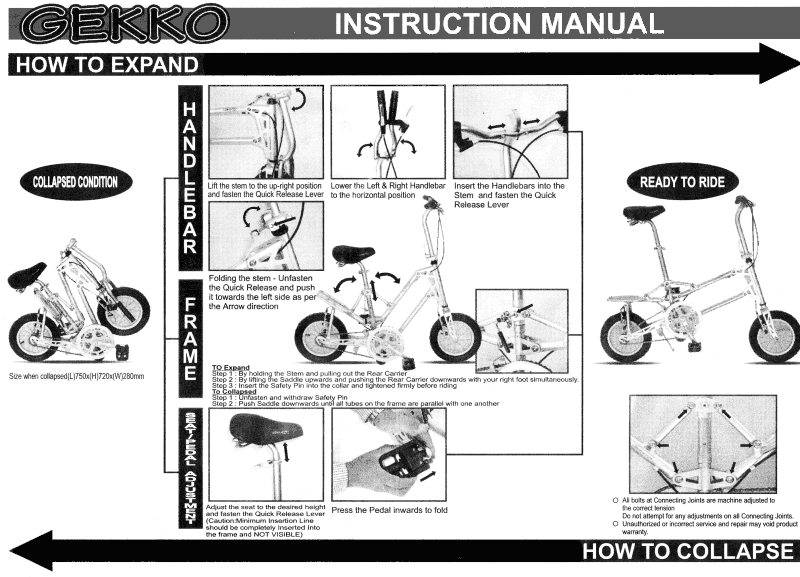 Just like Katie showed Cicero's De Inventione as the speech on training wheels, and his De Oratore as a normal bike ready to race, I too feel like De Oratore is the next step for Cicero in his career. In my opinion though, De Inventione was the instruction guide to how Cicero wrote De Oratore.
Just like Aristotle wrote Rhetoric to describe the attributes and what it is composed of (subject and adjunct), Cicero does a similar thing in De Inventione which clearly points out and defines the rhetoric terms that we have so far learned in class, as well as adding on some new ones like stasis. When going through the different branches of oratory, the canons of rhetoric, and even some of the special topics of invention he clearly defines them and explains each purpose and when they would be most appropriately used. Using this very informative writing style, I felt as though Cicero made this his instruction guide that he followed when he wrote De Oratore. I am very impressed that at age 20 Cicero understood rhetoric so well, and do such an amazing job explaining it; I could never explain rhetoric nearly as well as he does!
 When Cicero then goes deeper into rhetoric in De Oratore, he uses the foundation principles of rhetoric which he taught in De Inventione. Cicero follows his counsel of arrangement in De Oratore by separating his key points into three different books, making it very organized and understandable to read and follow along. When describing the education and training that must go into good public speaking, I feel that he leans more towards the Sophist's opinion on how powerful rhetoric can be, especially when taught and marketed. In the third book where he talks about decorum and delivery, he follows the basic principles of memory and delivery that he talks about in his De Inventione.
One main difference between De Inventione and De Oratore that I found was that De Inventione focused more on rhetoric towards the law and the court system, and De Oratore was focused more on rhetoric in the oral nature. It makes sense that De Oratory is based on an oral situation because it is written as though Cicero is in a conversation with his peers.
That which experience yields
In De Inventione, Cicero has just finished his schooling and
writing a book to demonstrate what his years of schooling have taught him. He
is only beginning his career as a rhetorician. When I first read De Inventione,
I thought, “This is good stuff” or “I hadn’t noticed that about rhetoric
before”, Cicero did an excellent job of adding a fine touch to Aristotle’s
system of rhetoric. You can tell that Cicero thinks he knows a lot about rhetoric.
Now let us fast forward 30 years…
 |
| Each of us must carve our own path. We are just at the begining. There is so much ahead of us! |
It was hard for me to
believe that the writers of De Inventione and De Oratore were the same person.
His writing and his ideas were very powerful. I enjoyed his insights on what he
projected were the needed skills of a rhetorician because I think I could tell
that this particular writer possessed many of them.
 |
| Cicero sculpted his own life as he followed his passions and goals |
Things take time. I was very inspired by the works of
Cicero, mainly because he didn’t give up on his dream. He began a journey as an
eager and promising student, but it was what he did with his life after his schooling was over that
really defined him. Like it was for Cicero, so let it be for us.
I think a great lesson to learn from Cicero is to follow
your heart and to stick with your goals. Who we are now is not a reflection of
what we are forever destined to be. Regardless of where we are now with hard
work, consistency, and time we can sculpt our lives into something beautiful.
Growing Up
As with Katie's
 |
| What better transformation to use as an example than that of the Bald Eagle from child to adulthood? America! |
At the time of its writing, De Inventione was indeed
authored by the young adult Cicero of about twenty years. Cicero must have been proud of his work, as
it was the best that he could accomplish at that time; even for such a fresh
new member of the rhetorical society, Cicero left a very noticeable mark. If not, people of today would not be
reviewing it. Still, though Cicero
spelled out the concepts expressed in the branches of oratory and the five
components in arrangement, the format could be considered a bit forced and
rigid—unnatural, even. This is not to
say that the piece is a poor instance of writing, but that it is only the first
attempt made by Cicero in his new career.
On the other end of the spectrum, there is Cicero's
De Oratore, which is a masterful work laid out carefully in a way that
demonstrates fluidity, knowledge, experience, and overall better presentation
than his previous endeavor. Perhaps this
is most notable in the fact that, as Katie said, Cicero's role changes in De
Oratore, a product of his later years. In
this newer work, the fledgling rhetorician Cicero has shorn away his young down
and taken to the skies of discourse with his seasoned, developed wings. Probably the most notable demonstration of
this is through Cicero's use of distancing himself from the text (as he personally
narrated De Inventione) and instead hashing out the words through the
discussions of third party characters. In
this way, readers focus less on Cicero and more on the nature of what he is
telling through the characters. Due to this
dialogue form, he is able to take himself directly out of the spotlight and
strictly put his creations up for display.
Still, at the end of the performance, it is the puppeteer who has the
final applause. Cicero merely disappears
for a time only to reemerge at the opportune moment and harvest when the field
is at its ripest.
 |
| Cicero's puppets are a direct and indirect means of siphoning more of the praise from his audience for himself. |
In summation, from his early De Inventione days,
Cicero practiced and refined his rhetorical skills in order to produce De
Oratore in its highly polished state. Part
of this involved change associated with experience, but also dealt with
learning that there was needed change in his old ideas—that putting them into a
more appropriate form of dialogue would yield better results. Now, seeing as I have taken this idea of
Katie's further, and I sort of have the floor, I would like to ask if anyone
wishes to expound upon any of the portions contained within my post. Either that, or maybe a segue from Cicero within
Cicero to a comparison of his De Oratore with Plato's Gorgias would be interesting. What do you think? Where will this discussion end up?
Monday, October 27, 2014
Cicero vs. Cicero or Training Wheels vs. A 10-Speed
De Inventione was
written when Cicero was 20. Just
emerging past a student of rhetoric into a true rhetorician, De Inventione
seems to become less of a new and exciting treatise into the heart and art of
rhetoric than a recitation of his learning.
Not that it is not well-written, informative, and, yes, persuasive
enough to make me think that De Inventione could easily be the Bible of
rhetoric, but it fails as a true treatise compared to his De Oratore. De Oratore is rife with experience and
knowledge of true rhetoric, not just theory.
De Inventione can thus be seen as a bike with the training wheels
on. It will still get you where you need
to go, certainly, but it just isn’t as mature looking. De Inventione contains all the correct
principles of rhetoric, just not as fully fleshed out. De Oratore is the full bike, containing all
the more subtle nuances of rhetoric.
 |
| This is De Inventione. It's still a bike, but less mature and functional. |
De Inventione mentions most of the rudimentary,
necessary parts of rhetoric. It cites
the importance of eloquence and proper arrangement. It defines and elaborates on stasis, especially
conjectural stasis. It speaks of the
branches of oratory (epideictic, judicial, deliberative). It lists all 5 parts of arrangement and
expands on them. Yet all of the ideas he
discusses seem extremely textbook-like.
He moves simply from idea to idea with analysis, but weak analysis. For example, the idea that “a person's name
can be used as an indication of his temperament” is intriguing but he does not
truly delve into it. Furthermore, he
does not truly understand yet the deep need for learning, wisdom, decorum, or
cultural understanding. He mentions none
of these extremely vital, but perhaps less “textbook” ideas in De Inventione, but does in De Oratore.
 |
| This is De Oratore. It's pretty formidable. |
Subscribe to:
Posts (Atom)