Showing posts with label common topics of invention. Show all posts

Tuesday, September 22, 2015

Multiple Perspectives

As the lecturer mentioned before the play, Sophocles seemed to have an affinity for dialogue. While the play was full of lengthy, dramatic monologues, these were broken up by snappy, often argumentative periods of back and forth rhetoric. 
There were numerous arguments over the course of the play, mainly focusing on Electra's hatred of her mother for killing her father, and her desires for her brother to come and avenge the travesty. It was these arguments and moral questioning that filled the body of the play. In the words of Dylan P, "the narrative stole the show". The powerful narrative, which was made even more effective by the physical actions and reactions of the actors, made for some very convincing arguments. While I of course most often sided with Electra (as the heroine), I found myself sometimes being pulled to see opposing point of views, particularly those of  Clytemnsestra and Chrysothemis.

Chrysothemis (Electra's sister) has good intentions, and when Electra was whining and dramatically waving her arms around, Chrysothemis' arguments seemed that much more well thought out. Even though Chrysothemis was clearly acting out of self interest, I couldn't help but agree when the Chorus told the sisters that perhaps they would be better off if they would listen to each other. As total contraries in how they chose to handle the situation, it was easy to see how they could balance each other out.

Electra, however, adds ethos to her argument with her constant prayers to the gods-- appeals to the supernatural. If her perpetual mourning pleases the gods, then how could she possibly just "submit to authority" as Chrysothemis suggests?

Finally, Clytemnestra, Electra's mother, makes some convincing arguments towards her side of the story. After, all, if Agamemnon sacrificed their daughter, it was only natural that she should feel some bitterness towards him. Alysha D elaborates on this in her post. This is an easy to see example of the topic of invention "cause and effect".

Friday, October 31, 2014

Form vs. Function: a Central Conflict in Architecture


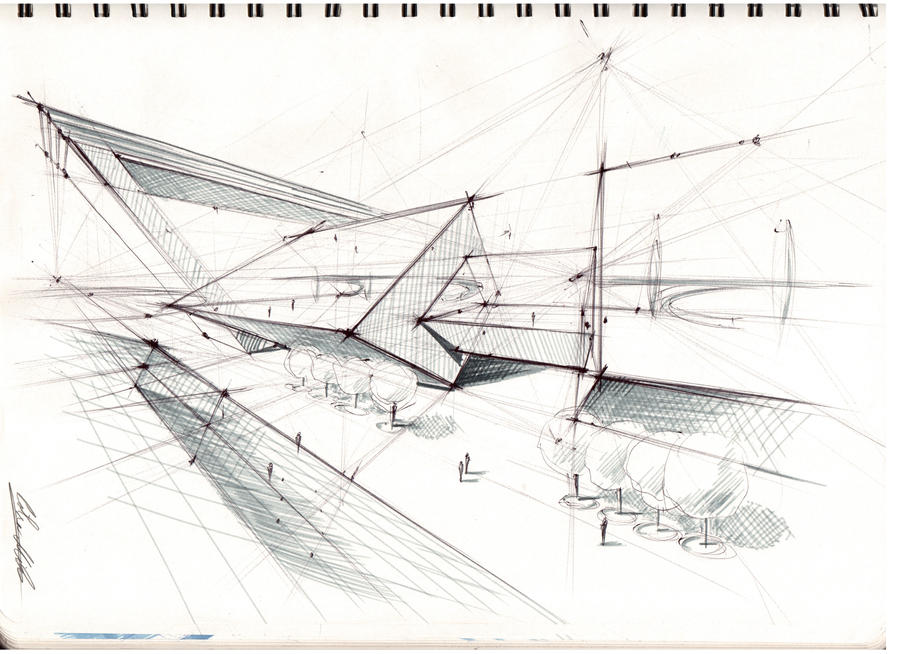
Sample Sketch-work
There seems to be a governing problem in most fields, especially some of the fields previously talked about by other students, that is a scarcity resources. The scarcity of resources present in all professions and in all of our lives manifests itself in architecture through a central conflict I've heard called "form vs. function".

A client comes to a meeting with the team of architects from the firm he contracted with in order to hear and see a design proposal; he likes what he sees a lot, he doesn't understand most of what he sees in the models and sketches and computer renderings, but it all looks really cool. He's excited and ready to get going with construction, then he's reminded of something he understands very well that brings his mind down to reality, numbers and dollar signs. It all depends on the client from that point on and the convincing ability of the architects, the architects would respond by talking about the reputation and purpose of the building and the client and his company, they would refer to the precedent set by architectural works done in the past and what those buildings have inspired in people, it seems like simultaneously the architects would use definition, division, and comparison in order to explain further the need for the designs they've come up with and why the price tag would be worth it.

One of Frank Gehry's sketches of Disney Hall. Due to
this architects reputation, most clients go to him
expecting something grand, so they expect to pay
the price. Unfortunately it's not like that for all Architects.
In the end, the architects' main argument would be how the form would influence the functionality (productivity of employees, appeal to costumers, etc.) in a positive way, thus appealing the main goal of most any company: increased profits. Mostly this appeals to the special topic of invention called deliberative (specifically referring to advantageous/disadvantageous) and also the common topic of cause and effect.

Finished Disney Hall, it's kind of cool to see a thought become
a reality, huh? 

Conflict Issues and Special Topics of Invention in Medicine

A Point of Conflict in Medicine
As mentioned by James in his post, the field of medicine is rife with restrictions, conflict, and moral dilemma.  Difficult decisions have to be made regarding ethics, but oftentimes the cold, seemingly unfeeling conclusion is the only one to be drawn.  Such strenuous situations can incite all manner of negative emotions and feelings—both in the doctor and in the patient. 
Topics of Invention in Medicine
Among the sick and afflicted, certain predicaments present themselves with solutions that are often seen as questionable.  In the case of narcotics, patients must decide firstly whether or not the sacrifice of full consciousness (and possibly morality) is worth the potential healing through the drugs.  Similarly, the doctor is also presented with the issue of right and wrong, and whether or not the risk of overdosing or addiction is too strong in a patient.  A potential instance of this could be:
Sometimes the standard is not enough.  This is where conflict sets in.
            Doctor: "The only way that you can be helped at this point if by the use of narcotics to help alleviate pain, but there is not much else that I can suggest."
            Patient: "No!  I don't want to throw away reality and my own ability to properly think.  Hampering that in any way causes me to shudder.  On top of that, the notion seems to me to be one of direct opposition to my religious beliefs.  It's wrong to me." 
            Doctor: "There is no known cure for your condition at this time, so the only assistance that I can provide is to lessen the severity of it.  Rest assured, I would not prescribe you with anything of lethal or harmful effect, but there is nothing else to be done.  I will not force you, but if you want any relief at all, then this is the only option I can provide." 
            Patient: "You've shown me the facts and I can't argue that this would be the only way as of now.  I want to take this avenue, but it goes against everything that I hold dear to me.  It's the principle!" 
Analysis:
Would these clone troopers be able to provide patients with
proper reassurance as to medical prescriptions and diagnoses?
Or, rather, would they simply force their views upon others?
Would this be right or wrong to do?

The doctor made the distinction between there being legally right and wrong scenarios in order to most remedy the situation, while the patient was trapped in the morality of the two.  Along those same lines of the special topics of invention, there was also the problem of what was advantageous and what was disadvantageous.  Benefits and drawbacks existed on both the judicial and deliberative sides of the spectrum.  In addition, under these circumstances, the common topics of invention of cause and effect, laws, documents, and authorities gain increased potency in their relevance and application.  Clearly laying out a path of logic via these strengthened common topics can be used to persuade an otherwise unwilling patient to make a decision on the use of narcotics in treatment.  

Thursday, October 30, 2014

Conflict Issues and Special Topics of Invention in English Teaching


English Teaching can often be quite stressful!
            Every day of the week, English teachers are constantly in some sort of conflict where they must convince others.  An extremely common point of conflict, or stasis, in English teaching is how to best teach the students.  Disagreements often arise between English teachers and other English teachers or, more likely, between English teachers and administrators on how to best teach and engage the children. 

           
Take this common scenario of conflict.  


Principal Collins, fuming, burst into Mr. Rice’s classroom early last Friday.  In a rage, she demanded to know why he refused to teach Shakespeare’s Romeo and Juliet to his 9th grade class this semester and taught them the more “mature” Othello instead.  “This violates the state and the board’s educational laws and outlines!  There will be a standardized test at the end of this year, and you haven’t taught them the necessary material!” she seethed.  Mr. Rice sighed.  He hated teaching Romeo and Juliet.  The class consistently became much more engaged in Othello than in Romeo and Juliet, and he had looked at the test objectives.  They required perhaps a small summary of the play and nothing more.  Why, he wondered, did he have to teach his class anything but what he wanted to teach them?  They would get everything covered that they needed to cover.  Grammar, essay writing, literature, everything needed would be taught.  Mr. Rice stated slowly, “Ms. Collins, I take great pride in teaching my class and helping them learn and grow in English.  My students’ standardized test results consistently have been 20% higher than the state’s average, and I see no reason to deviate from my proven method no matter how much the state or board changes the requirements or curriculum.”  “Your job is a good reason, Mr. Rice,” Ms. Collins simpered. 


English teachers may not want to teach the
standardized curriculum for their class.
            Here we see a special topic of invention common to public school English teachers.  The idea of the law vs. personal desire occurs quite a bit.  Mr. Rice wants to teach what he wants to teach in English.  However, the state dictates that he teach a certain curriculum to his students.  Mr. Rice might be a better English teacher without the restrictions of the curriculum, but he, by law, must teach a certain way or he will lose his job.  The common topics of invention of law and cause and effect also occur with this special topic.  Law or at least school board doctrine must always be taken into account in Mr. Rice’s teaching.  Furthermore,  Principal  
Collins thinks that if Mr. Rice fails to teach his students the proper curriculum, the students will fail the standardized tests.

Another special topic of invention seen in this scenario is learning vs. curriculum.  Sometimes learning does not occur even with approved curriculum.  Mr. Rice must struggle between teaching approved curriculum and teaching what he feels is best conducive to learning.  Reconciliation can occur with the style he teaches.

Engagement’s relationship to learning is yet an additional special topic.  Mr. Rice thinks that the more engaged a class is in a topic, the more they will learn.  I do not think anyone doubts this fact, but trying to engage students is a classic problem for all teachers everywhere.