Showing posts with label analyzing Electra. Show all posts

Tuesday, September 22, 2015

Not Just How, But Where

First off, I'd like to say that I couldn't stand Electra.  Not the play, the character, and not because of her drama, but because of her attachment to grief and revenge.  I have been severely wronged in my life, but to hold on to that pain and anguish and grief would be to hold on to the past.  And, as seen in the play, once she fulfilled her plan of taking revenge, she had nothing to live for.  I, personally, have chosen to live a life focused on forgiveness, optimism, and making the changed I can make in my life to improve it.  I feel like Electra could take that advice.

Her delivery of her grief was on par, as she was as dramatic as she could have been in her wild and "loud" hand gestures, defensive and indignant body language, and exasperated and offended tone.  The other characters also utilized such mechanisms of speech and performance to present their opinions, emotions, or stories.  As Chandler mentioned, the use of the drums during ominous or suspenseful portions of the script helped set a beat and rhythm for the delivery of lines.  It was a fascinating way to incorporate music to the point of adding effect, but not too much to drown out the spectacular stage skills of these actors and the tragedy being presented.

In addition to how these actors and actresses spoke, wailed, moved, and behaved, I wonder if the visual setting of where the events took place can be included in the canon of delivery.  I found interesting symbolism from the pillars and construction set-ups where the dialogue took place: metal bars as a scaffold to assemble upon, yet pieces of pillars broken and spray-painted strewn across the ground.  The setting of the scenes was in a constant push and pull of building and tearing down, a parallel to the family ties being strengthened or weakened within this family as arguments rage, siblings are reunited, and lethal revenge is taken.  It seems that the director knew the setting would have a rhetorical effect on the delivery of this play and sought to take full advantage of it.

Comical?

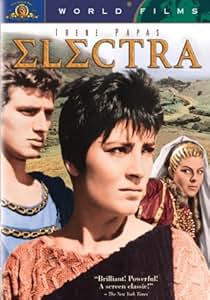
I was about to write about something completely different until I read various posts about the humor in the live performance of Electra. This was definitely not my experience. I watched the MGM film version which was comical in some aspects, but not intentionally.

The movie built up this dark seriousness that pretty much persisted throughout. For instance, even when something 'happy' (like when Orestes came back after succeeding in killing Aegisthus) happened, the music was almost as deary as when Electra and Orestes walk away guiltily at the end. Additionally, the fact that most of the action took place in this isolated village added to the lonely that Electra obviously felt. On top of this, the melodramatic movements and delivery of each line (and pause) built up a certain kind of tension. I have to admit that I literally laughed out loud for much of the movie because of how melodramatic the characters were in every one of their responses. However, I do think that all of this succeeded in showcasing Greek drama and how it strives to stick to a specific plot line and prove a point about humanity (in this case jealousy, rage, betrayal, guilt, etc.). Although, a bit of intentional comic relief wouldn't have hurt.


Also, as Chloe mentioned in her post, in most of the first quarter of the movie, the characters barely speak and then, when there is dialogue, it's in Greek. However, because I've watched a bit of foreign film/television shows, the subtitles didn't bother me too much. I actually think that the fact the the movie was in Greek rather than English added to the ethos of it all. If it had been in English, it would've had a bit of the 1960's The Ten Commandments feel. (It still kind of had that feel.)

Overall, the production was convincing as a Greek drama in the way it was produced. I could feel the tension and pick up on the emotions and themes of each character--even if I was laughing at their every dramatic gaze into the sky.

Killed Out Of Action

I love action scenes. As brutal as it sounds, watching any type of war, fight, or chase scene is entertaining for me. Obviously plays aren't meant to invoke the same adrenaline rush as movies do. However, I felt Electra was completely devoid of everything exciting and thrilling. I noticed that every part of the play that involved some sort of action was left to some sort of narration.

Monologues and dialogue are carefully distributed and intertwined throughout the play. While I felt Electra overreacted as she tirelessly ranted to herself about her dilemma,  I also started to sympathize with her every time her and her mom began to quarrel. I imagine Sophocles intended to instill within us the same dilemma Electra herself felt.

It appears that Sophocles depended more on the narration and delivery of events than the actual visualization of them. Instead of acting out the murder of Clytemnestra, for example, the characters portray the scene through dialogue and emotion. I found myself analyzing the tone, expressions, and words of each character instead of mindlessly watching a dagger come down.


Aegisthus's death is no different. Instead of anticipating a Lord of the Ring's style epic fight scene were the good triumphantly destroys the bad, we witness a short, yet heated exchange, and are left to assume he dies.


By understanding Sophocles' use of narration, we can better understand the dialogue of the play.

Where is OUR focus?

In response to the performance of Electra I have to be honest, I was a little unimpressed. I really enjoyed reading the play because I felt like there was a lot of emotion attached to it. In the play I thought that they made light of something that was supposed to be dark and full and as such I wasn’t really connected to the characters.

But analyzing whether or not this play is a tragedy is much more interesting that my opinion of the performance. Looking at the requirements that Aristotle put forth as requirements for a tragedy, it is clear to see that Electra does not completely line up. Among other requirements, the greatest one Aristotle put forth is that the character must have a tragic flaw and some sort of downfall that instills pity and fear into the audience. The reason why is because of a resolution effect that happens with the audience when the pity and fear are felt.
My argument is that Electra, as it is presented, is not a tragedy, but could very well become one if you change the perspective you are looking through. The play, as it is written, compels you to look at the situation through the eyes of Electra. This being the case, we may see flaws in Electra but they are not tragic because there is no downfall to accompany those flaws. In reality, Electra gets everything she wants.


But it is obvious that quite a few people in this class have already made this argument. Therefore I am going to extend my argument to this: This play COULD be identified as a tragedy. If we were to shift our focus and look through the eyes of Clytemnestra or Aegisthus you would see that their tragic flaws were lust and pride. That their downfall was the rebellion of their children and their own death. If this were the case it would make much more sense to classify this as a tragedy. 

The Art of Delivery

Though I admittedly do not attend plays as often as I should, I was not blind to the extraordinary talent that was demonstrated by the Westminster Theatre Department last night.  The lengths of some monologues, especially Electra’s, were impressive to say the least.

What stood out to me the most was the delivery of the script. During scenes like the false report of Orestes' death, and Electra’s grieving for her father and brother, the actors skillfully placed emphasis on special words by changing the pitch and volume. Sometimes there was a pause before a word and other times a word was especially stretched out.  In a rough sense of the word, it almost felt like the actors were singing. Often I would close my eyes—not to sleep, I swear—and would listen to the flux and tone of every sentence. It was beautiful. I cannot recall monologues verbatim but I often sensed a rolling pattern of melody, melody, melody, EMPHASIS, and so on.

In delivering a speech, an emphasis in the right place can completely change the view of a story.  As a Communications major myself, I have often been taught in my classes of the “art” of delivery when a news reporter or anchor speaks. Next time you listen to the news, play close attention to which words are stressed. A story can take any turn based on the words stressed.

Often in written word, we become locked into how words look on a page. However one of the beauties that we receive from the spoken word is the flexibility possible in delivery. More than actions and facial expressions, vocal emphasis helped me (the audience) listen and make sense of the narrative.  In Electra, the “music” of tone and the literal live music helped evoke the heights and depths of emotion within the Greek Tragedy.


Justice and Mercy: If Electra knew Jesus

I thought that Electra was an excellent window into Greek culture. It's interesting that the ostensible "hero", though obviously flawed, was obsessed with justice. This is a theme that we see also in The Iliad, both in the reading we did in our class and in other areas of the book. Greeks seem to be obsessed with justice and being treated fairly, though I would say that their poets saw how this societal trend could lead to hubris and destruction. I'd like to compare this, however, to our ideas of Justice and Mercy in an LDS context, as opposed to the Christ-less concept of Sophocles' culture.


For us, any time that we think of justice in a moralistic sense, we must view it in relation to mercy and the Atonement of Christ. For Electra, her inner sense of justice demanded that a vile murderer, her mother, must suffer as she had caused another to suffer. This drive seemed to be her main motivation in the play. An interesting twist at the end though, her tears over her mother's death, showed how her inner need for mercy was pulling against that drive, tearing her apart. It highlights so much the need for a Redeemer. The Savior already payed for her mother's sin! He already stood in her place and payed the price! (Or, I suppose, the Savior WILL, from the time frame of the play.) He payed, and forgiveness was secured, so we can forgive, knowing that justice is payed both for us and for others, and we don't have to suffer the terrible moral dilemma that Electra faced.

All Ears

When I started listening to the BBC radio version of the play, I kind of thought I was in one of those old black-and-white pictures, where the family’s gathered around their radio, captivated by stories about cowboys and spacemen. Everyone in the pictures looks completely engaged, as if nothing else could distract them; they seem to understand that listening requires undivided attention. The families in the photos’ intentness isn’t exaggerated; I found myself doing the same things even though I was wearing headphones.

Entertaining?
Besides sound effects, all the actors had to tell the story was their voices, so as I listened the qualities of their voices and production techniques became more and more apparent. At the beginning of the play, when Electra is complaining about her predicament, the actor had to exaggerate her delivery. I originally thought Electra was overblowing her circumstances, and that her voice was too whiny, but I had nothing else to reference. Electra’s voice and my imagination were all I had to gauge her emotions. Once I grasped this fact I began to connect more with the play and it held much more appeal.


I also began to notice how certain production techniques mirrored the actors’ emotions. When the actors sounded far away and then came nearer, like when the Chorus chided Electra either to action or inaction, it gave the effect of Electra’s troubled psyche becoming increasingly louder, moving from the background to the foreground of her consciousness. In the same vein, when Electra and Chrysothemis argue about killing their mother, the actors’ voices fading signified the fading of the argument; coming closer (and becoming louder) meant someone was making a point. The actors sounding far away also gave the effect of their physical distance from the other actors and the microphone. These techniques aided in creating a physical space for the listener’s imagination, engaging and rewarding their intent focus.

Orestes Grew Up?

While reading Sophocles' Electra I imagined Orestes as a large, mature, courageous man who carried confidence and power in every step. My mind created an image of this crucial character through the ethos and pathos his words solicited. We all have experienced this while reading a book: when you read Harry Potter you imagined Hagrid as a large, rough-looking yet kindhearted giant. When the movies came out, we were not disappointed.


When the play began Monday night, imagine my surprise when the actor portraying Orestes was young man who (in my opinion) did not project his voice appropriately to convey the power his character ought to have possessed. Compared to the actress playing Electra, Orestes left something to be desired. Yes, he was funny and witty, but he seemed to lack the authority I was expecting. The main reason for this discrepancy between my expectations and experience was due to an issue in delivery.

The way Orestes presented himself and his task at the start of the story created in my mind an image of a strong and powerful man. The god Phoebus told him he would go "alone, and by stealth, without aid of arms or numbers, [to] snatch the righteous vengeance of [his] hand". I pictured a man empowered by prophecy, one who has been patiently waiting his chance to avenge the blood of his household. My expectation was not met as the actor in my mind came off "too" humorous, too nonchalant, too silly. His delivery also seemed to lack passion, when pitted against the performance of Electra. This could be attributed to my personal preference, the acting experience of the two actors, my position in the audience, etc.


The point I'm trying to make is that delivery can make or break a play. I don't want to sound too harsh; I enjoyed the play and it was a fun and enriching experience. However, I also feel it important to stress that these performances were written just for that purpose: to be performed, either in oral tradition or in the theater. I would be interested to hear how the expectations of those who viewed the play compare with mine, or even those who listen to the radio version/watched the black and white video.


Was It Really That Tragic?

One day later, I am still bewildered by the play Electra.  I’m currently taking my first theatre class and so I naturally began to notice different aspects of the drama (though I’m no expert).  While the play as a whole was done well, the ending left me saying “What?!” to myself.  The final line was a comedic punch line.  Can we not handle grief?  If something is sad, let it be sad.  I was all the more befuddled by the Greek dance that came out of nowhere.  The play was entirely commendable, but certainly had me confused because of the ending.

Now, I’m not supposed to give a huge theatre summary.  Changing the subject, I was also intrigued by a discrepancy in the text we read and the play.  As shown in the play, Electra weeps over the death of her mother.  In the text, I don’t remember that happening.  This is important because it helps decide if Electra is a Greek tragedy according to Aristotle’s rubric.  I would argue that, at least based on the text, it is not a tragedy because, while the play if full of death and betrayal, Electra does achieve her ultimate objective of revenge and no downfall seems to come.  If, as in the play, she does lament the death of her mother, then the play is a tragedy be
cause she realizes her folly too late to bring her mother back. 


Finally, to end on pathos, Electra’s emotional appeals don’t seem to change much.  While she does oscillate between persuading and mourning, her theatric “beat” doesn’t change.  She uses the same tactics over and over.  I think that it was supposed to be that way in Greek theatre.  Electra embodies the emotional, while other characters embody logos, ethos, or all three combined.  

Words Sure Can Carry a Show

I was unable to view the live performance of the play, due to some unforeseen circumstances. However, I had the distinct pleasure of sitting in my room and listening to some actors I couldn't see narrate out the script to the play that I hadn't seen.

The effect was astonishing. In the past, when viewing plays, I found it so simple to be distracted by the outlandish costumes and colorful gestures. This time, contrary to what I was expecting, solely listening to the script actually allowed me to more easily delve into the meaning and truth of the play. I found I could more easily latch on to the words that they were saying, as well as the tone of their voices.

Similar to reading a book, it allowed me to create the characters and the setting in a way with which I could connect. I didn't have to fight with the limitations of the stage. My mind was free to interpret Sophocles however I wanted to.
You know the play. Fill in the picture for yourself.

It is a hard thing to describe. It didn't have anything tangible that the play or film lacked. But I feel like I got something out of it that I wouldn't have otherwise.
Ethos vs Logos, Electra vs Chrysothemis


Throughout Electra you can see that there are several strong arguments being made. Electra although perhaps justified in her hatred is only apt to see her own point of view while missing the option to add a counter argument by perhaps looking at what her sister Chrysothemis or her mother have to say. Her only persuasion is her strong use of an emotional appeal (Pathos).

Delivery aides in her pathological appeal. Throughout the play she is wailing and swinging her arms around and using many facial and physical gestures to make her point. This process works, everyone and I mean everyone within ear shot knows her point of view and the reasons backing it up.

Her sister on the other had uses delivery in another way. She is calm and collected and as mentioned by Katlynn Dalton, this makes Electra’s ideas seem a little far-fetched. Chrysothemis uses a logical appeal (logos). Personally I think this appeal is more alluring because her views aren’t tainted by immense hatred. Electra would have done well to listen to her sister if only to make a logical counterargument to convince the audience that she has more reason to kill her mother then her intense undying anger.


When her mother is finally killed delivery is utilized to help the narration of the play draw in the audience. The most intense moment of the play is narrated. The moment when Orestes and Electra go into the house to kill their mother. At first I thought this strange but then I realized that it allowed for the audience to imagine the event rather than try and act it out. In the end I thought this was a great way to utilize the imagination. The delivery of the narration was really what made this moment great. The chorus’s actions and the anticipation in their voice as they asked what was happening within the house created a shock factor. The delivery was vital to a good narration. Without a well-acted delivery this scene would have been boring. That is the power of acting.


All in all Electra uses an excessive amount of pathos and Chrysothemis uses mostly a logical appeal. Both have different delivery styles which add or detract from their arguments. Delivery also adds to rest of the performance enhancing it greatly. 

https://encrypted-tbn0.gstatic.com/images?q=tbn:ANd9GcSKv1i5PxH_1mbj0V_HZhcuJtdvRkBgEjNd8NyYFQUdUQUrpLWx
https://encrypted-tbn2.gstatic.com/images?q=tbn:ANd9GcQSYdUANyWS06akoAEGSK31nll2LZpYNo1l8VICkk8gfUY7AsM0mg

The Tragedy of the Tragedy


            I hate Greek drama.  It is dark, pessimistic, and focuses on the worst pieces of humankind without offering hope that they can be resolved.  That being said, attending the performance of Electra helped me grasp and appreciate more fully Sophocles' great skill as a writer.  Like Kapri Beus, I realized that Electra represented pathos and Clytemnestra, logos.  They always disagreed because arguments that they employed and responded to were fundamentally different from each other.  Orestes represented ethos.  Everything he did, he did simply because of who he was, the son of Agamemnon.  Because of the appeals they represented, I disagreed with the delivery of both Electra and Clytemnestra.  Electra was ironically portrayed as the more down-to-earth sister while Clytemnestra was a bit more whimsical.  When reading the play, I pictured them  more on an equal footing, which sent a completely different message.

            I also found it interesting that each of the children of Agamemnon mirrored the branches of oratory:  Electra was immersed in the past and made judicial claims about her mother's injustice, Clytemnestra was focused on the needs of the present and her epideictic blame of Electra for deliberately running afoul of Aegisthus and Chrysothemes, and Orestes deliberated about the advantageousness of his plans to fake his own death.


            While the tragedy of a brother and sister who murder their mother and stepfather and, through their act of vengeance, become them, was too dark for my taste, I can't think of a better representation of what we have learned so far in this class.  Sophocles truly had remarkable talent.  However, referring specifically to the arts, President Packer once employed the following quote, "There are many who struggle and climb and finally reach the top of the ladder, only to find that it is leaning against the wrong wall."  In that spirit, I wish that Sophocles had used his impressive talent to bring people closer to life, truth, and happiness instead of portraying the darkness and depravity of some people's lives.  May we learn from his mistake that his tragedy may not become ours.

"Leptis Theater," no changes made, by David Stanley, "https://creativecommons.org/licenses/by/2.0/legalcode"

Palms are Sweaty, Mom is Spaghetti

Perhaps, in its heyday, Electra was viewed as a by-the-book tragedy. Certainly, all the elements are visible: our main character is faced with both an external problem and an internal flaw,  and the interplay of the two leads to their fall or demise. However, the play falls short of the definition in one crucial way. The audience is supposed to feel a connection with the character and their flaw. If a tragedy is moving in the way it's supposed to be, we find ourselves sympathizing for the main character, rooting them on in spite of the knowledge we have of their faults. Electra lacks that connection.

The culprit for this disconnect may be an intense generation gap. Our distant brethren, the Greeks, although "moral", assigned that morality to issues in a fundamentally different way than we do today. Of course, some traits carry over. The mother's haughtiness and frank refusal to admit her own guilt leaves an aftertaste of congealed spaghetti.

Yum. 


  Since we are strongly encouraged to forgive, however, it is also hard to sympathize with the bitter Electra. In fact, we almost unconsciously start to dislike the "hero", and the viewer quickly realizes that there are no truly good characters in this play, only less bad ones. Her rants and refusal to admit even the tiniest amount of merit to her mother's actions help to shape Electra into the very thing she tried, and succeeded, in destroying.


The unexpected part of the play is that everything goes right. The bad people die, Electra is reunited with the only member of her family that means anything to her, and they live happily ever after. However, the real tragedy, the kind that lies outside the borders of the traditional definition, is internal. To paraphrase Hugh Nibley, "The tragedy of [the play] is not what became of [Electra] but what [Electra became]."

"Putting His Name (Ideas) in Lights"

Ancient Greece is a country that is heavily studied.  Whether for its architecture, art, government, mythology or science, it is a civilization that continues to influence the contemporary world.  I would argue, however, that no such aspect of this society has had a stronger impact than its philosophy.  The famous Greek philosophers were on a constant quest for reason and inquiry.  Their ideas stood as great pillars in society and have also penetrated our culture (learn more).

Sophocles once stated, “Wisdom outweighs any wealth.”  With that being said, it’s fitting that the recent performance of Electra was focused less on visual appeal and more on Sophocles’ script.  In the world of theater production today, it seems that the motto is, the more extravagant, the better.  Performances are strewn with elaborate, constantly changing sets, striking visual effects, entertaining musical numbers (accompanied by world class musicians, singers, and performers), and costumes that often transform the actors into the creatures from fictional tales.  These are the visual aspects that our society demands of the entertainment business.  


Though there was some sense of visual artistry in Ancient Greece, by breaking Electra down to its most simplistic form, this company was able to honor the stylistic elements of the play’s original portrayals. But, more importantly, they better emphasized Sophocles’ themes and ideas.  Throughout this piece, Sophocles explores universal themes, such as the value of justice versus expediency, revenge, and family conflict.  These ideas were expressed explicitly through the dialog and emotional performances of the actors.  The set was basic and stationary.  The only musical accompaniment was the occasional beating of a drum.  Nothing extra was required of the company than to masterfully give their lines.  The wisdom of Sophocles outshone the glam of the industry.

Multiple Perspectives

As the lecturer mentioned before the play, Sophocles seemed to have an affinity for dialogue. While the play was full of lengthy, dramatic monologues, these were broken up by snappy, often argumentative periods of back and forth rhetoric. 
There were numerous arguments over the course of the play, mainly focusing on Electra's hatred of her mother for killing her father, and her desires for her brother to come and avenge the travesty. It was these arguments and moral questioning that filled the body of the play. In the words of Dylan P, "the narrative stole the show". The powerful narrative, which was made even more effective by the physical actions and reactions of the actors, made for some very convincing arguments. While I of course most often sided with Electra (as the heroine), I found myself sometimes being pulled to see opposing point of views, particularly those of  Clytemnsestra and Chrysothemis.

Chrysothemis (Electra's sister) has good intentions, and when Electra was whining and dramatically waving her arms around, Chrysothemis' arguments seemed that much more well thought out. Even though Chrysothemis was clearly acting out of self interest, I couldn't help but agree when the Chorus told the sisters that perhaps they would be better off if they would listen to each other. As total contraries in how they chose to handle the situation, it was easy to see how they could balance each other out.

Electra, however, adds ethos to her argument with her constant prayers to the gods-- appeals to the supernatural. If her perpetual mourning pleases the gods, then how could she possibly just "submit to authority" as Chrysothemis suggests?

Finally, Clytemnestra, Electra's mother, makes some convincing arguments towards her side of the story. After, all, if Agamemnon sacrificed their daughter, it was only natural that she should feel some bitterness towards him. Alysha D elaborates on this in her post. This is an easy to see example of the topic of invention "cause and effect".

Can't live with them...

When Electra and her mother were bickering back and forth, I couldn't help but think about how my mother and I are similar to them. Fortunately my mother and I don't fight about anything as serious as death, but we believe so firmly in our arguments that they can sometimes be drawn out for days... Yet my mother usually wins being the one with the authority in the situation. Like my mother and I, both Electra and Clytemnestra were very powerful rhetorical speakers and had very well thought out arguments, but all the rhetoric in the world couldn't change either of their minds.


Electra is a character that clung to justice and the great mourning for her father eventually turned to hostility when she discovered Orestes was dead (at least we thought). Clytemnestra tried to cover the haunting feeling of murdering her husband Agamemnon with her great wealth and rank, but in the end it wasn't as powerful as Electra's motivations. Electra states from the get go that she will never give up on justice until it is served, and most of the play is spent with her trying to judicially convince other characters, with a thick layer of pathos, how horrible her mother is and to join her side; But with her mother being in such high power she wasn't a match for Clytemnestra or her step-father Aegisthus.


 Even though her mother was the Queen and thought she could get away with whatever she wanted because she was in a position of authority, Electra eventually won the fight. What was most interesting to me was how Electra threw herself over her mother's body at the end of the play, which proved to me even though her motives seemed justifiable, she realized that getting rid of her mother would never really satisfy the real issues she deals with internally. This further proves to me that revenge will never be the answer.

Two Complete Opposites

First off, that was not what I was expecting.  I actually laughed- and not even just a pity laugh. It was incredible how not only Sophocles, but the actors and actresses were able to lighten up an incredibly dark story.  I will admit, I enjoyed myself.  I especially was intrigued by the relationship between Chrysothemis and Electra.

Family relationships was a huge theme throughout the play.  Many I couldn’t connect with, but I felt a bond with the two sisters.  Electra and Chrysothemis were both affected by the same experience, yet were polar opposites in the way they decided to let it affect and guide their lives.  Each is trying to convince the other that they are handling the situation the wrong way.  At first, I thought Chrysothemis was very shallow and more like an evil step sister.  I realized, however, that she just takes a logos approach to the events that have happened, recognizing that unrelenting mourning will not bring about anything good.  Who’s to say hers wasn’t a better way?


Electra takes a pathos route to the situation; she feels like Chrysothemis is living a lie by acting as if nothing happened.  One of my favorite scenes was the conversation/argument between Chrysothemis and Electra.  A powerful statement by Chrysothemis explains a lot about their relationship, “It’s clear you could never bring yourself to praise my words, nor I your ways”. 


Although I do not have any siblings with this relationship, I do have some friends who just do not understand my words, and I do not understand their ways.  We both feel the other is not living the best way, and may at times argue- but when it comes down to it, I really do love them.  We see this type of relationship often in movies and in families.  Sophocles was a genius in connecting his audience then and now in being able to relate- as well as helping us to realize that our way is not the only way, nor necessarily the best.  We have to look over and accept differences in order to unite.  

Electra - An Emotional Rollercoaster

As with all plays, Electra really uses pathos to convey a message to the audience. From the beginning, we know (even if you didn't read the synopsis of the play beforehand) that Clytemnestra is the antagonist, as well as her husband, Aegisthus, and that Electra is the protagonist. I think that the delivery of these actors portrays their role in the play from the beginning. Electra's passion about her father's death seems so real. She is using gestures, wandering around the stage, and even yells at times to convey her passion and agony to the audience. Then, the big reveal is made that it is her very own mother who is responsible for the death of her father. The audience can't help but feel bad for her! 

I also think it is the case when Clytemnestra makes her first appearance. The way she talks, even seems cold, especially towards Electra, with whom we have already made an emotional connection. That automatically makes her seem like the bad guy, in our eyes.  There is one time, however, when I did succumb to an emotional appeal of Clytemnestra. That was when Clytemnestra was orating her soliloquy, and reveals her motive behind wanting her husband dead. He sacrificed his own daughter, Iphigenia. I thought Clytemnestra successfully swayed the audience, at least for a mere moment, to feel sorrow for her as well. However, that quickly changes when Electra comes back to reveal the circumstances in which it was necessary to sacrifice her in order for them to go on to win the battle of Troy. 

All in all, the entire play is filled with emotional appeals, from when Orestes is pronounced dead to Clytemnestra and Electra, to when Orestes reveals himself as alive and well, and willing to help avenge his father's death. I also thought the actors successfully used pathos to sway the audience when Aegisthus finds his wife's corpse, it made me feel bad for him, but also feel happy for Electra and Orestes for getting the revenge they so desperately wanted.

I think pathos is the most important appeal in theater. It helps the audience understand who is important, as well as who is bad and good. It also helps the audience to make a connection with the characters, that keeps them interested in the play in its entirety. 

Is it Tragic? Or Just Sad?

Upon first reading through the text of the play, I found myself thoroughly engrossed in the lives of these fictional characters: They had me clinging to each ornate phrase, urging me forward to the resolution... Until there was none.  I sat and stared at the end of the text with so many questions: What becomes of Chrysothemus?  Does the Tutor tell Orestes how much his mother loved him?  What happens to Electra now that her sole purpose of existence has come to pass? WHERE IS MY KATHARSIS?

...Frankly, I was quite irritated with Sophocles' apparent break from Aristotle's formulae for Greek Tragedy, and I found myself wondering how I would feel at the end of the actual play.

So there I was- the theatre dark, Aegisthus' having bade his penultimate farewells, the chorus' final words lingering on the air- when the play didn't end. Bewildered by this turn of events, with the anxiety creeping further into my stomach, I sat bolt upright in my seat, carefully studying the actions of the only character left still in motion: Electra.

She glided slowly to her mother's corpse, kneeling beside her with what began as smirk of victory, but steadily gave way to grimace of grief...  All at once, she threw her arms over the body, sobs racking her own as her estranged-sister, Chrysothemus, gingerly slid to her side.

...Woah.  Ending where it did, the text of the play provided no realization of the horrors of Electra's fatal flaws: Yet there, on stage, I watched as Electra seemed to recall (and, this time, take heed of) the words of ill-fated Clytemnestra: "A mother may be wronged, but she never learns to hate her child."

With one silent scene, these actors turned Sophocles' Drama into Aristotle's tragedy. Electra realized she had always been the thing she hated, had always loved the thing she'd been, and perhaps never truly hated the thing she now knew she loved: Her mother.  Electra knows Clytemnestra was not the only soul lost in her quest for "justice."

Monday, September 21, 2015

Film vs. Play

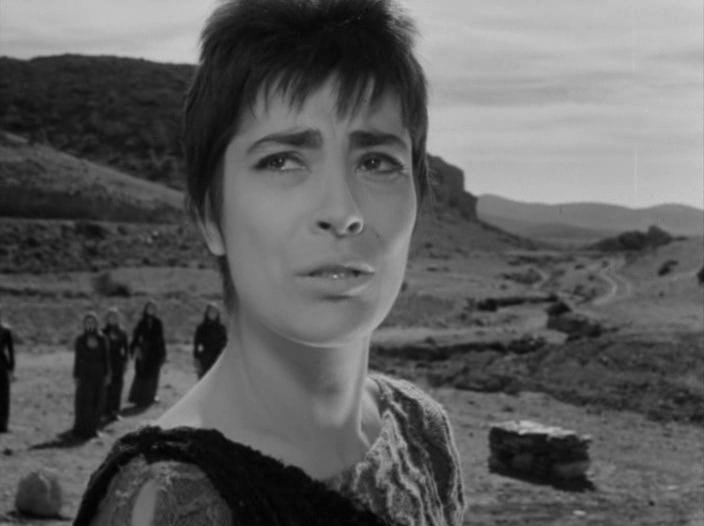
There is a difference when viewing a movie as opposed to a play. I have attended plays in the past, and noticed that when watching it, I am viewing the whole scene there on the stage, rather than a small screen shot in a movie. In the 1962 film Electra, the filmmakers would zero in on certain scenes, ones that they would want to emphasize, or make more dramatic. For example, when Queen Clytermnestra confesses that she killed her husband, the camera zeros in on her face to emphasize that certain part. I believe that this technique is a way of making the viewers respond in a more dramatic way.

When books are turned into movies, the filmmakers choose to leave characters or plot aspects out of the movie because of length, or for other reasons. In this particular production, Electra's sister Chrysothemis is non-existent. She gave us a relieving feeling in the text, like a retreat from the sadness that was already there. But in the film, since she is not there, the feel is more melancholy, and overall, just sad. I believe the setting of the film makes up for this melancholy feel, or at least brings it down a notch. It is set in the country, where Electra is banished, forced to live a country life. For me, the country is calming, so as I was watching the film, it was calming in a sense to see the countryside while these murder plots and negative feelings were present.


Another aspect that I noticed in the film was the music. Music definitely makes a great effect on the audience, especially in movies. Whenever a dramatic scene happens, there is dramatic music. For example, when Orestes and Electra were in the country house killing their mother, horrible, dramatic music was playing in the background. The chorus was outside the house wailing, adding to that dramatic effect.