Short Essay:
While one would like to believe that the most convincing word can be the word of faith and truth from that speaker of religious devotion, history suggests that maybe that isn't so realistic. Over the conflict between what we would like to hear and what we need to hear, what is spoken the prettiest is often the one that we cling to.
In Alma 30, the scriptures introduce a man named Korihor. This man, exercising his adept skill with words, leads away the hearts of a good portion of the people. But when he attempted to spread his teaching to the people of Ammon, he was kicked out of their country, because they saw that his words weren't of God. Two different groups of people were affected in two different ways by his deceitful words: the ones that heard what they liked to hear and the ones that were listening for what they needed to hear.
Nietzsche, speaking of contemporary society, stated that "God is dead. God remains dead. And we killed him." This doesn't that God died, in a literal sense. It means that people had rejected God as a credible source for moral principles. We as a people have rejected the words that we needed to hear, the Sunday sermons that so many people gave up long ago, to hear the words that we wanted to hear, the words that told us we could do what we want and live like we wanted.
Surrounded by other people who do not believe in a God, it becomes difficult to hear what we need to hear. Often, the words of faith and truth are drowned out by the words that are beautiful. Don't misunderstand. I don't mean to say that the words of faith and truth aren't beautiful. We just need to be like the people of Ammon and wade through the rhetoric to get to the religion that we need.
Short Rhetorical Analysis:
Despite my seeming condemnation of the wily use of rhetoric in the essay above, there are many benevolent uses of persuasion as well. Jacob, in Jacob 2-3, gives a speech attempting to persuade his people to depart from their corrupted ways and return to the fold of God. However, he employs some sage methods of achieving this end, since the truth isn't always as easy to believe as the lie we want to hear.
Upon reading only the first few verses, it was simple to see an excellent application of the idea of ethos. While Jacob is speaking somewhat bluntly to his people about their errors, he also persistently refers to them as his "beloved brethren." This helps establish some grounds upon which he can understand them to the point of being free to chastise them, as he is one of them. The reader can also tell that Jacob takes close note of audience, as his words were spoken in the most effective way they could have been to this group of people. He was stark and honest, and because of that his words pierced cleanly and deeply into the hearts of the people he spoke to. However, maybe that approach wouldn't have been the wisest had he been talking to a different group of people, one that didn't have as serious of sins or one that didn't have the same religious background.
Reading more closely into the text, one can see that throughout his speak he refers to the message from God that he is delivering to them. This is an example of the topic of invention, The Supernatural. Of course, he is truly delivering a message from God. However, by calling upon the name of God to support his testimony, regardless of whether or not God truly supported him, the reverence that the concept inspires is more than enough to instill consideration into the audience. He employs the figure of speech metaphor towards the conclusion of his speech, comparing the sins of the people and their fate to the "lake of fire and brimstone."
While Jacob knew that the truth was the only power that could save these people from themselves, he needed to convince them of that before any change could happen. That is why he was wise in how he communicated his message to a group of people in need.
Showing posts with label posted by Benjamin C. Show all posts
Showing posts with label posted by Benjamin C. Show all posts
Tuesday, December 15, 2015

Wednesday, December 9, 2015
Computers - Watch what You Say
Most people don't
understand technology in the slightest. Aside from the current
culture of being well-versed in the use of Twitter, Snapchat,
Instagram, and Facebook, nobody really understands the depth of the
information being transferred around inside their cellphone or on
their laptop. And nobody fancies knowing that information, either.
A few years ago,
there was a large scare kicked up because people discovered that the
NSA was spying on us through our computers. Social media became
flooded with outraged, new-found political activists who were
infuriated that the government could spy on them without any warrant.
“This must be a violation of my First Amendment rights.” It
seemed as though people were about ready to light torches, pick up
their pitchforks, and head right down to the White House to clear up
the little misunderstanding. Then, as suddenly as the pitchforks had grown
out of nowhere, they vanished in a thin cloud of smoke.
The angry mob was
right, for the most part. According to precedent set by the Supreme Court many years ago, the government is restrained from most
intrusions upon our privacy, with the exception of suspected
criminals under the protection of a warrant. Although there appear to
be laws that protect our use of the Internet from organizations and
individuals that seek to do us harm, we need to be constantly
vigilant in order to protect ourselves because no law can save us
from our own hazardous tendencies.
The problem was
Historically,
there's very little precedence by which one would judge future
actions. Never in history have people had access to such an infinite
wealth of knowledge and information that is instantly accessible and
carried around in everyone's pocket. Back in ancient times, life was
different. Money was a physical item that was kept in banks.
People's discussions of private matters were done in private
locations. Shopping was done in a store. Now, money is virtual
concept, private matters take place on virtual, public sites, and
shopping is done from six different virtual stores from China,
Russia, and Canada. Any and all information that exists can be
accessed from the Internet.
The problem is
The amount of
information that exchanges hand over the Internet everyday is vast.
Incomprehensibly, unmeasurably vast. “Number of stars in the sky”
or “Amount of sand at the beach” vast. And although the
government has been prohibited from watching cat videos over your
shoulder, your privacy isn't ironclad. Individuals that are
well-versed in exploiting inexperience with the Internet are more
than capable of doing what the NSA has been told to not do anymore.
These people, “hackers” if you will, are relatively safe. The
same laws that everybody was pointing at back during the privacy
scare have created a number of blind spots in which these hackers can
take cover.
The solution will
be
 This piece is not
going to claim that there should be some laws put into place that
protect us from malicious persons or organizations on the Internet.
The government is hopelessly powerless to save you. Even if they had
the authority to pursue them, finding and putting an end to illicit
activity over the Internet would be like trying to find a needle in a
stack of needles. Law cannot save your Christmas photos this time.
Next, there are
companies that claim to be able to create coding that reinforces and
protects your computer and your information from phishing, from DDos
attacks, and from almost all different types of malicious software.
But there's little substance to most of this. The nature of this
technology allows it to be infiltrated and manipulated, and there is
so little that anyone can do to protect information that you put
online.
What I do not want
you to take from all of this is that you should create a bunker of
solid steel and hide in there for the rest of your life, feeding off
of Ritz crackers and EZ cheese. True, it is impossible to stop
someone from stealing information that you've posted to the Internet.
So, be careful. Don't post stupid stuff to the Internet. People are
far too comfortable and too trusting in what they allow others to see
about their lives, because they feel like they have control over what
is posted. But honestly, once someone posts something to the
Internet, they don't own it anymore. Fame is fleeting, but the
Internet is forever.
Tuesday, December 1, 2015
Annotated Working Draft of Final Project and Hot Spots in Computational Linguistics
1. Communication and Persuasion in Software Design
The entirety of my field is focused on communication, between two people or between a person and Siri, and yet much of it lacks apparent persuasion. However, the field changes constantly, and Siri's ability to comprehend nuance is improving daily.
2. Storytelling in Software Design
Storytelling in my field equates to being able to identify and analyze issues, create solutions, and then convey this to those in power to make a difference. This requires both the ability to express such issues and to comprehend others expressing similar issues.
3. The Brief and Bold History of Software Design
People have been desperately struggling to get others to understand them since the beginning of time. Now, we are attempting to create coding that can understand us as well.
4. Institutional Authority and Communication in Software Design
The Association for Computational Linguistics runs most of the show. It was designed in order to help many separate research threads compile and assimilate their research, so as to increase overall knowledge and understanding in the field.
Super Sizzlin' Spots
1. (Field) Computational Linguistics has to do with the literal and minute details of communication between man and tech. The many aspects of language that we disregard as elementary are, in fact, the most difficult to reproduce and analyze.
2. (Personal) There is no computer program or software in existence that is able to comprehend human speech like you and I do and it is very likely there never will be. The means by which robots understand us is so foreign, it is difficult to grasp. This distinction is easily one of the most fascinating I have ever come across.
3. (Historical) The history of the field is brief and volatile. Research is constantly being done and technological breakthroughs occur one, maybe twice a week.
To clarify, Computational Linguistics is what my field narrows into. I assumed that doing simply "Software Design" would simplify this process. Oh, how wrong I was. I would like to specify more precisely what I will be discussing.
Tuesday, November 17, 2015
Biblical Eloquence in Joshua 24:15
The full scripture reads:
15 And if it seem evil unto you to serve the Lord, choose you this day whom ye will serve; whether the gods which your fathers served that were on the other side of the flood, or the gods of the Amorites, in whose land ye dwell: but as for me and my house, we will serve the Lord.
This is the foundation upon which my parents wanted their children to be built.

Metalepsis: One of the constructs used in this verse is the phrase "my house." Initially, I took it to mean that his family will also serve the Lord. However, by substituting this idea with a physical object that embodies a family, he conveyed another message as well. Like my parents, Joshua intended to say more than that he would teach his children the gospel; he meant to say that the gospel would be the foundation upon which his children would be built.
Tuesday, November 3, 2015
Can't Arrest Me if They Can't Catch Me
First Version - "My adventure with the Po-Po"
Audience and Setting: This is the version of the story I tell you solely hoping that I can somehow convince you of how awesome I am.
My friends and I are avid fans of a certain game that we know as "Fugitive." For those of you that don't know what this is, too bad - I don't have all that many words to tell this story. What's important to know is that this game required us to be out and about into the late hours of the night, and was best played without any"geographical inhibitions"...meaning we often went though strangers' yards.
One late night, I was playing with a group of twenty to thirty people. This night, unknown to me, the police had been called out, probably because of some trespassing reports or something else ridiculous.
At roughly the same time, I was being chased by my older brother. In our escapade, we had traveled about a half a mile through a forest, across a playground, and a number of people's yards before I managed to take refuge on someone's house without him seeing.
In preparation for this exhausting game, I had ingested a lot of liquid. Like, a LOT of liquid. And now it was all coming back to hit me at possibly the worst time ever in the history of human existence. With my brother at the base of the house searching for me and nowhere else to hide, I was out of choices and I peed off the roof of the house into some sand below.
Luckily, this all went down while the two police that had been dispatched to check out the high school observed from across the street. Once lights started flashing, nothing else mattered. My brother and I got out of there like we had just been caught at the scene of a murder. We ran for what seemed like a mile, jumped off of a bridge, and ran through a foreclosed house before we felt like we had safely escaped them.
Did I learn my lesson? No. It was actually somewhat exhilarating to be chased by the law. In fact, we were almost arrested two or three weeks later for trespassing at the high school while playing the same game. But we were never caught, so did we actually do anything wrong?
Second Version - A Safe Night of Harmless Fun
Audience and Setting: This is the version of the story I tell you hoping that you don't think me any less awesome while seeing the story from a different setting.
"What you didn't know couldn't hurt you, mum.[maxim or proverb]"
My mother clearly disagreed. Apparently, my younger brother had unwittingly let slip a brief account about the misadventures of my youth around the dinner table.
"You could have been arrested! You could have been expelled! You could have been shot at, for goodness sake![anaphora] I want to hear the whole story, and I want to hear it now."
All of these were true. Running from the police is rarely a good idea. But I wasn't going to admit that to her. I could just come up with a good lie with my brothers and we would be home free. And, as hesitant as I was to tell the story, the event had long since passed and it was too late to punish me for it.
"Alright, here's how it happened. Back in high school when Daniel and I used to play Fugitive a lot with our friends, we sometimes saw the police hanging around[litotes]. One night in particular, we were somewhere we shouldn't have been and the police chased us. We didn't want to have to deal with them, so we just didn't let them catch us. We're good kids, mum, so it's not like they were going to do anything to us anyway.[precedent]"
A blatant lie. We would have gotten a weighty ticket, which we weren't able to pay, so our father would have lent the money to us. All we would have had to repay him with was a long grounding being employed fixing his weighty car[antanaclasis].
"Well, I suppose no harm was really done since you did come out of it unscathed."
Success.
Monday, November 2, 2015
There and back again: A doe's tale
A doe fell dead, her sightless eyes staring out to the calm, peaceful sea.
This doe had been blind in one eye; she had a difficult time maintaining awareness of her situation from all sides. Her parents warned her about the dangers that come from the forest. So, she decided to graze close to the edge of a cliff. At the bottom of the cliff was the ocean. With her good eye, she could watch the land for hunters and dogs and other dangers. She thought the sea safe.
One day, some hunting-sailors spotted the doe while sailing along the base of the cliff. They had been fishing fruitlessly, and they needed something to bring to the market at the end of the day.
With her blind eye to them, the doe saw no danger. The sailors aimed and shot and hit and killed her. It was only as she fell off the cliff to the ocean that she saw that it was perceived safety that ended up being dangerous. But it was too late to see much of anything anymore.
Thursday, October 29, 2015
Personal Stories Catalog - Benjamin Cope
1. The story of the time I almost died rock climbing [near death story, inspirational story]. I tell this story pretty rarely and only when prompted to, because it was a pretty scary experience.
2. The story of how I was forced to become friends with the boy that is now my best friend [best friend story, story about how people change]. I haven't ever talked about this story, I think. But it's a pretty good story.
3. The story of the time I lost a debate in spite of the fact that I won the debate [high school story, upsetting story]. I often rant about this story because my friends bring it up all the time.
4. The story of the first deaf person I met and how she taught me my second first language [language story, best friend story]. I tell this story when people ask me how I learned ASL.
5. Story about saving Shadow, my dog, from a nearby animal shelter after years of asking my parents for a pet [happy story, animal story]. I tell this story anytime someone meets my dog. Which happens every time someone comes to my house because I make them all meet my dog.
6. The story about my experience as a professional video game player [nerd story, story about making new friends in weird places]. People often respond to this story with a scoff and a roll of the eyes.
7. The story of how I stole all of my friend's girlfriends [story about stupid high school relationships, funny story]. I bring up this story to make fun of my friend whenever he gets serious with a girl.
8. The story of how I failed my senior English class in high school and convinced my teacher to give me an A anyways [debate story, high school story]. I tell this story when I used to compare grades with my friends to show off how cool I am.
9. Story of how I ran away from the police after peeing off of the roof of a stranger's house [humorous story, story about adventures with my friends]. I don't really tell this story because I don't want to incriminate myself.
10. The story of how I didn't go to my high school graduation, prom, or any other senior activities [high school story]. I don't tell this story. I'm just out of any reasonably good stories because apparently I've lived an astoundingly boring life. #rip
Tuesday, October 27, 2015
Storytelling in Computer Science
Foreword
It is often necessary for programmers to discuss bugs in operating systems that they've released. One of the most important skills for someone creating a product for the public is identifying and resolving any conflicts with the product, often after it has been released. That is why beta programs exist; the product is released to a small group of people so that any major bugs can be patched before the final product is given to the public.
Example Story
Setup: This example is for a video game, because who doesn't love a good video game from time to time?
 Story: The Beta weekend for Titan II has been a success. However, some players are experiencing issues. Once they have finished creating their characters, the world isn't rendering. As they can't interact with the world around them, these players aren't able to test out any of the game past the beginning. These players are streaming these issues to the community, and it's having negative effects on our projected player base. Some of the people that pre-ordered the game have asked for refunds. We need to work on the visual coding for the game or we're dead in the water.
Analysis
This seems like it would be the typical discussion between fellow programmers of a major bug directly following a game's release. It first identifies what is causing the problems, and it then implies what some of the negative effects of the problem will be.
Retelling the Story
Programmers must now convince their superiors that this major bug must be patched.
Projected sales for our game have drastically plummeted. Social media outlets are showing that common expectations for the game are dropping lower and lower. Popular streamers are revolted at the designs lack of foresight. One of our most consistent correspondents has begun making several videos showcasing game-breaking glitches in our design. Even opposing companies are mocking are game, calling it "Floating Titan II." We need to go into the programming and fix the problem so that this project doesn't die before it has even launched.
I reversed the order of the story so that the result, which is the really worrisome piece of information, is being presented first. I also added other pertinent information that may help persuade the audience, my superiors.
It is often necessary for programmers to discuss bugs in operating systems that they've released. One of the most important skills for someone creating a product for the public is identifying and resolving any conflicts with the product, often after it has been released. That is why beta programs exist; the product is released to a small group of people so that any major bugs can be patched before the final product is given to the public.
Example Story
Setup: This example is for a video game, because who doesn't love a good video game from time to time?

Analysis
This seems like it would be the typical discussion between fellow programmers of a major bug directly following a game's release. It first identifies what is causing the problems, and it then implies what some of the negative effects of the problem will be.
Retelling the Story
Programmers must now convince their superiors that this major bug must be patched.
Projected sales for our game have drastically plummeted. Social media outlets are showing that common expectations for the game are dropping lower and lower. Popular streamers are revolted at the designs lack of foresight. One of our most consistent correspondents has begun making several videos showcasing game-breaking glitches in our design. Even opposing companies are mocking are game, calling it "Floating Titan II." We need to go into the programming and fix the problem so that this project doesn't die before it has even launched.
I reversed the order of the story so that the result, which is the really worrisome piece of information, is being presented first. I also added other pertinent information that may help persuade the audience, my superiors.
Friday, October 23, 2015
Communication and Persuasion in Software Design
 |
| It's true, though. |
The other communication that goes on occurs when you stick two of these shut-ins into one room and tell them to collaborate. This situation sounds something like what Eli describes in his post; it utilizes wording and language that most other fields of study and labor cannot relate. If any of you have tried to learn a coding language at some point, you'll understand that this distinct and enigmatic form of communication isn't easy for just anyone.
If any real persuasion does take place, it is between a programmer and their superiors. Between proposals and technical reports, a software designer faces the challenge of describing vocationally complex concepts to someone who is, for lack of a better term, technologically inept. Sadly, it doesn't work like a computer; they can't just insert data and receive the immediate and precise results of their labor. To put it concisely, the most difficult communication and persuasion that goes on in my field happens when I'm communicating with people that aren't in my field.
 |
| And you thought French was a hard language. |
Thursday, October 15, 2015
Midterm Essays
Why or why not does the Encomium of Helen or the Funeral Speech of Pericles typify epideictic oratory? What other function is it serving?
The Funeral Speech of Pericles does serve as an epideictic oratory; just not in the way that its title would have you believe. The speech is more of a funeral oration for Athens than it is for Pericles. It assigns the role of "the noble" to not only the soldiers that dies fighting in the Peloponnesian war but everyone that called Athens home and it assigns the role of "the base" to Sparta, the victors of the war. Thucydides's speech places blame upon the enemies for doing that which is vicious and evil, despite the reality that neither side was truly virtuous in this instance.
Thucydides's speech also serves as a call to arms. Athens was devastated as a result of the war, and Thucydides saw that this threatened their way of life. He appeals to their emotions and their sense of honor as Athenians to not be defeated as a people, even if they had been defeated as a nation.
The Funeral Speech of Pericles was an epideictic oratory for the men that died and for the Athens that was. But it was also an inspiring model for the Athens that they could continue to struggle to become again.
What is the relationship between politics and rhetoric in ancient Greece?
Rhetoric is the art of persuasion - convincing someone that they should agree with what one says, even if sometimes they don't know that they are. Politics is the practice of influence - getting someone to do what one wants, even if they don't know that they are. In the modern world, where people have instant access to readily available information, politicians can convince them of almost anything.
Consider Greece, on the other hand, where such information is not as readily available and knowledge of the world around you is only attainable from the people around you. Greece was the birthplace of democracy; it was the first society in which the people's voices could be heard - even if "the people" were limited to free males. This meant that it was the first opportunity that someone gifted in the art of persuasion had to imprint his ideas on another person with legitimate effect. People were given the power to act on the opinions that they held, and the opinions that they held belonged to those with the power of persuasion.
What is the relationship between politics and rhetoric in ancient Greece? Rhetoric is the tool, politics is the product, and ancient Greece was an intellectual culture with minds waiting to be molded into something new.
Tuesday, October 6, 2015
Judging for ourselves
It's way easy to be harder on yourself than it is to be hard on other people. Why? Why can't you just love you for what you can do? Uchtdorf put it best when he said "if we look at ourselves only through our mortal eyes, we may not see ourselves as good enough. But our Heavenly Father sees us as who we truly are and who we can become." Just cut yourself some slack, friend.
The majority of President Dieter F. Uchtdorf's talk was about simplifying and thinking about the beauty of the pure, unadulterated gospel. However, towards the end he starts taking about this very struggle that we as humans go through. We are constantly unsure of ourselves and doubting what we are capable of doing.
He goes on to reference several other humans that had these same doubts: Moses, the great prophet; Saul, the king; and Gideon, who ended the worshiping of Baal among the Israelites. Hey, at least we're in good company. He finishes this thought with a bit of anaphora, repeating the phrase "his grace." This helped tie up his talk by compelling the listener to this about the atonement of Christ and the grace it provides. It was an easily noticeable rhetorical device, but that doesn't diminish the profound emotional effect that it could have.
 |
| Allow His grace to carry us. |
He goes on to reference several other humans that had these same doubts: Moses, the great prophet; Saul, the king; and Gideon, who ended the worshiping of Baal among the Israelites. Hey, at least we're in good company. He finishes this thought with a bit of anaphora, repeating the phrase "his grace." This helped tie up his talk by compelling the listener to this about the atonement of Christ and the grace it provides. It was an easily noticeable rhetorical device, but that doesn't diminish the profound emotional effect that it could have.
Tuesday, September 29, 2015
Death of the Tweeter
Didn't we all get upset in high school when we were reading some novel and we thought that some symbol meant something and our teacher told us it actually meant something else? The author died 200 years ago; what could he possibly know?
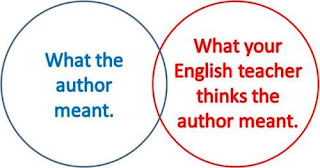
Roland Barthes, in La mort de l'auteur, wrote that "to give text to an Author is to impose a limit on that text." He argued that the meaning of any given text was derived from the individual reading it, not from the musings of the author.
When we read a text, our natural inclination is to see it from our perspective. We don't consider the author because we're not the author. The same is true of modern day "texts," if you will. The moment someone pushes send, tweet, or post, a piece of information is put on display for the world to see, and no two people will interpret it like another.
But let's consider how it would go if these words were spoken. Could it be easier to understand, or would the author of the words still die as soon as they leave his lips? I would argue that the author dies as those words are spoken. Misunderstandings aren't often a result of the medium through which the words are transferred. They are a result of misinterpretation on the part of the one who is listening. People will find a way to misconstrue anything in any way that they can.
So don't worry, kids. You can keep on tweeting. But death may be coming your way.
Tuesday, September 22, 2015
Words Sure Can Carry a Show
I was unable to view the live performance of the play, due to some unforeseen circumstances. However, I had the distinct pleasure of sitting in my room and listening to some actors I couldn't see narrate out the script to the play that I hadn't seen.
The effect was astonishing. In the past, when viewing plays, I found it so simple to be distracted by the outlandish costumes and colorful gestures. This time, contrary to what I was expecting, solely listening to the script actually allowed me to more easily delve into the meaning and truth of the play. I found I could more easily latch on to the words that they were saying, as well as the tone of their voices.
Similar to reading a book, it allowed me to create the characters and the setting in a way with which I could connect. I didn't have to fight with the limitations of the stage. My mind was free to interpret Sophocles however I wanted to.
It is a hard thing to describe. It didn't have anything tangible that the play or film lacked. But I feel like I got something out of it that I wouldn't have otherwise.
The effect was astonishing. In the past, when viewing plays, I found it so simple to be distracted by the outlandish costumes and colorful gestures. This time, contrary to what I was expecting, solely listening to the script actually allowed me to more easily delve into the meaning and truth of the play. I found I could more easily latch on to the words that they were saying, as well as the tone of their voices.
Similar to reading a book, it allowed me to create the characters and the setting in a way with which I could connect. I didn't have to fight with the limitations of the stage. My mind was free to interpret Sophocles however I wanted to.
 |
| You know the play. Fill in the picture for yourself. |
Tuesday, September 15, 2015
Everything is awesome
Have you ever noticed how when you were a kid, your parents thought you were the best soccer player ever? Even when someone else clearly bested you, they just got lucky. Have you ever noticed how, when things were at their worst, someone tries to convince you that everything is awesome.
Oddly similar to my parents, Thucydides does an excellent job of making people feel better by speaking lies delivered in nice, pretty packages of truth. The majority of his piece is a stretch of reality. It's all in praise of Athens and its greatness, which is humorous, considering the circumstances of the Peloponnesian War. Even worse, it actually doesn't much address Pericles, aside from brief mentions here and there. However, when one considers the audience, it's clear that the speaker has a powerful ability for decorum. His speech lacks logos, but the pathos is so powerful - the audience is already mourning the loss of loved ones and he's not holding back on the sweet talk.
Eli's post talks about people's irrational behavior, and how people are susceptible to being built up just when they've been let down. That's what kairos is, essentially, and that's what Thucydides is heavily leaning on in his speech. So how is the history by Thucydides rhetorical? It's a parent at a funeral telling their child that everything is awesome, when apparently, it's not.
 |
| Yes, I was talking about this, |
Oddly similar to my parents, Thucydides does an excellent job of making people feel better by speaking lies delivered in nice, pretty packages of truth. The majority of his piece is a stretch of reality. It's all in praise of Athens and its greatness, which is humorous, considering the circumstances of the Peloponnesian War. Even worse, it actually doesn't much address Pericles, aside from brief mentions here and there. However, when one considers the audience, it's clear that the speaker has a powerful ability for decorum. His speech lacks logos, but the pathos is so powerful - the audience is already mourning the loss of loved ones and he's not holding back on the sweet talk.
Eli's post talks about people's irrational behavior, and how people are susceptible to being built up just when they've been let down. That's what kairos is, essentially, and that's what Thucydides is heavily leaning on in his speech. So how is the history by Thucydides rhetorical? It's a parent at a funeral telling their child that everything is awesome, when apparently, it's not.
Subscribe to:
Posts (Atom)