Showing posts with label conflict. Show all posts

Saturday, November 1, 2014

Conflict Issues and Special Topics of Invention in Business Consulting

Conflict Issues
Many points of conflict arise in the work place, especially in that of business consulting. Among the most critical is the plan of action that will be taken. In business consulting the majority of work is done within a team setting. As a result of this team or group setting many opinions arise causing much debate in regards to the most “advantageous” way to proceed with a specific client.

Within the team a conversation could go something like this:
Consultant 1 – Looking at the past financial statements it looks as though our original theory was incorrect. We need to reconsider the issue that is stopping the client from growing.
Consultant 2 – What did you see in statements that cause you to believe that?
Consultant 1 – (Providing some level or reasoning to his change may say) the original forecasts we predicted were based on falls pretenses.
Consultant 2 – What do you suggest we do from here?
Consultant 1 – Well from the information that we have thus far it appears that (some plan of attack) would be the best way to proceed.
Consultant 2 – That is a good idea, but I have dealt with clients such as these before. I have made the mistake of following your idea. The end result very rarely ends the way planned so let’s do this approach instead. (Consultant 2 may then offer a different option and the conversation would continue until an agreement was made.)

Analysis
Almost all of the dialogue between the two consultants refers to the options they have that will affect the future in an advantageous or disadvantageous way. This is often done through the use of documents as consulting firms often times refer to past financial statements. An important topic of invention that is often used in this field is that of past fact and future fact. This is often used by those consultants who are the “team leader” (in this case consultant 2) as they typically have more time and have attained more experience. This could be created into its own topic of invention (we could call it experienced vs. experienced).

Conflict issues and special topics in translation

As I mentioned in my last post, translation has a lot of conflicting issues in regards to how something should be translated. No language translates one-hundred percent perfectly into any other, and even dialects can have very contrasting uses of words (consider the American vs. Australian use of "barbie"). One of the most obvious arguments between methods of translation is deciding between translating something word for word, known as metaphrase, and translating something based on its context, a.k.a. paraphrase.


A typical sight of this occurrence would be between two translators working on the same text, and arguing back and forth which usage of translation would be more beneficial.

"Look Johnson, I need you to go back through these documents and re-translate everything. The client is expecting her book to be understood properly and your work is too awkwardly written.

Johnson sighed. "But sir, I'm doing exactly what the client asked for. She wanted understood like it's supposed to, so I used a direct translation to better context how it is meant to be used in her own language."

"I disagree. stated his boss. The wording isn't flowing like it should and it will leave readers confused and estranged from the importance of the story in general.

"If I replace it though, the original meaning and beauty will be lost in the translation!" Johnson argued.

"The beauty is already being lost with your slipshod grasp of the readers's attention spans." his boss countered. "If no one understands it, then no one will read it. I expect you to review your work and perform a re-translation of the text that's more reader friendly."

An example of bad literal translation

This conversation is meant to show the key special topic of invention: direct vs. indirect translation. Each side has advantages and disadvantages that contrast one another, and must be determined with care by the translator based on several factors. There are several more common topics of invention that gain a large amount of emphasis. One's audience is key to determining the translation type, as six-year-olds will not understand the appreciation of purposely presenting phrases as they are in their original form. Cause and effect is also vital because a poor translation can be confusing and alienate the audience.

Conflict Issues and Special Topics of Invention in Psychology Professoring


A Point of Conflict in College Psychology Professoring:

              It seems like college students are always trying to boost their grades and they often do this by trying to talk the professor into giving them extra credit or being more lenient on a current score. Of course the professor can’t be too liberal with giving good grades or the class will not accurately reflect the effort and learning that respective students put into the class. However, the professor also wants to help his or her students achieve what they can in the class.

Topics of Invention in Professoring:

              The typical situation is that the student comes into a professor’s office and talks to him/her one-on-one. Let’s say that the student did absolutely miserably on the last test and is worried about losing a scholarship due to the failing grade (just to up the stakes a little). The professor wants to help, but also has to make the situation fair to other students.

              “I did notice that your test score was very low, much lower than I would expect given your attendance and participation. I notice that you usually sit in the front of class and, according to your grades, it seems like you always turn your homework in on time and well done. I can’t give you any additional points since that wouldn’t be fair to the rest of the class. However, I think I will offer an optional extra credit assignment and allow students to write up a case study analyzing the psychiatric condition of other students as they enter and exit the testing center. Based on the length and quality of your reports I will offer appropriate points of extra credit. How does that sound?”

Analysis:
Rebellious and rude students are less likely to
win their professors' sympathy. Good thing I'm neither...right?

              When professors are approached by students they have to use a variety of topics of invention to seem both fair and just. Worthiness/Unworthiness of the student is a big point because a professor won’t help a student who doesn’t deserve the help. This is often based on past fact/future fact because the professor must account for how the student has worked before and how they are likely to act in the future. The Degree of help has to be decided because the balance of fairness and Justice must be maintained. Often the gradebook acts as a testimony of being both a document and a witness against/for the student.

Conflict Issues and Special Topics of Invention in Engineering

A Point of Conflict in Engineering
A lot of conflict arises when it comes down to inspections.  Just like a college student during cleaning checks, there can be a lot of tension when an inspector comes to visit a large power plant.  Even small imperfections in some equipment can be costly.  However, some of these imperfections, if left unchecked, can be catastrophic.  Thus, the conflict is between money and level of risk.

Topics of Invention in Engineering
Imagine a small power plant company, called EnergyGive, has a monthly safety inspection performed by one of their engineers, Bob.  EnergyGive has been struggling financially the past year, so it has implemented budget cuts.  Bob is performing one of his inspections one day when he observes some small cracks forming in the base to one of the power generators.  These cracks will cost a lot to repair.  He may say something to this extent to his superiors:

          “We have been under compliance for the past several inspections.  This month I have observed possible issues that can impede future success.  There are small foundational cracks forming at the base of Generator D.  In order to remain under compliance, these cracks need to be addressed as soon as possible.  If nothing is done, these cracks can propagate and cause equipment failure.  I have investigated the reparation costs, and it would be prudent to address this issue in a timely manner before those costs increase.”

Analysis:

Bob made sure that his superiors understood the advantages of repairing the cracks.  In this context, it was crucial that he present himself in a deliberative manner to help encourage action.  He emphasized the future problems that could arise using an antecedent/ consequence common topic of invention.  Additionally, he refers to compliance, which is following prescribed standards set by governmental agencies, in connotation to law.

Friday, October 31, 2014

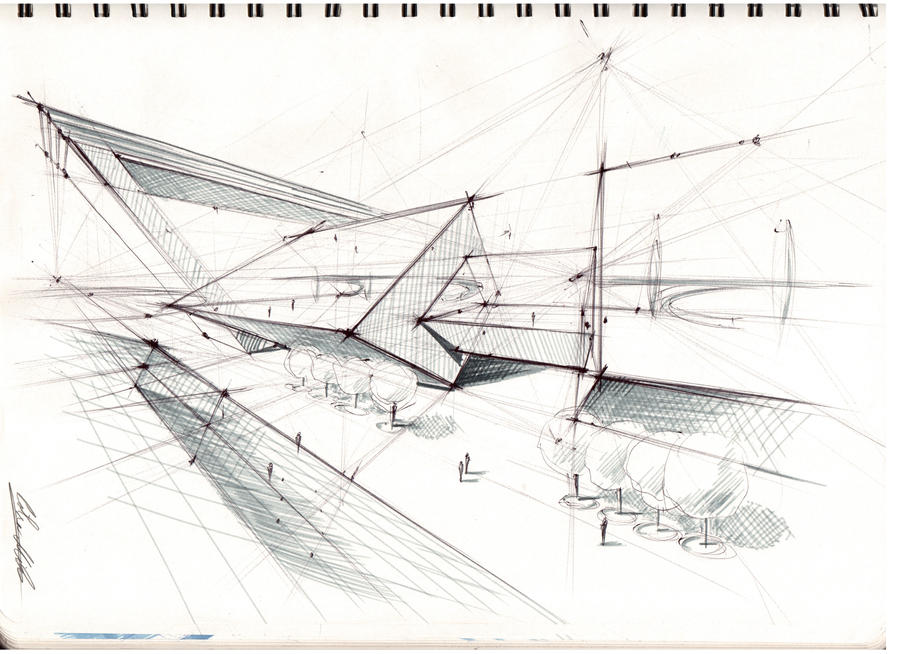
Form vs. Function: a Central Conflict in Architecture


Sample Sketch-work
There seems to be a governing problem in most fields, especially some of the fields previously talked about by other students, that is a scarcity resources. The scarcity of resources present in all professions and in all of our lives manifests itself in architecture through a central conflict I've heard called "form vs. function".

A client comes to a meeting with the team of architects from the firm he contracted with in order to hear and see a design proposal; he likes what he sees a lot, he doesn't understand most of what he sees in the models and sketches and computer renderings, but it all looks really cool. He's excited and ready to get going with construction, then he's reminded of something he understands very well that brings his mind down to reality, numbers and dollar signs. It all depends on the client from that point on and the convincing ability of the architects, the architects would respond by talking about the reputation and purpose of the building and the client and his company, they would refer to the precedent set by architectural works done in the past and what those buildings have inspired in people, it seems like simultaneously the architects would use definition, division, and comparison in order to explain further the need for the designs they've come up with and why the price tag would be worth it.

One of Frank Gehry's sketches of Disney Hall. Due to
this architects reputation, most clients go to him
expecting something grand, so they expect to pay
the price. Unfortunately it's not like that for all Architects.
In the end, the architects' main argument would be how the form would influence the functionality (productivity of employees, appeal to costumers, etc.) in a positive way, thus appealing the main goal of most any company: increased profits. Mostly this appeals to the special topic of invention called deliberative (specifically referring to advantageous/disadvantageous) and also the common topic of cause and effect.

Finished Disney Hall, it's kind of cool to see a thought become
a reality, huh? 

A Point of Conflict In Manufacturing

A common conflict that arises between manufacturers and material engineers is when the engineer suggests a material or technique that raises the price of the production, or the increases the time it takes to produce a product.

A typical persuasion scenario for a material engineer is when they attempt to convince a manufacturer that a certain technique or material is correct for the item being produced. Let’s say the company in question is producing iPhone 6 cases, a material engineer might make his case in the following way:

Dear Mr. Doe,

I’ve reviewed the requirements for the new iPhone case you’re planning to produce and I have thought of some different materials which would serve you nicely. First option is a simply injection-molding some polyurethane. This route would be cheap, but it wouldn’t be as strong as other options. It would cost around $XXXX for the tooling and around ¢0.X for each unit produced. The second option involves the use of a high-impact polymer which can still be injection molded. While this route would be more expensive, you could charge more for the product, and the actual case would be extremely durable. An impact resistant polymer like the one used by the Mag-pul® Corporation would be the optimal material and you would even be able to claim the case is constructed from military grade materials. The tooling would be about the same, but the price of production per unit would increase.


Analysis: While there are several topics of invention used in this example, the major one has to stem from the promotion of the impact-resistant polymer. The engineer is stating that it would be advantageous to take the more expensive route to ensure quality. He uses an authority in the field of polymers to strengthen his argument. The engineer also uses definition to an extents when he described the type of polymer he has in mind. Virtue also weaves it’s way through the argument; although not explicitly stated, the engineer asserts that making an inferior product which is  cheaper is less virtuous that producing a high quality (although more expensive) product. 

Thursday, October 30, 2014

Conflict Issues and Special Topics of Invention in English Teaching


English Teaching can often be quite stressful!
            Every day of the week, English teachers are constantly in some sort of conflict where they must convince others.  An extremely common point of conflict, or stasis, in English teaching is how to best teach the students.  Disagreements often arise between English teachers and other English teachers or, more likely, between English teachers and administrators on how to best teach and engage the children. 

           
Take this common scenario of conflict.  


Principal Collins, fuming, burst into Mr. Rice’s classroom early last Friday.  In a rage, she demanded to know why he refused to teach Shakespeare’s Romeo and Juliet to his 9th grade class this semester and taught them the more “mature” Othello instead.  “This violates the state and the board’s educational laws and outlines!  There will be a standardized test at the end of this year, and you haven’t taught them the necessary material!” she seethed.  Mr. Rice sighed.  He hated teaching Romeo and Juliet.  The class consistently became much more engaged in Othello than in Romeo and Juliet, and he had looked at the test objectives.  They required perhaps a small summary of the play and nothing more.  Why, he wondered, did he have to teach his class anything but what he wanted to teach them?  They would get everything covered that they needed to cover.  Grammar, essay writing, literature, everything needed would be taught.  Mr. Rice stated slowly, “Ms. Collins, I take great pride in teaching my class and helping them learn and grow in English.  My students’ standardized test results consistently have been 20% higher than the state’s average, and I see no reason to deviate from my proven method no matter how much the state or board changes the requirements or curriculum.”  “Your job is a good reason, Mr. Rice,” Ms. Collins simpered. 


English teachers may not want to teach the
standardized curriculum for their class.
            Here we see a special topic of invention common to public school English teachers.  The idea of the law vs. personal desire occurs quite a bit.  Mr. Rice wants to teach what he wants to teach in English.  However, the state dictates that he teach a certain curriculum to his students.  Mr. Rice might be a better English teacher without the restrictions of the curriculum, but he, by law, must teach a certain way or he will lose his job.  The common topics of invention of law and cause and effect also occur with this special topic.  Law or at least school board doctrine must always be taken into account in Mr. Rice’s teaching.  Furthermore,  Principal  
Collins thinks that if Mr. Rice fails to teach his students the proper curriculum, the students will fail the standardized tests.

Another special topic of invention seen in this scenario is learning vs. curriculum.  Sometimes learning does not occur even with approved curriculum.  Mr. Rice must struggle between teaching approved curriculum and teaching what he feels is best conducive to learning.  Reconciliation can occur with the style he teaches.

Engagement’s relationship to learning is yet an additional special topic.  Mr. Rice thinks that the more engaged a class is in a topic, the more they will learn.  I do not think anyone doubts this fact, but trying to engage students is a classic problem for all teachers everywhere.