Showing posts with label advantageous/disadvantageous. Show all posts

Saturday, November 1, 2014

Conflict Issues and Special Topics of Invention in Actuarial Science


Points of Conflict

There are two main situations in which conflict arises in the life of an actuary. The first of these situations is with clients. Clients need to feel like the work they are having done for them is valuable and being done at a competitive level. They need to have no reason to feel like they should doubt the actuaries’ abilities. When they do, conflict arises and it is the actuaries’ job to persuade the client to believe that the services they are receiving form the actuaries’ respective firm are the best that they can get. The second situation is when fellow actuaries or team members disagree on a process of a project or any other type of work being done at the workplace. Such conflicts arise often and usually end with a negotiation between team members, both having to make exceptions to let both people continue working in harmony.

Topics of Invention

                An example of the first of the two situations discussed above is given below.

Client: “I have seen that there are other actuarial firms offering similar work for less pay, I am  thinking about switching to them because I have heard that their services are quite similar to      yours…”

Actuary: “I see. If I had heard that same thing and was in your shoes, I too would be questioning who  I was paying to analyze my risk. However, I can assure you that ____ services are not only more  efficient, but that the quality of work that is done throughout the whole company at ____ is far  superior to ___. Not only would it be a mistake to switch, but because of how sought after our  services are it might be too hard for you to come back to ___ if you do decide to leave. It would be  wise to stay with ___ where your work is done at a higher standard and you are able to know  personally the people working with your company’s risk.  

Analysis


This actuary defends himself as well as his company well in this example using deliberative oratory. The special topics of invention of the advantageous vs the disadvantageous are show within his brief comparison between himself and the competition. He makes a clear statement and testimony that the client would be wise to stay with the actuaries’ company. 

Conflict Issues and Special Topics of Invention in Accounting


A Point of Conflict in Accounting


A common point of conflict in the field of accounting exists between non-management level employees and management concerning the logging of time it takes to complete projects for clients. The amount of time an employee logs dictates how much the firm will charge the client. If a project takes less time than projected than the firm charges the client less and makes the client happy – everyone wins. If an employee take longer than the budgeted amount of time then the firm has to charge the client more money to cover the cost of the employee. The added cost makes the client unhappy and the firm will come down hard on the employee. This will motivate employees who fall behind under report the amount of time it took them to complete a project. Though this falsified report seems to not hurt anyone the company ends up at a deficit because they still have to pay the employee for the extra time but they do not get to charge the client extra money to compensate. So management is constantly engaged in a campaign to persuade their employees to be honest with reporting their hours.

A Possible Conflict

A partner, Pam, notices one of her senior associates, Sebastian, working long hours on his only project. After a few weeks, Sebastian finished his work and turned in an excellent project. Pam then checks to see how the client should be charged for Sebastian’s work. Though pleased with his work, Pam was a little hesitant to check the hours, as she was certain he went way over to create such a quality project. To her surprise, the hours were within the budgeted amount. She promptly called Sebastian into her office where she inquired about the hours expended. A little defensively, Sebastian said that he worked what he stated. Furthermore, he asserted that even if he had worked longer it was only his own time that he wasted so it should not make a difference. With an impressive employment of judicial invention, Pam explains to Sebastian that, outside of the fact that understating hours is unethical and a lie, it really is not fair to the company that we give clients projects that cost more than we charge them. In the future, clients will be expecting projects of a quality that cannot be replicated in the budgeted amount of time. It is only fair (JUSTICE) that the client be charged the amount that reflects the true cost of labor.

Friday, October 31, 2014

Form vs. Function: a Central Conflict in Architecture


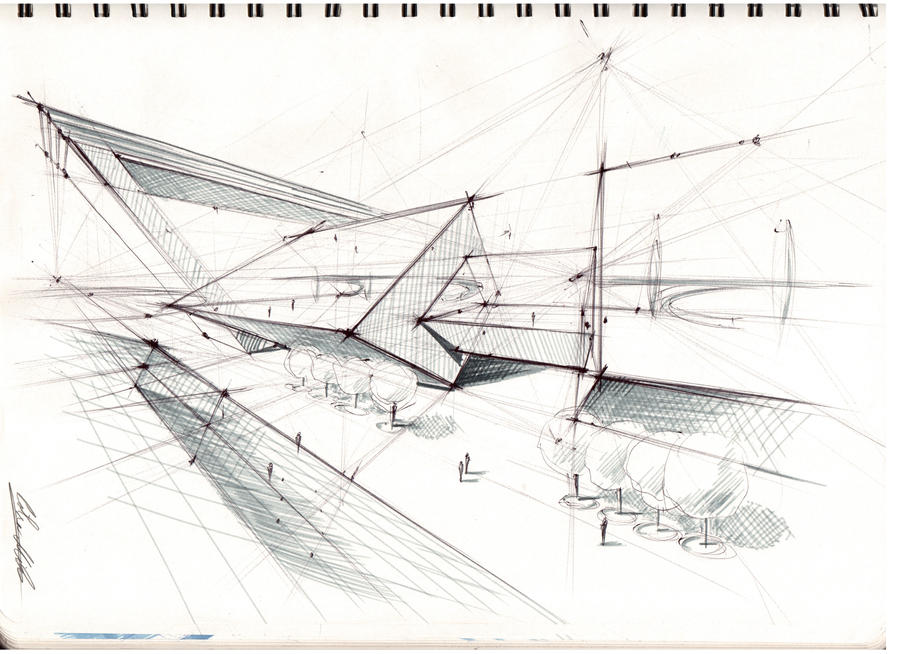
Sample Sketch-work
There seems to be a governing problem in most fields, especially some of the fields previously talked about by other students, that is a scarcity resources. The scarcity of resources present in all professions and in all of our lives manifests itself in architecture through a central conflict I've heard called "form vs. function".

A client comes to a meeting with the team of architects from the firm he contracted with in order to hear and see a design proposal; he likes what he sees a lot, he doesn't understand most of what he sees in the models and sketches and computer renderings, but it all looks really cool. He's excited and ready to get going with construction, then he's reminded of something he understands very well that brings his mind down to reality, numbers and dollar signs. It all depends on the client from that point on and the convincing ability of the architects, the architects would respond by talking about the reputation and purpose of the building and the client and his company, they would refer to the precedent set by architectural works done in the past and what those buildings have inspired in people, it seems like simultaneously the architects would use definition, division, and comparison in order to explain further the need for the designs they've come up with and why the price tag would be worth it.

One of Frank Gehry's sketches of Disney Hall. Due to
this architects reputation, most clients go to him
expecting something grand, so they expect to pay
the price. Unfortunately it's not like that for all Architects.
In the end, the architects' main argument would be how the form would influence the functionality (productivity of employees, appeal to costumers, etc.) in a positive way, thus appealing the main goal of most any company: increased profits. Mostly this appeals to the special topic of invention called deliberative (specifically referring to advantageous/disadvantageous) and also the common topic of cause and effect.

Finished Disney Hall, it's kind of cool to see a thought become
a reality, huh? 

Conflict Issues and Special Topics of Invention in Speech Pathology

A Point of Conflict in Speech Pathology


The main point of conflict I foresee as a speech pathologist is the argument over "necessary and proper". While many of us are familiar with this phrase in terms of our government, I'm using it to identify the cases speech therapists make throughout  their careers in regards to whether or not therapy is necessary and will be effective for individuals struggling to communicate in any way. 

Topics of Invention in Law

There are many opportunities for persuasion when dealing with communication disorders. I want to quickly describe two different scenarios that will in one way or another affect each of us. 

Scenario One: 

Imagine sometime in the near future. You're graduated, working, and you have one beautiful child. They are three years old and what you would describe as "extremely shy" Usual communication consists of pointing and making noises rather than word formation. The preschool teacher has noted that your child has a hard time joining other kids and often paces the room and simply watches. You're the parent and need to decide, is this behavior normal or is there an underlying problem?  

Scenario Two:

It is much further into the future. Your parent or grandparent is aging and activities of daily living are becoming more laborious for them. They require extra care now, but the decline you are most concerned with is their ability to chew and swallow. What do you do? 


Analysis

My field deals with highly charged, emotional situations such as these. Health of loved ones is something that is sensitive and dear to all of us. You want to do what is beneficial for those who are in your charge, you feel responsible. As a speech pathologist, I would take your concerns and do a little research. In order to identify the problem, I need to know the composition of the situation. For example, does the child have hearing loss or have an intellectual disability? Is the parent/ grandparent losing their teeth or had a stroke? Identifying these little parts help expose the whole problem. I would need to then compare these observations to what I know is standard or expected from someone in this age group. (You need to have a knowledge of what is "regular" in order to identify atypical behaviors.) Finally, I would help you see how therapy would be advantageous in improving the quality of life for the individual (helping your child eventually be able to interact with other children, or how therapy will help your parent/ grandparent safely be able to maintain independence and avoid a potentially harmful situation). The special topics of invention (parts/ whole, similarities and differences, and advantageous vs disadvantageous), will also then be used to help persuade your insurance that such interventions are necessary and proper. Those are the three topics of invention that are very common in my field.   


Conflict Issues and Special Topics of Invention in Elementary Education

A point of conflict in Elementary Education
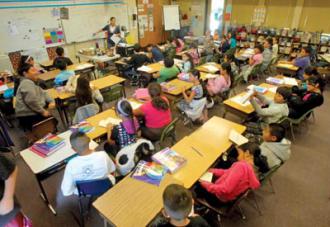
Politics and Elementary Education frequently come into conflict and one point is that of classroom size.  The schools aren't receiving enough funding from the government to hire more teachers and some schools are even letting go of teachers.  This leads to fewer teachers and more students so class sizes are increasing rapidly.  

Topics of invention in Elementary Education
Speaking a community forum a teacher or group of teachers may try to address the need for smaller class sizes to benefit the learning of the individual students and help funding for this to occur. A teacher could say something of the following:
A crowded classroom in California
"We are here to discuss the future of our children, our community and our country.  Have you ever been in a large group and something had been discussed that you didn't quite understand but because of the size of the group you felt your voice had been lost?  Children today are getting lost in these large class sizes.  They are entering a different community with different rules and often they get lost and left behind.  Isn't this contradictory with the No Child Left Behind Policy?  Your children and community need your help.  It is possible to make a difference in our community by donating and helping to fund the schools so that class sizes can be smaller and your children can have their voice heard and their needs met.  This is how real learning will occur.  The benefits are enormous for not only your family, but also our community and country.  Please stop and think of the future and make a difference today."

Analysis
A special topic of invention that was used is that of The Advantageous/The Disadvantageous where the disadvantages of large classroom size was emphasized and the advantages of small classroom was also emphasized.  The teacher wants to move the community to action so he/she will use the special topics of invention for a deliberative speech.  Some other common topics of invention can be used like Law (No Child Left Behind), Antecedent and Consequence (consequences of large classroom size), and the Possible/Impossible (show the difference that is possible when action is taken).