Introduction
In
second grade, I had a particularly horrible teacher. I cannot remember his name, but I do remember
his complete and utter incompetence at explaining even the simplest concept to
our class in a way we would understand.
One day, after a particularly ineffective lesson on verbs in which I was
being an extreme smart aleck, he snidely asked if I would like to teach the
class. Fully valuing the fact that he
had finally recognized and accepted his own teaching ineptitude, I readily
agreed, got up from my seat, strolled to the front of the class, and began to
teach my second grade pupils on the value of verbs. Needless to say, the subsequent events did
not go well for me, and I was shoved back into my seat. I realized much later that his unsuccessful
teaching method came from the fact that he could not communicate with and
engage his students. I also realized
much later what a rhetorical question was.
 |
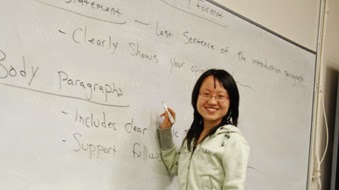
| Don't let a second grader take over your class. Communicate! |
My experience
illustrates an intriguing dilemma about teaching, especially English teaching:
in a field all about communication, participation, and learning, why are so
many teachers so ineffective at communicating to their students in a way that
engages and endears them to their teacher?
We have all had terrible teachers.
Why, when they have chosen the profession of education and have all the
necessary qualifications, are some so bad at what they do? There might be several answers to this
quandary. For one, communication is not
the only way to be successful in the classroom, so it can sometimes be
forgotten as truly important. Other ways
to be a successful teacher are to grade quickly, enforce classroom rules,
understand material completely, get along with staff, devote time to self-improvement,
and love what you do. These do not
involve communication that much. However,
by far, the most important method for success is communication. It governs nearly everything you will do as a
teacher. Your work is literally
communicating and persuading students about literature, writing, and grammar,
which are, in themselves, subparts of communication and persuasion. Thus, communication is absolutely imperative
to effective English teaching. Without
effective communication, no teacher can be truly excellent. The teachers might know the subject matter by
heart. They may have carefully
constructed lesson plans. But if
teachers cannot engage students in learning the material, every carefully
learned and crafted lesson goes to naught.
A bad teacher is usually a teacher who cannot communicate
successfully. Although teaching is more
than just successful communication, as prospective English teaching majors, it
is completely and utterly essential that you learn how to communicate and
persuade well in your classes. Learn
these skills of communication now, and you will not be frustrated with your
students later on. In order to be the
most effective teacher you can, you need to be able to effectively communicate on
a general classroom level with the skills of clarity, arrangement, and
entertainment, and on an individual basis with persuasiveness.
 |
| These students are engaged in their English teacher's lesson because he can communicate effectively to them. |
Clarity in the Classroom
The most
important communication will be in your classroom. You talk the most in the classroom, and you affect
the most people in the classroom. The
most important aspect of any teaching method is simply clarity. The sign of any true comprehension of
material is if you can teach it simply, carefully, and fully without any
confusion, so teaching with clarity demonstrates how well you know certain
material. Simplicity is especially
important when talking to a large group because the message must be
comprehensible to everyone in the room, from the student with a knack for
English to someone who cannot seem to grasp English concepts of grammar, literature,
or writing. This idea of clarity as the
best means of teaching exists throughout history. For example, in his De
Doctrina Christiana, Saint Augustine instructed readers that the best
way to teach a sermon to a large
group is to use simple language, but to not be
tedious or over-repetitive (81). The
same principle applies not only to sermons, but also to English teaching. You can easily slip into unwanted
condescension about which St. Augustine so carefully warns us if you talk
clearly but repetitively and below the level of your students. Thus when teaching a lesson, you should always
keep in mind your students as your audience and change how you teach a concept
respectively. For example, how you would
explain a concept to an AP English classroom would be perhaps a more deep and
complex explanation than how you explain a concept to a regular English
class. Although you will probably learn
how to address different class scenarios when you do your teaching classes and
student teaching, the course outcomes usually lack any mention of effective
communication. Thus, it is up to you to recognize
the need for clarity when teaching. When
you use clarity and firm simplicity, your students will appreciate your
teaching style and will respect you more for teaching effectively. You will build up your character (known as ethos in rhetoric (Burton)) and admiration from students because
you are concise and clear without any arrogance.
 |
| Saint Augustine allows us to see the historical context and importance
of talking clearly without condescension
|
Arrangement in the Classroom
To communicate
and persuade your students to learn, you need more than simply clarity. How you arrange your lesson is also vital to
effective communication. Arrangement,
in ancient Greece and Rome, was chiefly concerned with the exact order used in
a usually persuasive oration (Burton), but today, arrangement is extremely
important to all large-scale speaking and writing. The importance of arrangement extends from
the fact that the best way to competently teach is to form arguments and ideas
that follow a logical and clarifying organization. Many English teachers, especially those who
only lecture, do not practice effective arrangement. Even with carefully planned lessons, some
teachers get easily sidetracked or jump quickly from one idea to another
without any transitions or real arrangement.
I had one teacher my senior year of high school whom I regard as one of
my worst teachers. She knew her material
and was highly intelligent, but she was so scatter-brained that I learned
nothing from her. Even if concepts are
explained clearly, if your transitions between thoughts and ideas are as sudden,
scatter-brained, and confusing like my teacher’s, all the clarity in the world
will not really help successful communication in the classroom. One of the best ways to help your arrangement
is to use
technology such as PowerPoint and Prezi. These presentations can add an entertainment
value to your lessons, while also keeping you focused. In order to avoid boredom, PowerPoint should
be a guiding mechanism for an already basically memorized presentation, not
just read out loud slide by slide. By
already knowing your own material well and by keeping to a logical and clear
arrangement that moves from one idea to another, you will better help your
students learn.
 |
| We as teachers can use PowerPoints to assist our arrangement of our lessons. |
Entertainment in the Classroom
 |
| Today's students want instant entertainment from their classroom experience. We can use entertainment to further the class engagement levels and help classrooms learn! |
Teaching high
school students extends far beyond simply relaying information to your
students. In today’s world of easy and
quick gratification and social media, everyone, especially teenagers, requires
instant entertainment. A huge conflict
(called a stasis in rhetoric (Burton)) with teaching today is engaging
students in a lesson while still maintaining a stimulating curriculum. The best way to have the best of both worlds
is to simply combine rigor with entertainment.
Thus, while your classes can still be challenging—and they should be
challenging—your lessons should also have an element of entertainment. For example, in Roman antiquity, Quintillian in
his progymnasmata, writing exercises that taught grammar
and how to speak and write effectively, made sure that his drills were
entertaining as well as informative (Burton).
Today, our entertainment value can come from technology such as social
media or videos. However, because new
technology is usually just a fad that passes rapidly, quick wit and humor
inserted into your lesson is often the best way to engage students. While you always want to remain
authoritative, a pleasing and humorous speaking style (called middle style
in rhetoric) will never go amiss in a classroom where students often demand entertainment. English classes can include a ton of
entertainment through wit in lessons.
For example, students might be required to diagram sentences to learn
grammar, but diagraming “Josie engulfed the giant pickle into her pudgy pie
hole” is much more entertaining than diagraming “Josie ate the large pickle.” Entertained students will be usually be far
more engaged in a lesson than those who are not entertained. Teachers must always meld entertainment and
engagement with the curriculum to truly help students learn.
Persuasion in One-on-One Situations
 |
| Parent and Student Meetings with you do not need to be heated or angry experiences. Through persuasion to your side of a situation, parents and students will be appeased and respect you as an authoritative figure. |
Although most
of your time will be spent in the classroom, and thus most of your university
learning will be geared to teaching whole classes, we often forget that we must
also communicate with others on an individual basis, either with parents,
students, or faculty members. Without
knowledge of persuasion as well as communication techniques, you will not be
able to successfully solve issues with individuals. Your audience has changed from a large group of people
to a few or one. How you approach
individuals versus an entire classroom must also change. Clarity and arrangement are no longer
essential for your argument, but rather frank but appeasing talk is vital to
convince individuals about your point. This
switch in communication is due to the fact that the context of your situation
has changed, and your language must also. For example, much of the time, the people,
especially parents and students, you will be dealing with on an individual
basis will be angry or frustrated at grades, behavior in the class, or other
problems that classrooms typically encounter throughout the year. Large classrooms usually do not present
heated situations. Thus, the language
you use in a large classroom will be much different than the language you use
to address angry individuals. This
change in language often involves an increase in persuasion for
individuals. Persuasion rather than just
simple communication is much more important on an individual basis than with
classrooms. In the classrooms, your job
is to teach and instruct while engaging the student’s attention and learning. Individually, while you might be still
instructing if a student has a question about an essay or assignment, you will
most likely be convincing someone of your side of a situation in order to
explain a bad grade or horrendous behavior.
You will be using rhetoric, the art of persuasion (Burton). Successful individual persuasion will allow
parents to accept a bad grade as reality without making you the “bad-guy.” However, without successful persuasion on an
individual basis, students and parents will likely still be angry, and you will
not garner from them the respect as a successful teacher you deserve. I have seen teachers both convince and fail
to convince me that I deserved an unwanted grade. I respected the persuasive one and continued
to be frustrated with the unconvincing teacher.
Although, not commonly part of an English Teaching major’s university
courses, in order to be a respected and successful teacher, it is imperative
that you learn how to persuade individuals to accept your side of a
situation.
Conclusion
 |
| With successful communication and persuasion, you can become the best English teacher you could ever be! |
Communication
and persuasion are essential to the English teacher. Although we teach communication, we are
occasionally surprisingly ineffective at communicating effectively to our class
and individuals. However, in order to
teach well, as we all want to do, we must be able to master the art of
communication and persuasion through clarity, arrangement, entertainment, and persuasiveness. With effective
communication and persuasion, students will listen and learn from you, and a
second-grader won’t try to take over your lesson.
Works
Cited
Augustine, Saint. De Doctrina Christiana. Grand Rapids: Christian
Classics Ethereal Library, n.d. Online
Christian Library. Web. 13 Dec. 2014
Burton, Gideon. Silva
Rhetorica. Brigham Young University, n.d. Web. 13 Dec. 2014.