Showing posts with label post assignment Mid Term 2. Show all posts

Thursday, February 26, 2015

A Pattern for Learning

The girl I visit teach could not be more different from me. She’s a freshman; I’m a senior. She doesn’t know what she wants to major in; I’ve known since seventh grade that I would major in English. She listens to mainstream Christian Music (think Reliant K); I listen almost exclusively to British artists (think Ed Sheeran). She wants a sapphire in her engagement ring; I’m all about the diamonds. You name a topic, and we will each have a very different answer.

I found out today that we’ve both been thinking about the same question. Why do we go to college? What is the point of higher education? It should be no surprise that our answers are very different.

Tuesday, February 24, 2015

Parties, labels and bigotry

As we interact with one another, we generally find ourselves declaring our university majors, political allegiances, and religious affiliations.  As we do so, we are not only joining groups of like-minded people, but we are also indulging the human impulse to identify and label ourselves.  And by doing so, we necessarily 
separate ourselves into groups comprised of “us” and “them.”

In the act of labelling others, we often lose the nuances of people’s personalities and opinions. Many of society’s ills can be traced back, at least in part, to the oversimplification of issues through the process of labelling.  Political gridlock, religious intolerance (Jesse B), conflict over political correctness (Rachel M and Chloe M), and the disdain that often exists between academic disciplines are often the result of oversimplifying people and problems through labeling. (Jenna P). Problems arise when, upon meeting someone, we assign them a label—like "English Major," "Utah Mormon," "Rebublican," "White," "Gay"—and immediately allow our predetermined views of such categories of people to skew our view of them or their opinions. 

By trying to label ourselves, we can inadvertently limit our own thoughts, opinions, and even identities.  Often we seem to discard all other aspects of our identity when we try to conform ourselves to some preexisting label. For instance, one who self-identifies as pro-choice
 may feel compelled to adopt other generally associated policy positions in the pursuit of ideological purity. Thus, the supporter of the pro-choice platform may ultimately feel pressure to support marriage-equality and permissive drug laws.

This kind of labelling is ultimately a form of social tribalism.  In the sophisticated social structure in which we now live, this overly simple tribalism is no longer necessary. Society is safe enough for people and positions complete with complicated nuance. However, if we persist to engage in simple labelling, we will continue to manufacture differences and force unnecessary conflict.


9 to 5 No More!

When I read Michelle’s post about taking more time to “play,” it caused me to think of the American work schedule. Since the Fair Labor Standards Act in 1948, American society has adopted the norm of a 40 hour work week. Employees in the 1940s fought for fair work conditions; Ford Motor Company even scaled back its weeks from 48 hours to 40 hours.

The 40-hour workweek was created to encourage companies to limit the work they could demand from employees. With the changes in machinery, productivity and technology, society has more or less mastered the art of productivity. It’s easier to communicate, follow up, keep in touch, and connect. Online cloud systems (Asana and Gantt, for example) allow teams and companies to track their progress on projects and campaigns. Companies like Cisco, Skype and GoToMeetings enable teams to connect from all over the world. I remember one time I was on a conference call with team members across three countries and four time zones. This newfound mobility calls into question whether it’s necessary for a team to meet at the same location 40 hours a week. I am confident it’d be worth it for companies to begin exploring more flexible workplace policies.


The book Let my People go Surfing greatly buys into this idea—if it’s more important for someone to take a two hour break and go surfing so that they can clear their head and come back refocused, then so be it. If companies were to relax their work schedule policies, would it create happier, more productive work cultures? I believe that yes, it would. If I knew I wouldn’t get fired for taking a day off every week, I would absolutely be more motivated to get my work done in four days than in five, but that’s just me.

Credentialism's a Platypus

 Watch the video first, because you won't  understand the title or any of my clever puns  until you do.

 *Spoiler alert* My post will have a lot in  common with Jenna's. But this is a big deal. And  we call it,

 CREDENTIALISM!

 Chances are, you've been slave to this platypus  at one time in your life or another (even if you're  like Jenna and Jerrick, and aren't right now). So  many people go through school, go through  internships, go through jobs, only for the  diploma. Only for the extra bullet on a resume.  Only for the chance to gain the position they actually want.

And this cannot be right! Besides the fact that we are supposed to gain knowledge for our personal benefit and to "go forth to serve," the world is different now. People aren't just looking to see that you have a diploma. They want to know that you extended yourself--that you took advantage of the opportunities in your life and developed skills and experience.

Mind you, maybe you develop those things by doing an internship or getting a different job. That, however, is a different thing altogether. Doing something for more purpose than the diploma or the resume is good. Doing it solely for the credentials? Bad.

I could cheat my way to that diploma. Or, better yet, with our new, easy, and convenient friend the internet, I could just print off a diploma and give it a fancy frame. Doing things for the credentials does nothing for society and nothing for you in light of all the new jobs and masters degrees out there. You won't be able to get that cool job or that cool position just because you have a transcript and a loaded cover letter. You'll just be giving in to the platypus.

The College Athletics Cash Cow

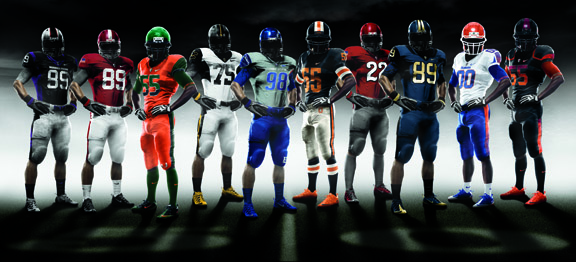
Often in college sports, there are stories of a athletes coming from nothing and making it all the way to the collegiate level. Every fan loves these stories because they embody everything that sports represents. Unfortunately, these stories aren't as happy as they seem. 

College athletics is a multi-billion dollar industry. In 2010, the collective revenue of 15 of the highest-grossing football programs was more than 1 billion dollars. That's just 15 school out of 347 division 1 schools in the United States. In an article by ESPN, it showed a list of the top 75 schools royalties in retail collegiate-licensed merchandise from July 1, 2013, to June 30, 2014 was over 4 billion dollars. I'm just talking about football but I'm sure that many other sports bring in lots of money too. Yet, the athletes that play for these school will never see one dime of these outrageous profits. Why is this?


For one, many high level officials feel that it would be immoral and unfair to pay some athletes more than others when they both worked very hard to get into school. Others, say that there just isn't enough money to pay the athletes. 

Both of these arguments make no sense, in the workforce the most qualified receive higher compensations and it should be the same in sports. If one athlete is better than the other than they deserve higher accolades. Also, how can there not be enough money when many of these schools are making millions off these athletes. Oh and I forgot to mention that college athletes aren't allowed to receive anything for free or they can face suspension. But universities have no problem getting easy money from many of these athlete.   

If someone creates something that other people value then they should be rewarded for it. Many schools sale thousands of jerseys and yet the athlete doesn't receive even a small percentage of these sales. This is simply not right! I'm not saying that we should pay all college athletes because I think that athletes are extremely lucky to receive a free education. However, I think that athletes should at least receive a percent of their jersey sales just like they do in NFL. I don't the answer to this problem but I do know that it is a problem that needs to be changed.   


Priorities

“Oh, you’re an English major, huh? Cool…. So, what are you going to do with that?”

I can’t tell you how many times I’ve heard that.

When you think about college degrees, chances are you will start thinking about which students are more likely to get a job after they graduate. We all know that the accounting majors will have a job and the engineers (whatever it is they actually do) will too. The family life majors will probably not graduate, since they’re getting married this semester—ten bucks says they marry one of the business majors who already has a job. And so it goes, you get the picture.

Paper or Plastic?


Buying things now days has been made pretty easy; you don't even need money! With the amount of consumption on the American credit card the question must be answered: Who's paying for that?

The "All-Knowing" Science

"I believe in science!" said Esqueleto in the movie Nacho Libre. In the context of the movie this is a comical statement, because it seems that Esqueleto would have no knowledge of science. However, the idea that science is all-encompassing entity of knowledge underlies the mind-set of many people. In fact, I would argue that from its struggle to separate from religion, people have turned science into a religion. The world-renowned scientists of today are prophets and oracles that declare absolute truths that must not be questioned (except possibly by other authorities).

Monday, February 23, 2015

How You Doin'?

“Hey how are you doing?”
“Good. You?”
“Yeah good!”

As human beings, what makes us ask and answer this question? We know the response (usually good even though they may not be), and we know they usually ask us the same question back (and we usually answer back with good). These casual conversation starters are modern day dogmas that we have become accustomed to because that’s what everyone else does.

The question becomes, where was the changed frame of reference that got society to resort to such meaningless casual conversation starters. Researching this topic, I came across an example of the 1950's cartoons where the Beaver family would always ask everyone how they were doing and get a bright and enthusiastic response or something that led to comedic drama. I imagine back around those times and before, they didn't ask how someone was doing and expect good as an answer all the time. It was more comprehensive and understandable so another person could actually know how exactly that person was doing. Today’s way of asking this question is more an acknowledgement of someone's presence rather than the actual question. Sometime between then and now, a changed frame of reference set us up in this automatic process.

A lot of times when I do this, I really don’t care how the person I’m asking is really doing. It’s usually someone I see in passing or occasionally. I think many people can agree with this. The question is, how do we liberate ourselves from this accepted authoritative regime? It’s one that will seem to continue unless society as a whole contributes to the idea that this is pointless and to only start conversations with people if we actually care about the response.