Showing posts with label dogma. Show all posts

Sunday, March 1, 2015

Switching Channels: Radio's Role in Society

Last week, I wrote about radio and the way it is perceived by broadcast executives. Too many feel that radio is dead, that because radio is old it is no longer relevant. I disagreed.

I work as an assistant producer at a radio station. Everyday I see firsthand the possibilities that radio has, the relevance of radio. But I realize that not everyone holds this opinion. And not everyone has the privilege of being involved in radio firsthand. So I started asking around.

Thursday, February 26, 2015

Down The Rabbit Hole

In the search for how to make voting easier so that we will get a government that more fully represents the people, I looked into many ideas, including the good, the bad, and the outright radical.

In the search, I stumbled upon a journalist working in Detroit. When describing his feelings about voting on the internet, he expressed worry about what it could lead to, “#DownTheRabbitHole” has he put it. Opening voting up to the internet could easily lead to politicians taking control of the voting process. This is a valid concern, but is it all that different from the idea that there are politicians today tinkering with the voting process?

In communicating with an analyst in Denver, I discovered a much more radical solution. Dissolve the legislative branch of the government, and draw a random sample of citizens each year to fill those seats. Statisticians would love the idea, for this “sample” would be the best estimation of the “population” that is possible. If your name is drawn out of a randomization process, you go work for the government in deciding legislation.

This would lead to a government that, statistically speaking at least, would be a better representation of the people—which is exactly what we would be trying to do with enabling voting online. Its feasibility, however, remains an issue. What will the future hold? I suppose it is up to us, but we need to vote to make it happen.

Tuesday, February 24, 2015

Missionary Work in the Modern World

Recently I was released from my calling in my ward as the ward mission leader.  Right when I was called, I was very unsure of what to do.  The previous ward mission leader came to me and let me know some of the things he had done, and he said I could pretty much do what I wanted.  My Bishop even told me that I could do what I wanted.

Part of the dogma of missionary work is that you go out and physically do missionary work by meeting with people in person.  Sometimes calling them on the phone can be appropriate, but even then you usually only do that with people you’ve already contacted in person.

As a newly called ward mission leader, I was told by the stake that our ward would be doing a pilot online missionary program.  We mostly focused on using Facebook to communicate with old friends about the Gospel.

Most of the members of my ward weren’t too excited about doing online missionary work.  They felt awkward about it, because they didn’t want to bother their friends.  I think this is the same worry that people have about missionary work in person.

I think we should be more comfortable with doing missionary work online.  I personally believe that the reason so many people are uncomfortable with it is because it’s new, and it’s out of the set of rules, or the dogma, that everyone is used to.  This can make change hard, but I think it will benefit us a lot if we’re willing to make the change.

Video Killed the Radio Star?


As the years have gone by, radio seems to have been kicked farther and farther into its grave. First, the Walkman and portable mix tapes. Then CDS. And the most fatal blow of all—MP3s and iPods. Each development has made radio seem more and more irrelevant. Why listen to a random stream of music when you can listen to a personally curated playlist? And when’s the last time you heard of a family sitting down together to listen to their favorite radio program? It was when your grandparents were talking about their childhood. Nowadays, we have our widescreen hi-def 3D plasma SmartTVs to keep us entertained.

So radio is dead, right? Broadcast executives sure treat it like it is.  And that is the source of their many problems.

9 to 5 No More!

When I read Michelle’s post about taking more time to “play,” it caused me to think of the American work schedule. Since the Fair Labor Standards Act in 1948, American society has adopted the norm of a 40 hour work week. Employees in the 1940s fought for fair work conditions; Ford Motor Company even scaled back its weeks from 48 hours to 40 hours.

The 40-hour workweek was created to encourage companies to limit the work they could demand from employees. With the changes in machinery, productivity and technology, society has more or less mastered the art of productivity. It’s easier to communicate, follow up, keep in touch, and connect. Online cloud systems (Asana and Gantt, for example) allow teams and companies to track their progress on projects and campaigns. Companies like Cisco, Skype and GoToMeetings enable teams to connect from all over the world. I remember one time I was on a conference call with team members across three countries and four time zones. This newfound mobility calls into question whether it’s necessary for a team to meet at the same location 40 hours a week. I am confident it’d be worth it for companies to begin exploring more flexible workplace policies.


The book Let my People go Surfing greatly buys into this idea—if it’s more important for someone to take a two hour break and go surfing so that they can clear their head and come back refocused, then so be it. If companies were to relax their work schedule policies, would it create happier, more productive work cultures? I believe that yes, it would. If I knew I wouldn’t get fired for taking a day off every week, I would absolutely be more motivated to get my work done in four days than in five, but that’s just me.

To Be Politically Correct...

We live in a day and age when it is imperative to always be "politically correct." There are instances when an individual steps out of bounds in what they say, like with Justine Sacco who got fired for being racist. In fact, at least once a week I see a story on Facebook entitled something like, "You Won't Believe What ________ Said." With the accessibility of the internet, it is easy to get yourself in trouble for something that you post for the whole world to see.


This ultra-correct ideology to me is an example of tolerance, but tolerance taken too far. Now, there are times and places to say things and to not say things, like with Justine Sacco. But, on the other hand, if I were to publicly broadcast that I do not believe gay marriage is right, I would probably get shamed by my online peers. For me to say something that I believe or don't believe, I am called a bigot, judgmental, and un-Christian.

This idea of tolerance reminds me of frames of reference, a principle of the Enlightenment. To me, dogma of political correctness is based on frames of reference. For me to say my beliefs about gay marriage to my LDS friends would not get me in trouble, because they share a similar frame of reference with me. But to step out of that frame of reference would be to step into a war zone where I am bound to get shot down.

The problem with being "politically correct" is that it at times takes away a bit of our freedom of speech. (Again, keep in mind that I acknowledge there are some things that are absolutely inappropriate to say.) To have to be politically correct is to have to alter the way I say things to make it appear as though I agree with the rest of what society says, or risk being called on the carpet. To claim a belief because of my religion or just as an opinion is labeled as narrow-minded and ignorant. I can't have beliefs unless those beliefs line up with the frame of reference of everyone else. I mean, I can, but maybe I'll end up like Justine Sacco.


An Irrational, Incurable Disease


“This political correctness just continues to spread. It’s like a disease. It’s like an incurable disease. It’s just spreading and it’s irrational.”

Rush Limbaugh’s quote rings true as we look at our government, our schools, our society, and realize how the idea of being politically correct permeates our civilization and the way we communicate with others. In 2013, a college student in California was asked to take off a cross she was wearing at school because it might offend other people. Students are not allowed to pray at public schools because it could be deemed insulting. The Obama administration has banned government agencies from referring or linking terrorism to Islam – for fear that it might offend someone.

Being politically correct is all about dancing around a subject so we don’t step on someone’s toes. Our society has taken on this idea that we can never hurt anyone’s feelings, even if something is the truth. We even see this ideology infiltrating all the way down to children in our school systems. In Massachusetts, a school principal cancelled Honor Night in order to avoid hurting the student’s feelings who weren’t getting an award. He was creating an idea that there are no winners or losers.

As Limbaugh put it, political correctness is spreading and is irrational. It encroaches on personal freedoms of rights, such as freedom of speech and expression. Praying in schools may offend non-Christians. But what about the Christian’s right to wear a cross necklace, pray, or worship as he pleases, and share that belief with others? Not only does the dogma of needing to be politically correct all the time encroach on personal rights, it also eliminates the drive and motivation necessary for healthy competition in schools and in the work place.


We need to change our frame of mind. We should not have to always worry that we will lose a job if we mention our religion. I am entitled to my religion just as much as someone is entitled to not claim a religion. We need to not have to apologize for saying the word “thug” because it might offend people of the non-Caucasian race. By constantly worrying about being politically correct, we are letting government, and general authorities in our society control how we think. We need to stand for our rights, our beliefs, our hard work, and what is true. Not just say whatever sounds “politically correct.”


Monday, February 23, 2015

Challenging Dogmas, Not Policies

Some kinds of change are different than others. The same is true of calls for change. It's one thing to want something (in particular) to change, and another to want things (generally) to change. The latter type was the sort characteristic of the European Enlightenment. People were after a deeper, broader kind of change, change that involved radical shifts in thinking about the world, not just different decisions in managing their world. They sought changes that required overhauling or overthrowing the political, intellectual, or cultural authorities of their day. Enlightenment thinkers were challenging dogmas, not policies.

In asking my students to re-create the Enlightenment, to a degree, by challenging the status quo, I'm asking them to take on a dogma that's operative in our present day, and not just argue for a shift in policy. A dogma is a set of received beliefs that are part of the belief system of a given group. It's the party line. It's the set of principles that organize and constrain that group. Dogma is ideology: a set of ideas, and a logic that flows from them. Dogmas and ideologies provide a rationale for policies, but they are bigger value systems that underly policy.

How You Doin'?

“Hey how are you doing?”
“Good. You?”
“Yeah good!”

As human beings, what makes us ask and answer this question? We know the response (usually good even though they may not be), and we know they usually ask us the same question back (and we usually answer back with good). These casual conversation starters are modern day dogmas that we have become accustomed to because that’s what everyone else does.

The question becomes, where was the changed frame of reference that got society to resort to such meaningless casual conversation starters. Researching this topic, I came across an example of the 1950's cartoons where the Beaver family would always ask everyone how they were doing and get a bright and enthusiastic response or something that led to comedic drama. I imagine back around those times and before, they didn't ask how someone was doing and expect good as an answer all the time. It was more comprehensive and understandable so another person could actually know how exactly that person was doing. Today’s way of asking this question is more an acknowledgement of someone's presence rather than the actual question. Sometime between then and now, a changed frame of reference set us up in this automatic process.

A lot of times when I do this, I really don’t care how the person I’m asking is really doing. It’s usually someone I see in passing or occasionally. I think many people can agree with this. The question is, how do we liberate ourselves from this accepted authoritative regime? It’s one that will seem to continue unless society as a whole contributes to the idea that this is pointless and to only start conversations with people if we actually care about the response.

I Didn't Vote

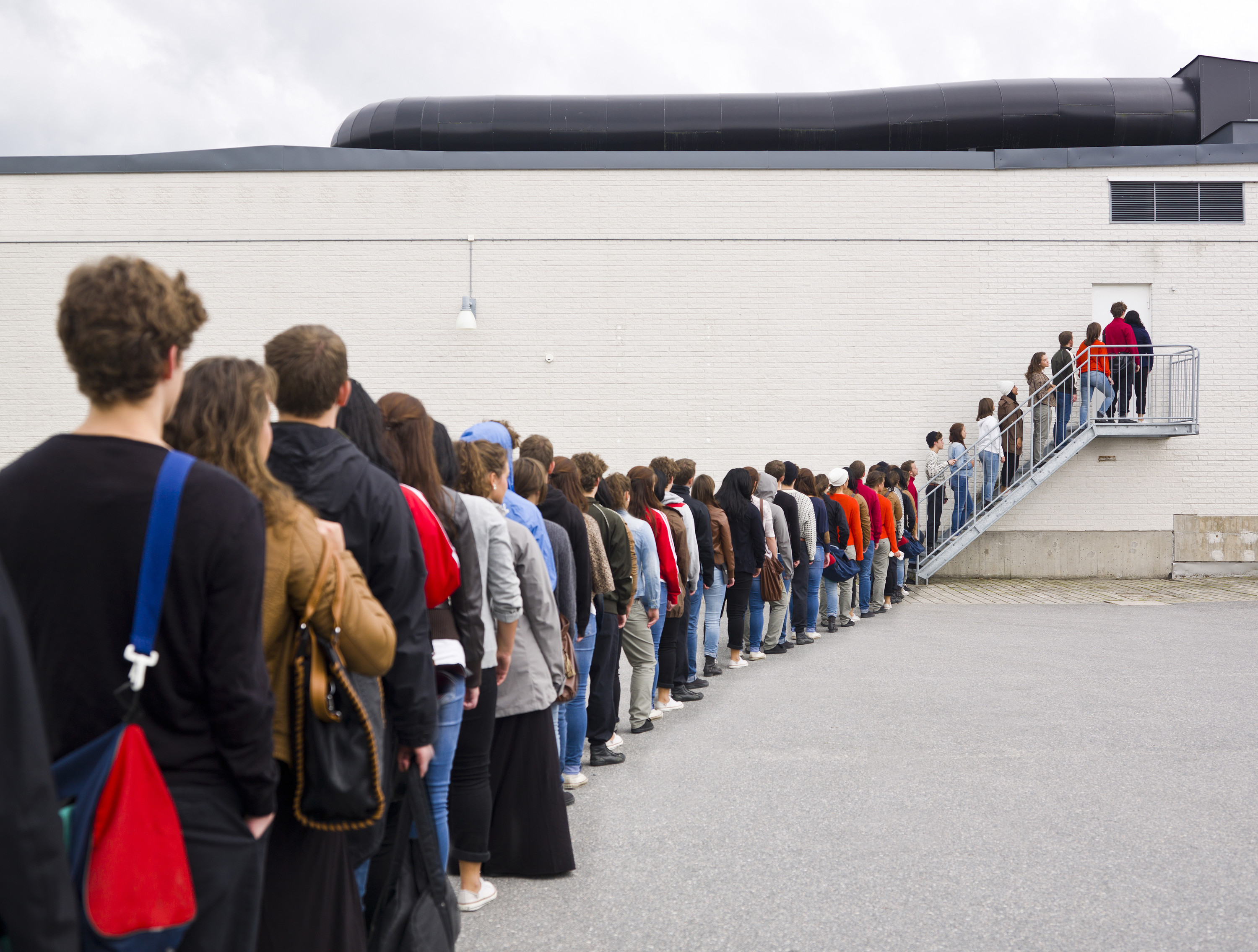
November 4, 2008, I walked into my local Department of Motor Vehicles branch to do what a good American citizen does, vote. After making it through the door I saw a line that seemed to be longer than any I had before encountered. The wait to vote was well over an hour. So I did the unthinkable, I walked back out the door and went on to other activities.

But, is it all that unthinkable? Every election millions of voters never show up, never cast a ballot, and never vote. For me, it was a convenience issue. I didn’t have the time to wait in line for hours, and I think millions of Americans have similar issues. The system is simply too out dated to accommodate them.

The system made sense for hundreds of years. You show up, cast your ballot, and your vote is registered—they had no better way. But we do. We have a better way at our disposal. The internet is doing incredible things in areas such as business, communications, and even banking. Many people who do not vote today because they do not have the time would be able to vote because they can do it virtually anywhere, and with only a few clicks online. Thus, millions of those who didn’t have the time would now be able to vote.