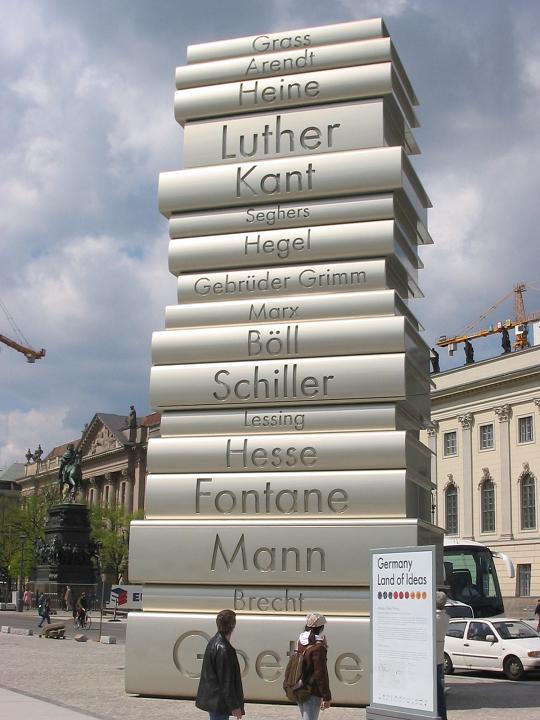
"What gunpowder did for war, the printing press has done for the mind."
 |
The Walk of Ideas designed by
Scholtz & Friends to celebrate
the invention of modern printing.
|
Wendell Phillips lived during the 1800's so he saw the outcomes of this Renaissance technology. The ability to communicate had always been essential to the influential people of any time period. Even more important, however, was the ability to immortalize their words. Painstaking methods, such as carving into solid rock, were employed so that a ruler could "live on" beyond his death. How else would we know of the great deeds they performed? When Gutenberg developed his printing press, suddenly it was easy to not only immortalize, but also spread one's ideas. Without it, the extent of a great mind's
sprezzatura in speech and writing would have been lost or limited, as mentioned by Kekoa in our salon discussion.
On the other hand, maybe some ideas should have been lost. Violent revolutions and reformations grew out of humanistic ideas that spread quickly with the ability to mass produce writings. Dictators and despots controlled the masses with propaganda. Many lives were lost and countries were left in shambles, such as France after its revolution.