Showing posts with label rhetoric of the revolution. Show all posts

Tuesday, March 10, 2015

Trottin' with Trotsky

What a mustache.
It came to pass that I went to the temple with my ward instead of doing my blog post on time. This may or may not be a call for pity. (Is it working?)

Leon Trotsky's real name was Lev Davidovich Bronstein, but the lack of consistency in his identity didn't seem to affect his ability to stick to the truth when he predicted the future. Trotsky's The Proletariat and the Revolution is an outline for the working class to use as they rise up against the government. Political riots had broken out in 1903-4 as a result of dissatisfaction with the government (with the failed Russo-Japanese War and other general stupidness), but the working class had abandoned their revolutionary cause. So Trotsky came in to revive the efforts.

To map out the proletarian revolution, Trotsky uses a great deal of anthypophora (i.e. asking questions and then answering them himself). This format is an appeal to logos, even if it isn't as sound as a syllogism or some statistical proof. It is clear. It is concise. It is simplified. "How do we do this? Why, we do this." Very appealing.

This clear-concise-simplified-ness is backed up by pleasant pockets of lists and repetitions. Trotsky uses a great deal of "we ought"'s as nails to hammer in his message. It's an indirect way of commanding that builds Trotsky's ethos ("Hey, I've thought this through. I have enough authority to say we should do this.). It also smothers his argument in a heap of oughts, each one richer and more convincing than the one previous.
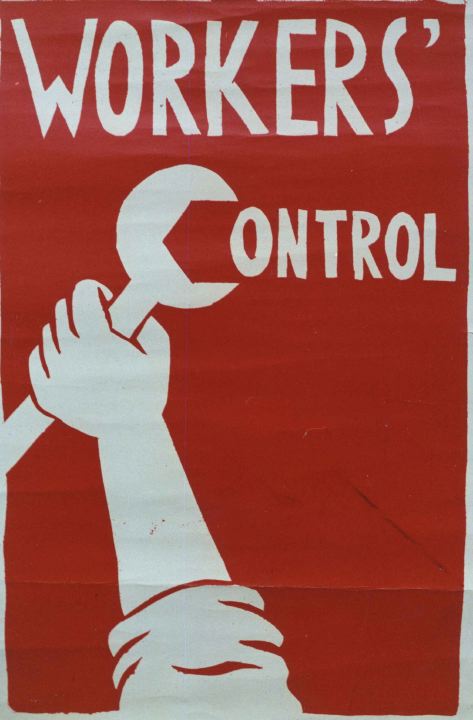
That's what I do with
my wrenches.
The most powerful of these repetitions comes at the end of Trotsky's Proletariat. He gives his revolutionary forces a name and a cause: the NATIONAL CONSTITUENT ASSEMBLY! (Sounds fit for a comic book, don'tcha think?) Then he uses more oughts and more powerful directives leading up to a wonderful, flourishing finish: "We ought to carry on the most intensive propaganda in the army in order that on the day of the strike each soldier...should know that he is facing the people who are demanding a National Constituent Assembly."

AND THE CROWD GOES WILD!

Trotsky's words aren't the most pathos-sparking, but his direct, low-style speech is incredibly attractive to the logic. The proletariat must have taken his words to heart, too, because the revolution turned out almost exactly like his roadmap. I guess all a revolution needs is an outline to run with--and then the runners to run with it.

Bloody Knuckles, the War Has Already Started!

Russia was at war with Japan, and Japan was soundly defeating the Russians. Even though the Russians were badly losing, their tsar Nicholas II refused to end the war. Many soldiers were needlessly dying. On top of that, the working class of Russians were being treated very poorly.

Lenin blames the rich capitalists for every ill of society. Without regard to anything else, he piles hate on top of them, blaming them for “rivers of blood”, exploitation, and making “the government and army their servants….” Blood is strongly alluded to in this piece. Being engaged in a war, the people of Russia would have very tangible ideas associated with blood. Lenin refers to the capitalistic, rich owners of capital as “blood-suckers.” Imagine having an enemy shed the blood of your son or brother, how would you feel about being oppressed under a “blood-sucker”?

DOWN WITH CHIANG KAI-SHEK! LONG LOVE NEW CHINA!

On October 10th 1947 Mao Zedong presented The Manifesto of the Chinese People’s Liberation Army as a means of analyzing the political circumstances of the time. There had been a series of events leading up to this manifesto beginning back in the 1920s. When Sun Yat-sen, the leader of the Kuomingtang (KMT), the Chinese Nationalist Party, passed away Chiang Kai-shek took his place. Unfortunately, unlike Sun, Chiang was unable or rather unwilling to maintain good relations with the Chinese Communist Party (CCP).


Chiang desired to wipe out the CCP and so he began a civil war, but this civil war was poorly timed. Not long after it began Japan invaded China forcing the Nationalists and the Communists to form a truce. After the Japanese surrendered the two parties refocused their anger on one another. For a time Chiang received aid from the United States as the attempted to help negotiate an alliance between the two parties. This upset the CCP even more.

Mao Zedong, the leader of the CCP had recently come across some Marxist literature which inspired him to write the manifesto. The words he used were powerful and the manifesto had a great effect on the people. It rallied the people behind Mao and it ultimately led to Chiang’s evacuation to Taiwan.
Mao begins by sharing a narrative of the status of the war. He reminds the people of the strength of his Red Army and their superiority over Chiang’s army. “Wherever our troops go, the enemy flees pell-mell before us…”

He continues on by bringing shame to Chiang Kai-shek’s name by accusing him of being “…devoid of all gratitude… traitorous, dictatorial and against the people.” This is a theme that we see repeated throughout the manifesto.

Mao then quickly sets forth 8 policies that he plans to put into effect. I believe this has an immense effect on the people. He is not only saying Chiang is bad, I am good, follow me. He took the time to present his plan to the people and he appeals to their desires and emotions by proving to them that he supports them. He said, “We are the army of the Chinese people and in all things we take the will of the Chinese people as our will.”


To end, Mao uses his powerful words once more to enthuse the people and to invite them to join his great cause. He explains that they “are shouldering the most important, the most glorious task in the history of [their] country’s revolution.”

Monday, March 9, 2015

Importance of the Fourth Estate

               Ferdinand Lassalle’s “the Working Man’s Programme” really typifies some of Lassalle’s socialist ideas which took place during a break out of revolution in Germany during the 1800’s. His ideas received a lot of pushback, which caused Ferdinand to do some prison time, but also moved him almost effortlessly to the leadership of the new forming political party at the head of the social working class at the time. In his address about the importance of the working class, or the “Fourth Estate”, he uses a great deal of well thought out rhetoric to address his audiences and time his speech appropriately.

                Lassalle’s goal is to convince his audience of the importance of having the working class be involved in the state, and that their involvement will better all people of all classes, not just the individual. Lassalle uses Marx’s ideas about social change as a basis of authority for his arguments. This is really interesting as he eventually pulls away from Marx and uses those ideas to compare and contrast to his view that the state itself can be the tool to bring social reform. This is a powerful technique as he is able to appeal to all his audience members by mentioning ideals from the thoughts of Marx and then making it more in line with what is already in place. Some would call this a cowardly approach to a revolutionary speech, but I think it is a clever way, a “sales tactic” if you will, type of approach to transfer enthusiasm about his ideas to his audience.

              
              There is a great deal of pathos in Ferdinand Lassalle’s speech, but I feel it is used in a different way than some of the usual ways rhetoricians of the revolutionary age used this appeal.  Instead of using it to the effect of stirring the crowd to action by building their emotions, he uses it to show how much he cares about his ideas, and how much he emotionally feels these ideas are needed in the state. This has an effect on an audience that respects Lassalle’s ethos. Those that see his passion are stirred to action not by direct feelings that were conjured up in them by Ferdinand’s words, but by Ferdinand’s own emotion for this topic. This is a common approach used in coaching sports and is very effective if the relationship with your audience is strong. “What’s important to you, is now important to us” is a phrase that sums up well how Lassalle used the pathetic appeal in this speech.