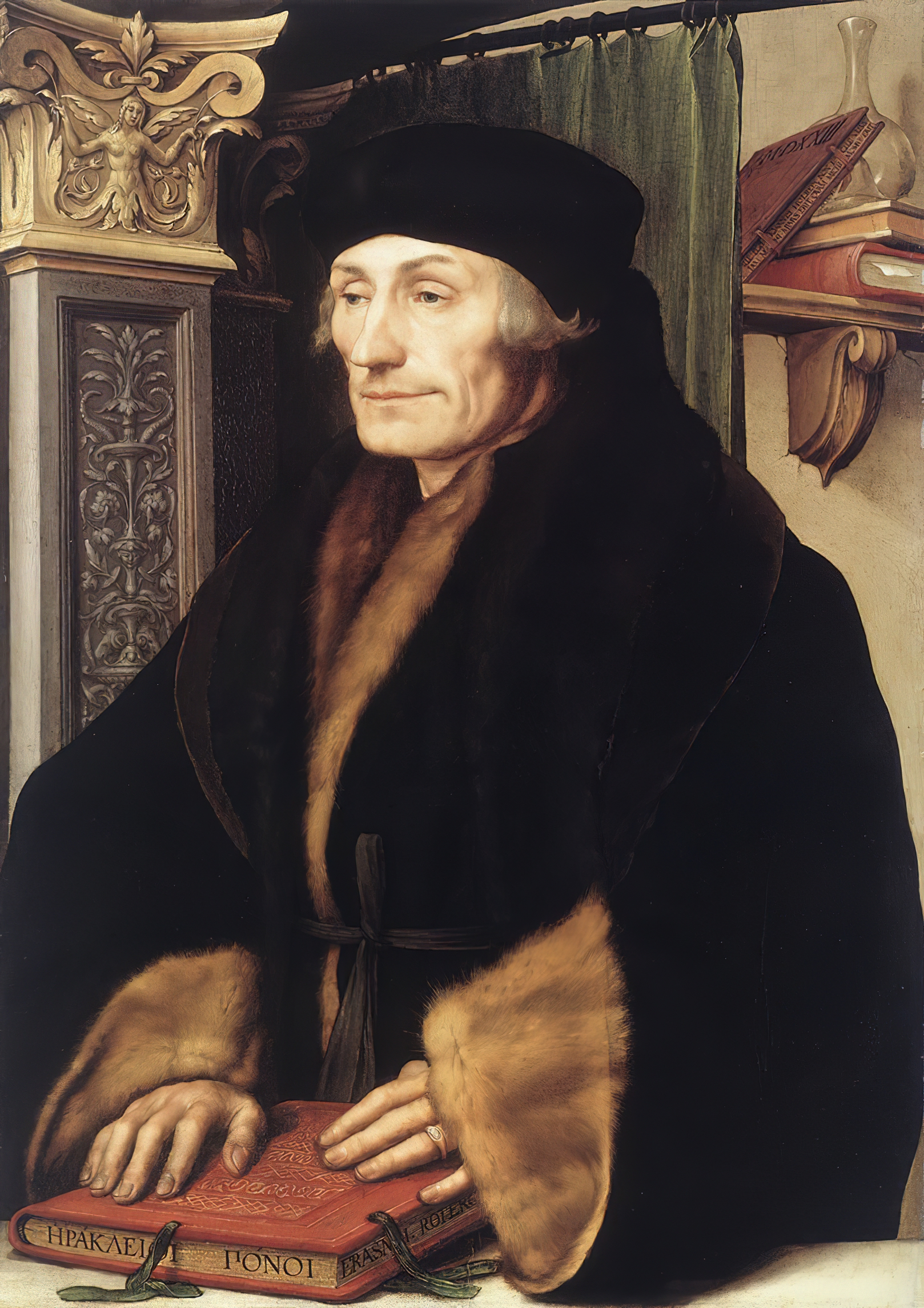
Showing posts with label post assignment 5. Show all posts

Tuesday, January 20, 2015

God is the only Certainty

One way I saw the issue of certainty come out in Erasmus' thoughts was in Chapter 2. Erasmus notes that the Spirit, supposedly given to every man, helps each to interpret things a bit differently, and that it may reveal different things to different people. As he wrote, "Let us admit that the possibility actually exists for the Spirit to reveal to a simple layman what is not revealed to many scholars." To Erasmus' point, it is fair to wonder how certainly one could believe a philosopher who maybe wasn't aware or enlightened of the same principles as a younger, simpler man.

For Luther, from what I could understand in his argument, his issue of certainty would be less stressful to me as an early 16th century reader, because it seems less worrisome. As Luther said in Part 2, Chapter 5, "both [my] creation and preservation come to pass by the sole will of the omnipotent power and goodness of God." If I'm a common villager living in the 16th century, I assume there is plenty of housework and farming and walking and surviving to be done. I as a hardworking commoner do not have the time or resources to dedicate to become a well versed devout Christian, so leaving it all up to God's omnipotence and grace sounds much more convenient and simple.

Certainty to Christians is a bit different, I think. That's the beauty of Christianity: we don't need to be certain in everything because we are certain that God will help us through whatever comes our way. Certainty in our beliefs allows us the confidence to be uncertain in everything else. Life is unpredictable, so it's impossible to be certain about temporal things. God is the only constant in a Christian's life.

This entire idea of certainty relates to what was happening with the Protestant Reformation. All the sudden, there were plenty of new beliefs, sects and theories on how to know what was certain--which one was true. Luther, Erasmus and others all had their own ideas of how we could know what God wanted for us. How grateful I am that Joseph Smith decided to go directly to the source and ask God Himself what he should do. God was Joseph's only certainty.


The Middle Road or The High Road

In the reading, Erasmus takes a very conservative approach. He says "I must confess that I have not yet formed a definite opinion on any of the numerous traditional views regarding the freedom of the will." Throughout his writings, he makes arguments for both grace and works, and ends up with a middle of the road approach. I feel looking at his logic and way of thinking help us understand perfectly why he was attributed to Christian Humanism and called the "Prince of the Humanists." By neither straying to the far left or far right of the argument, he typifies the ideas of Christian Humanism, who combine the often opposing ideas of the individual and of Christian principles. On the other side, the arguments of Martin Luther assert a strong position, in which he holds true to the doctrines he puts forth. His attitude is attitude is more reflective of the Reformation and the need for change.

These two approaches were reflective of the audience that they were trying to appease to. Erasmus's conservative approach appealed to the conservative, who may have had an open mind like Erasmus, but did not take strong action to the new ideas of the time. However, Luther, in addition to protecting his own reputation, was striving to help relieve any possible worries of those of the Reformation by presenting a strong, confident rebuttal to Erasmus.

These approaches can be seen in our time as well. It definitely depends on the audience being spoken too. Leaders of nations with different cultural backgrounds must also strive to see all sides of the arguments by looking at the current and historical context. However, an example of the stronger approach might be a leader of any social movement. The leader would have to attempt to retain followers and gain new followers by using a confident approach that appealed to reason and emotional strength.

Some Rules Are Meant To Be Broken

Some rules are meant to be broken! At least, that's what my public relations professors says. In PR, students are taught how to strategically solve problems using a book called, A Matrix Approach to Public Relations and Marketing. The Matrix provides guidelines and rules to help one successfully approach a problem. This is our "bible" in public relation. Every time we start a PR campaign we look to the Matrix to guide us and help us along the way. The only problem is that the Matrix is just a broad view of the PR industry and doesn't contain all of the answers to the problems that  PR professionals face. Thus, this is why sometimes you have to think outside the box and break some of the rules that you've been taught.


I think something very similar happened with Luther and Erasmus. During the renaissance the idea to seek for new knowledge was resurrected and both Luther and Erasmus embraced it. They were both God fearing men and knew the bible to be the word of God. However, they had several questions about the bible and about the Catholic church and its practices. At the time, those who questioned the church and its practices were severely punished. Thankfully, they were brave enough to stand up for their beliefs and to their surprise many people agreed with them.


Although they did not share the same exact view on religion, both Luther and Erasmus paved the way for many other influential people and helped them think outside the box. In fact, if it hadn't for both of these great men then there might have never been a reformation and we might still be in an apostasy. But lucky for us, they were able to think outside the box and break some of the rules.      


Religious Authoritarianism and Relative Truth

On the topic of religious authoritarianism I find myself conceptually somewhat divided. I have met plenty of people who don’t think organized religion has the best answers, or all of the answers. My best friend, in fact, feels exactly this way. I can remember him coming to church with me so many times, and so many LDS core doctrines resonated within him. And yet, he was never baptized, and I couldn’t figure out why. During my mission, I wrote to him often, seeking to see some sort of change in him, that if somehow I could ask the right questions, or provide the right answers, he would have that lightbulb moment and come around to my way of seeing the world. It never happened, and a year after being home from my mission, I recall we had the conversation again. I just wanted to know, honestly and sincerely why he couldn’t accept baptism into the LDS faith. He explained to me, clearly and plainly, “I find so much truth with LDS people, but I don’t see all of it. I don’t think it’s untrue, necessarily, I just don’t think it’s all of the truth.” I was dumbfounded. I had nothing else to say but that I respected his views on it, and would seek to understand it better in the future.


I relate this experience because I feel like it was all I could think about while reading Erasmus and Luther. Truth is a difficult concept to capture in these rhetorical terms. As I read Erasmus, I found myself nodding my head, feeling some form of wisdom in his words. Then, reading Luther I thought, wow what was Erasmus, and myself by association, thinking?! I find truth to be whatever resonates within one’s own soul, and I think the contradiction of interpretation in the scriptural proofs to be evident of that, just as I found in my discussions with this old friend. I think that is a large part of what I have felt in the Renaissance and the Reformation. Man, being unwilling to follow a course in which his soul finds no comfort, reaches out for something else. Some would use the term, he is reaching higher, but I can’t willingly associate this with a vertical plane. It is not higher or lower, simply different.

Civil but Keen Debate

It seems to me that many of us are noticing a parallel between Erasmus and Martin Luther and modern day politics.  While there is a healthy debate between the two, I notice a bit more cordiality and respect than in our modern political debates.  That increased respect of the other’s free will seems to me a lot more in tune with the humanistic respect of other’s will.  I would say that they were much more humanistic than our modern politicians in that regard.  With such lines like, “My reading of Martin Luther’s Assertion was quite unprejudiced, except that I felt towards him a favor such as a lawyer feels towards a hard pressed defendant,” it's hard to feel that they are ‘mud-slinging’ their opponent.  Perhaps I idealize their debate with old fashioned chivalry, but I sincerely do not feel that they had a burning hatred of one another, rather a civilized yet keen disagreement. 

It's Always About Religion

When starting a conversation with someone new, people often give the same words of advice. “Just stay away from religion,” they always say. Upon reading the Discourse of Free Will one can quickly understand why. For centuries, religion has been cause for great conflict.  In this novel, Eramaus and Martin Luther go head to head as they discuss their opinions and supporting arguments for the definition of free will, a large aspect of religion. During the age of the renaissance, Christian humanism exploded as humanistic ideals took center stage. Eramaus greatly supports these ideals as he believes in the free will of man and gives light to the idea that God does not impose on man’s will but according to Luther, all men are slave to sin making free will nothing but a name. Though both religious men, their vastly different ideals go head to head and history continues to repeat the pattern.


As Martin Luther began to expound his ideas, the Protestant Reformation took place as Luther’s teachings opposed that of the Catholic Church. Continual debate on beliefs and interpretations continued to emerge and soon, the once all powerful religion of Catholicism turned into several varying religions.


This patterns continues to the time of the American pilgrims. English colonists seeking to break free from British reign, sailed to the American continent and began a new life. One of their largest demands? Freedom of religion. Men sought to worship what they may without the fear of conflict. With salvation on the line, people have great cause to seek the truth that will bring them salvation. Religious conflict continues to be a cause for conflict, even to this day. Numerous debates arise on topics such as religion in school, religious beliefs on morality, and more. However, much like Martin Luther and Eramaus, debates on religion are likely to continue throughout time and it is likely that men will never come to see eye to eye. 

Undeterred conviction


Similar to Robert Allen, as I read through these two discourses on free will I couldn't help but think of modern day political debates. They both seem to respect one another to a certain degree, such as when Luther says, “To the Venerable Master Erasmus of Rotterdam, Martin Luther wishes Grace and Peace in Christ.” There is a sense that both of these men recognize the intellect within one another, but like in any modern day political debate they both have firm convictions which they will defend to the death. Maybe not literally to the death, but they will use everything they have such as their intelligence, the scriptures and other doctrines to support their argument. They also point out the fallacies within the other’s debate.

As I read these discourses I began to realize that these men stand firmly in their beliefs that I don’t think either one could be persuaded to the other side. And I personally believe that they understood that. Although it almost seems like Luther was about to switch sides at the beginning of his discourse when he said,

“I concede to you openly, a thing I have never done before, that you not only surpass me by far in literary prowess and intellectuality… but that you have in two ways also dampened my spirits and impetuousness, and slackened my strength before the battle began.”

Reading those words, I thought that Luther might be seeing Luther’s point in all of this, but then he goes on to say,

“For although you write wrongly concerning free will, I owe you no small thanks, because you have confirmed my own view. Seeing the case for free will argued with such great talents, yet leaving it worse than it was before, is an evident proof that free will is a downright lie.”

This leads me to believe that even though they addressed their discourses to one another, their real audience was the public. They knew they couldn't convince one another so they tried to convince the common people, who must have been confused during such a time, of the accuracy of their own points of view. Both used great logic, philosophy and the scriptures to back up their arguments so it all comes down to how one really wants to interpret the evidence presented.
I feel as though I have learned much from the two of them. Not only on free will but also on how to properly argue a point. I hope we can all learn from these great men and these wonderful works of literature that they have left behind.


Erasmus, Desiderius; Luther, Martin (2013-06-20). Discourse on Free Will (Bloomsbury Revelations) (Kindle Locations 1702-1705). Bloomsbury Publishing. Kindle Edition.

The elephant and the fly

As I march deliberately, dedicatedly, and sometimes directionlessly through my college education, I find myself relating to the rhetorical strategies of Erasmus, in his contribution to the Discourse on Free Will. As he states (satirically?) and Luther confirms (also satirically?) that disputing the opinion of Luther is akin to the fly opposing the elephant, my mind turned to my own educational and professional pursuits (what is the resume, if not an exercise in self-aggrandizement in the face of the vast professional world). But beyond my own experience, I thought this comparison was fitting when evaluating their rhetorical strategies.


Erasmus: Can't take scripture literally, then takes scripture literally. Paints everyone as exaggerators, but then condemns the exaggerator.

In reading the arguments of Erasmus, I was struck by how generally he stated his terms. Rather than provide all of the many scriptural examples he alluded to, he simply proclaimed that there were enough to derail the thought train of Martin Luther. He also plays up his relative obscurity as humility in comparison to the fame of Luther:
"Thus I am here not as a judge, as I said at the outset, but as a disputer."


Luther: Will trample Erasmus underfoot, masquerading as a humble giant.

"Therefore I shall be even more grateful if you gain greater certainty through me, just as I have gained in assurance through you."

Luther's response to Erasmus is almost comical. He uses humility as a tool as well, but does so in a very clever way. He speaks as if he is coming from a higher place, and that he can easily argue away what Erasmus has presented. 

"My friend Erasmus, may I ask you to suffer my lack of eloquence, as I in return will bear with your ignorance in these matters. God does not give everything to each and we cannot all do everything. As Paul says, “Now there are varieties of gifts, but the same Spirit” (1 Corinthians 12,4).

Satirical deference seems to be Luther's game.

Both writers appear to do what they can to evoke notions of humility, though Luther impressively does it in tandem with asserting his own self-assurance.

Times Have Not Changed

When reading the writings and about the lives of Erasmus and Luther one thing kept coming into my mind--this sounds a lot like the debates of today; though the great arguments of today do not necessarily have to do with the bondage or liberty of human free will. Today's arguments, whether they be on gay marriage, abortion, size of government and government spending, involvement in foreign wars, etc. really come down to (in my opinion and not without exception) one side (liberal) arguing for what they believe to be good, moral, sensible, and making efforts toward tolerance; and the other side (conservative) arguing for what they believe to be right, true, absolute, and standing firm on the grounds of commitment.
This seems to be exactly the way Erasmus (liberal, in this comparison) and Luther (conservative) generate their ideas and make their arguments. Erasmus seems to make his arguments based on reason, philosophy, tolerance, and consensus. Luther, on the other hand, strictly debates based on revelation, an appeal to absolute truth, and commitment to the source. In this Erasmus really is a child of the Renaissance, and even spokesman of the Northern Renaissance (a rebirth in/return to thought); while Luther the leader of the Protestant Reformation (a re-formation of/return to truth and doctrine).

If the Discourse on Free Will Were Written in Utah 2015

The Protestant Reformation is largely accepted as beginning in 1517 when Martin Luther nailed his 95 theses on the Wittenburg Castle Church doors. This was the beginning of public questioning of the Catholic church in Europe, which, at the time, was the all-powerful church in all of Europe. There was no legal alternative for religious worship and those who were viewed as going against it's teachings were labeled as a heretic and possibly burned at the stake. While the nailing of the 95 theses could be labeled as a spark, what came after was a forest fire. Notable people began discussing religion and religious views, which began many sects that are still around today. Never before had so much debate been had, nor such a willing audience listened.

I believe that it is this context, the Protestant Reformation, that makes the Discourse on Free Will such an important and interesting work of literature. Since it was a time of confusion, people were asking questions and searching for answers that made sense based on what they knew as well as on what they hoped was true. Additionally, the church was one of, if not the, most important realm of an individual's life. Their whole lives revolved around worship.

So, what if the Discourse on Free Will were written today? I don't think it would make hardly a drop in the ocean and I definitely do not think that people would be reading it in another 500 years. There is so much information, so many books and so many articles being written today that something like this would probably be lost on the web. Perhaps a few people would click on a link talking about whether or not predestination is real or if we have free choice, but ultimately, I believe the following would be small and ultimately forgotten. Additionally, today we see an increasing secularism in our lives. Even for avid church-goers, people tend to separate their religious life with the rest of their lives (BYU and the culture we live in is quite unique). Therefore, I think that the context of the Discourse on Free Will is ultimately what makes the piece so important and relevant not only in the 1500's, but today. 

Scriptures as Evidence

When I was a freshman in high school, an upperclassman on my swim team started a conversation that left me perplexed, given that she was citing scriptural reasons why, in her opinion, my faith did not qualify to reside under the umbrella label of Christianity as hers did.  While this particular incident left me hurt and confused (especially considering my knowledge of the scripture at the time was more focused on the broad details than the specific) what happened was a small example of a common theme in Christian history—utilizing the scriptures to form a personal opinion on how gospel principles should be played out in a church.

Philosophy vs. Theology: Erasmus vs. Luther

"If any man will do his will, he shall know of the doctrine." (John 7:17)

            The Protestant Reformation brought major religious conflict to Europe and had two voices that came to dominate its arenas of debate and apologetics. These two voices argued at the heart of the conflict. Desiderius Erasmus and Martin Luther made irreplaceable arguments surrounding free will during the development of, what would become, Christian humanism. We will examine the effectiveness of the rhetoric within their written arguments to one another, and it is worth noting (for context) that Erasmus centers his argument on moral philosophy while Luther centers himself within theological dogma.

            Luther led a far-reaching theological movement against the authoritarian Catholic Church. His rhetoric, within his argument “On the Bondage of the Will,” takes a stance that is, in many respects, congruent with a Platonist’s (e.g. Luther says that Erasmus “attribute[s] more to free will than the Sophists hitherto did”). These introductory remarks—where Luther equates Erasmus to “the Sophists”—serves as a type of proof which is used to both discredit Erasmus as being the ultimate relativist (one who will say anything to win an argument and cares little for the “Truth”) and to position himself as one who believes in, and professes to have obtained, absolute “Truth.” In Luther’s mind, he is the man that escaped “Plato’s cave.”

            Erasmus, the man given the title “Prince of the Humanists,” remained open-minded while presented his arguments. Erasmus repeatedly addresses the logic behind open-mindedness—a critical concept within Humanism—while sharing his philosophical views. Erasmus does this not only to emphasize its importance, but, by discussing open-mindedness with his audience, he simultaneously invites the quality within us. Erasmus’ presents Christianity as a discernible morality and, in my opinion, employs a more persuasive use of rhetoric than Luther does.

            Where Erasmus presents scriptural proof of God's varied emotional responses to mankind's choices to validate his philosophies of free will, Luther presents his personal scriptural interpretations using those interpretations to speak for God. Luther presents these interpretations as incontrovertibly true which, coincidentally, is in complete harmony with the authoritarian practices within the Catholic Church. This was they very type of hegemonic manipulation he was seeking to reform. Luther—the veritable voice of religious reformation as a response to authoritarian repression—seems guilty, within his arguments, of the same thing he spent so much effort to condemn.


From One Humanist to Another

As we were asked to write this week’s blog post on our response to Erasmus’ and Luther’s Discourse of Free Will, to be honest, my first initial response was, “I don’t get it.” I had a hard time following the two men’s points of view. But I did do some research and looked at some outsides commentary on the book that hopefully helped me understand the reading better.

Even if I didn’t fully understand what the two debaters were saying, I did try to pay attention to their rhetorical devices. Both seemed to have an excellent awareness of their audience and their opponent, and a good sense of decorum. Erasmus starts out his very first 
section by acknowledging that he is looked at as much more        
insignificant in comparison to Luther. He understands that his 
audience could be the general public and he recognizes their 
thoughts and feelings. Throughout his writing, Erasmus, also 
seems to write a lot of comparisons and analogies so that more 
people will understand what he is trying to say.

While they are both of the same day and age, Erasmus and Luther have different opinions of free will and different ways of examining the will of man. Erasmus is rejecting the Reformation’s version of man and explains that man is capable of doing good and this good can lead to his salvation. He talks a lot about grace and how man can receive different types of grace to be saved. He offers a lot of examples from history and the Bible, but as a humanist, he puts a lot of human reason and philosophy on his interpretation of the Bible. He also tries to acknowledge many different sides to his theories. But his human reasoning seems to weaken and muddle his position as he tries to argue this Christian doctrine, but doesn’t exactly take a strong enough stance.

Luther, on the other hand, becomes more sure of his position as he responds to Erasmus. And while he debates against Erasmus, he wants to bring him to an understanding of the truth, as well. Luther’s main source to his argument is solely the scriptures. He comes much more strictly from the Reformation philosophy and mindset, to where he believes the Spirit is what is necessary to interpret the scriptures and not as much human reasoning. Based on his interpretation and methods of arguing, Luther believes man is not capable of doing good, but that he is evil in nature and is brought down by sin, but is unaware of his own corruption. Man is not free to choose grace.


Both men do a good job of acknowledging who their audience and opponent is, but differ in their opinions of man’s sin and free will. They also have different ways of arguing this as Erasmus gives a more humanist thinking approach to scripture, and Luther sticks to a Protestant Reformation approach and goes off of scripture alone.

Haters Gonna Hate: Why Audience Is Important

The hate group, the swing group, and the love group; these are how modern companies classify customers’ opinions of their products. Because it is hard for a company to switch someone from the hate group to the love group, companies tend to have their advertising directed at the swing group. We could consider the customers to be the company’s audience.
 
People are classified by their opinion into these 3 categories
In reading the debate between Erasmus and Luther, it is easy to see who the intended audience is. Erasmus is targeting the swing group, and Luther is targeting the hate group (at least the head of the hate group).

How to defeat your opponent

One of the more interesting aspects of this debate in terms of Renaissance rhetoric is how Erasmus and Martin Luther each address his opponent. Obviously different types of debates and different subjects of debate require different approaches, but at least present-day debates seem to have a basic set of rules to control the atmosphere and allow reason to dominate. Analyzing the two debaters from this earlier time period makes me think that either a couple of these seemingly apparent rules were either nonexistent or ignored.

For example, Martin Luther just seems plain rude. He gives out backhanded compliments at every opportunity and basically calls Erasmus ignorant more than once. At times I wondered if he was opposing Erasmus himself rather than Erasmus's arguments. Erasmus, on the other hand, had a much more mellow tone of voice and even appeared to acknowledge his own lack of understanding. He also seemed to be concerned for the implications of misunderstanding doctrine by appealing to reason, whereas Luther seemed to be appealing more to emotion.

The audience choice was another striking difference between the two. Again Luther was very focused on Erasmus. Every comment was directed at Erasmus with the motive of trying to convince Erasmus of his viewpoints. Erasmus addressed the general public with Luther in mind. He seemed to be interested in converting followers rather than converting the opposing side's leader. There may have been a practical reason for this. Luther apparently was more popular and had no need to obtain more followers. The next step up would be to bring down the opposing side completely. Erasmus recognized this, so he was focused on drawing more support from the people. These decisions show how rhetoric had to be properly used for a given circumstance to gain the upper hand.

A Great Debate!

Both Erasmus and Luther implored rhetoric using the scriptures in a similar way. They would introduce a topic and then go straight to the bible to add validity to their words. Expounding upon the scripture they had just referenced, they would attempt to make their point by stating their interpretation of what had been said. This style reminded me of the Montaigne style essay we recently did where we started with a quote and then talked about or thoughts on it.

Although they did not agree with one another they did show outward respect to each other. One aspect I think is important to note is that they had tolerance for the others belief an opinion even if they didn't agree with it. This freedom to express a belief that is different to the norm and not be punished impacted the protestant reformation. It allowed more and more people to stand up for what they thought to be right and live according to it.

Desiderius Erasmus argued his perspective on free will from a Christian humanistic point of view. He pointed out how the bible tells us and shows us what we should do and the way we should do things. The Church also aids us in knowing what we should do in this life. Erasmus illustrates how we need to act in order to fulfill what we have been instructed to do. The responsibility to act rests with man and God has given us the power to act and fulfill all the commandments that God has given us.


Based on the amount of logical persuasion Erasmus used, I would have to say that I think his argument was much more influential. He had a plethora of proof from the scriptures that he brought to the argument and effectively explained it.

The Difference in Rhetorical Discourse


“Brutus was an honorable man” – Antony, “Julius Caesar”

As I was reading the Erasmus and Luther arguments, that line from Antony kept coming into my head. Here were two men, each trying to undermine the other, yet treating each other with respect that was, in some places, over the top. Eventually, readers of “Julius Caesar” come to see the honorable line in an ironic light, and I also came to see Erasmus and Luther’s praise for each other as ironic. They used phrases like “literary prowess and intellectuality” to build the other up while in the same breath they tore the others argument apart.

Although they each had different ideals, they both attempted to persuade—one of the pillars of rhetoric. However, in their modes of persuasion they highlight a difference between rhetorical theory of the Renaissance and current rhetorical theory.

Blind Sure, But Not Gulible

From: Ethics Alarm
Jesus taught, "Can the blind lead the blind? shall they not both fall into the ditch?" He used this parable to explain the importance of knowing what you do in this life and using your own free will. It becomes more clear in the next verse when he says, "The disciple is not above his master: but every one that is perfect shall be as his master" (Luke 6: 39-40).  Choosing your master will affect what you become and what becomes of you. 

Monday, January 19, 2015

Is There Free Will or Not?

The discourse between Erasmus and Martin Luther on free will is a fascinating discussion.  Both men used some strong language and rhetoric to argue with each other, and it was awesome to see an in depth discussion about something that is so important to those of us who are Christians today, since the debate over free will isn't entirely settled among all Christian faiths.

Despite the combative and maybe even offensive rhetoric that both Erasmus and Luther used, both still remained respectful of each other.  For example, Luther says to Erasmus “… artfully you debate this matter with wonderful and continuous restraint, preventing thereby my becoming angry with you.”  It’s a great example to me to see two men with very different and opposing viewpoints argue peacefully and civilly with each other.

While remaining respectful of each other, it was a thought-provoking debate.  Luther clearly starts his arguing from the belief that everything comes about because of God’s grace, or whatever God wills to happen.  For example, Luther states “But tell me this:  was anyone of them made a saint, did anyone of them receive the Spirit or work miracles in the name of the free will, or by the power of the free will, or to confirm the free will?  Far from it, you will say, but in the name and by the power of Jesus Christ were all those things done, and for the confirmation of the doctrine of Christ …”  Before Luther stated this, Erasmus had said “But you fail to define the limits within which we should think of the will as acting and as being acted upon.”  Erasmus clearly was attacking Luther by pointing out that Luther would speak of free will as being free and as being acted upon, but then state that free will is a lie.  Erasmus’ view was obviously the belief in free will.


I believe that Erasmus was much more convincing than Luther.  Luther seemed to come off as if to say that Erasmus was ridiculous because he wasn’t going along with what was clearly the truth, but then Luther didn’t seem to have any real evidence to back himself up.  Also, coming from an LDS perspective, I agree with Erasmus, so I’m sure I have a bias J.

Obscurity vs Certainty: Erasmus & Martin Luther on Free-Will

           With topics of religion it is my personal opinion that the delivery and invention of one’s argument is often far more important than the truths or content therein. Erasmus & Martin Luther both take very different angles when making their arguments on free-will.

Erasmus

            Erasmus’s mode of argumentation, not even to mention his actual view on what he is arguing, is that of reason before scripture or doctrine. Erasmus uses his own to reason and logic to rationalize his arguments. Instead of scriptural references, he uses powerful analogies, such as the boy who can’t reach an apple without his father’s help, to really drive home his ideas… but he wouldn't let the untrained audience know that. There were loads of scriptures throughout Erasmus arguments, but their inclusion was primarily a tool used to balance Erasmus arguments of “man meriting salvation” and “God’s grace”. Martin Luther would later argue “Erasmus speaks out of both sides of his mouth”, which I think is a valid observation, although I feel that Erasmus did it quite effectively. Erasmus further used the scriptures for their uncertainty rather than to back up doctrinal truths. This uncertainty of the scriptures is another effective invention by Erasmus in building his two sided argument on the existence of free-will and God’s grace.
A key scripture argued/used by both Erasmus & Luther

Luther

            Because Martin Luther’s Bondage of The Will is in direct response to Erasmus’s argument his approach is quite different in many ways. Martin Luther focused wholly on divine truths back by the scriptures, counter arguing Erasmus use of scriptures. Luther focused on what he believed to be the certainty of scriptures, which he argued that if any verse seemed obscure it was due to the weakness of the reader, not the Word itself. He continues to use the scriptures as a foundation of certainty to back up his arguments and attack Erasmus’s. This method of Luther’s was clear when he said that Erasmus argues “like a man drunk or asleep” blurting out things here and there.

So who won the debate?


            As a Mormon I was able to see a little of truth in both arguments. Interestingly I felt more apt to side with Erasmus because of his rhetorical style, using both the scriptures and reason to back the duality of his argument. For Christian humanists & people of the reformation however might have sided more with Martin Luther as his argument was a little more “happy” or easier on the ears than Erasmus’s.