Showing posts with label Martin Luther. Show all posts

Tuesday, February 3, 2015

Why We Do What We Do

William Shakespeare said, “It is not in the stars to hold our destiny but in ourselves.” This quote kept coming to mind as we talked about the individuals and themes of the renaissance. As the discussion progressed from Petrarch’s experience on the top of mount Ventoux to the influence that William Shakespeare had on England I could not help but ask myself, what was it that drove all these philosophers, authors, theologians, and artist to make the impact that they had on society? How were all these individuals able to find it within themselves to go against the norm and create something new?   

Tuesday, January 20, 2015

Scriptures as Evidence

When I was a freshman in high school, an upperclassman on my swim team started a conversation that left me perplexed, given that she was citing scriptural reasons why, in her opinion, my faith did not qualify to reside under the umbrella label of Christianity as hers did.  While this particular incident left me hurt and confused (especially considering my knowledge of the scripture at the time was more focused on the broad details than the specific) what happened was a small example of a common theme in Christian history—utilizing the scriptures to form a personal opinion on how gospel principles should be played out in a church.

Philosophy vs. Theology: Erasmus vs. Luther

"If any man will do his will, he shall know of the doctrine." (John 7:17)

            The Protestant Reformation brought major religious conflict to Europe and had two voices that came to dominate its arenas of debate and apologetics. These two voices argued at the heart of the conflict. Desiderius Erasmus and Martin Luther made irreplaceable arguments surrounding free will during the development of, what would become, Christian humanism. We will examine the effectiveness of the rhetoric within their written arguments to one another, and it is worth noting (for context) that Erasmus centers his argument on moral philosophy while Luther centers himself within theological dogma.

            Luther led a far-reaching theological movement against the authoritarian Catholic Church. His rhetoric, within his argument “On the Bondage of the Will,” takes a stance that is, in many respects, congruent with a Platonist’s (e.g. Luther says that Erasmus “attribute[s] more to free will than the Sophists hitherto did”). These introductory remarks—where Luther equates Erasmus to “the Sophists”—serves as a type of proof which is used to both discredit Erasmus as being the ultimate relativist (one who will say anything to win an argument and cares little for the “Truth”) and to position himself as one who believes in, and professes to have obtained, absolute “Truth.” In Luther’s mind, he is the man that escaped “Plato’s cave.”

            Erasmus, the man given the title “Prince of the Humanists,” remained open-minded while presented his arguments. Erasmus repeatedly addresses the logic behind open-mindedness—a critical concept within Humanism—while sharing his philosophical views. Erasmus does this not only to emphasize its importance, but, by discussing open-mindedness with his audience, he simultaneously invites the quality within us. Erasmus’ presents Christianity as a discernible morality and, in my opinion, employs a more persuasive use of rhetoric than Luther does.

            Where Erasmus presents scriptural proof of God's varied emotional responses to mankind's choices to validate his philosophies of free will, Luther presents his personal scriptural interpretations using those interpretations to speak for God. Luther presents these interpretations as incontrovertibly true which, coincidentally, is in complete harmony with the authoritarian practices within the Catholic Church. This was they very type of hegemonic manipulation he was seeking to reform. Luther—the veritable voice of religious reformation as a response to authoritarian repression—seems guilty, within his arguments, of the same thing he spent so much effort to condemn.


Monday, January 19, 2015

Obscurity vs Certainty: Erasmus & Martin Luther on Free-Will

           With topics of religion it is my personal opinion that the delivery and invention of one’s argument is often far more important than the truths or content therein. Erasmus & Martin Luther both take very different angles when making their arguments on free-will.

Erasmus

            Erasmus’s mode of argumentation, not even to mention his actual view on what he is arguing, is that of reason before scripture or doctrine. Erasmus uses his own to reason and logic to rationalize his arguments. Instead of scriptural references, he uses powerful analogies, such as the boy who can’t reach an apple without his father’s help, to really drive home his ideas… but he wouldn't let the untrained audience know that. There were loads of scriptures throughout Erasmus arguments, but their inclusion was primarily a tool used to balance Erasmus arguments of “man meriting salvation” and “God’s grace”. Martin Luther would later argue “Erasmus speaks out of both sides of his mouth”, which I think is a valid observation, although I feel that Erasmus did it quite effectively. Erasmus further used the scriptures for their uncertainty rather than to back up doctrinal truths. This uncertainty of the scriptures is another effective invention by Erasmus in building his two sided argument on the existence of free-will and God’s grace.
A key scripture argued/used by both Erasmus & Luther

Luther

            Because Martin Luther’s Bondage of The Will is in direct response to Erasmus’s argument his approach is quite different in many ways. Martin Luther focused wholly on divine truths back by the scriptures, counter arguing Erasmus use of scriptures. Luther focused on what he believed to be the certainty of scriptures, which he argued that if any verse seemed obscure it was due to the weakness of the reader, not the Word itself. He continues to use the scriptures as a foundation of certainty to back up his arguments and attack Erasmus’s. This method of Luther’s was clear when he said that Erasmus argues “like a man drunk or asleep” blurting out things here and there.

So who won the debate?


            As a Mormon I was able to see a little of truth in both arguments. Interestingly I felt more apt to side with Erasmus because of his rhetorical style, using both the scriptures and reason to back the duality of his argument. For Christian humanists & people of the reformation however might have sided more with Martin Luther as his argument was a little more “happy” or easier on the ears than Erasmus’s.  

Christian is the New Greek

Though Erasmus of Rotterdam and Martin Luther disagreed on the issue of free will, they both demonstrated the Renaissance theme of Ad Fontes. Each returned to and recognized the value of Greek tradition in his treatise.

Erasmus compares the battle of Achilles and Hector to the fight between religious sides (location 1615), emphasizing the intensity and utterly unyielding nature of the conflict. Doing so, he characterizes the adamant war between himself and Luther--and we see more evidence of that adamancy in Luther's rebuttal. 

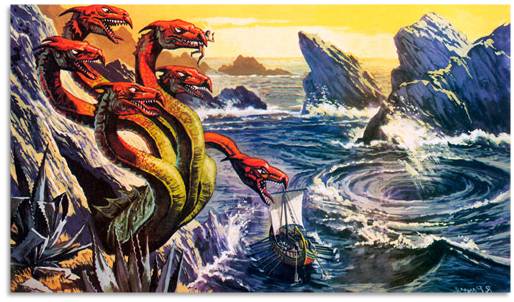
Erasmus then alludes to Scylla and Charybdis (location 1631). These two sea monsters from Homer's The Odyssey express Erasmus' feelings about giving credit to free will as well as to the grace of God: saying that man's free will does it all in life would be sailing straight into the hungry mouths of six-headed Scylla; saying that the grace of God is solely responsible would be flushing yourself down the Charybdis toilet. Interestingly enough, this latter subscription was Luther's, and Erasmus' comparison suggests that Luther opted to sink his argument's whole ship rather than lose on just a few points of doctrine. (Odysseus' decision in The Odyssey was much the wiser.) 

Luther likewise uses Scylla and Charybdis in his treatise at location 1789, and in the same way, too. Only he is not as subtle as Erasmus. Instead, he openly criticizes Erasmus for "escap[ing] safely through" the two opinions, finding refuge in the middle ground instead of defending an extreme.

Ironically, Luther had just alluded to another famous Greek by Aristotle in a spirit of 'friendly criticism' (location 1776): "Plato is my friend, but truth must be honored above all." We see from the rest of Luther's treatise that he did indeed honor every truth he could find, but would certainly not consider Erasmus a friend.

Through these citations of Greek people and ideas, Erasmus and Luther showed their intellectual prowess and thus increased their ethos. They also created powerful mind-candy metaphors with which to enhance their arguments.

Rhetoric at its Finest: Erasmus vs Luther

Erasmus and Luther blossomed out of the Renaissance with evidence of the class theme: What a Piece of Work is Man: Humanism and Rhetoric.They attempted to argue/persuade each other and others in their time and beyond how free will takes role in one’s life. 

 “I think there to be a certain power of free choice…by free choice in this place we mean a power of the human will by which a man can apply himself to the things which lead to eternal salvation, or turn away from them.” - Erasmus

Erasmus believed that all human beings possessed free will, and that the idea of predestination was not in sync with the teachings of the Bible. He believed the principles of the gospel depended on the existence of free will, and that grace only helped one to come to a knowledge of God.

"The essence of Christianity which you (Erasmus) describe -- is without Christ, without the Spirit, and chillier than ice ---" – Martin Luther

Luther responded that we are unable to bring ourselves to God alone; that sin disables us to do so. Therefore, there is no free will for humanity because any free will they might have is taken over by the influence of sin. He argued that people do not choose between good or evil, because they are naturally dominated by evil, and salvation is the product of God changing a person's heart. He held that arguing otherwise was insulting God, and would not make one Christian.

Looking at the two points of views, I can understand where each one is coming from. Erasmus tends to rely more on humanist principles, and Luther tends to rely more on Christian faith. These principles together create a bond called Christian Humanism. We do have free agency, which was a gift from God. We also have the gift of repentance, which we can use if we do choose sin and decide to change. We do need to choose good, but we can’t do it alone because everyone chooses evil at some point in their lives, and we need that extra help called the Atonement. Tying back to theme, this interaction and communication between the two is a great example of how rhetoric and humanism was used during the reformation.