Erasmus compares the battle of Achilles and Hector to the fight between religious sides (location 1615), emphasizing the intensity and utterly unyielding nature of the conflict. Doing so, he characterizes the adamant war between himself and Luther--and we see more evidence of that adamancy in Luther's rebuttal.
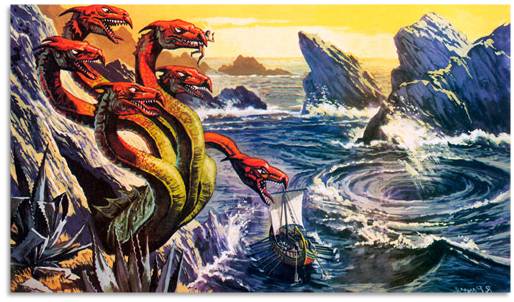 Erasmus then alludes to Scylla and Charybdis (location 1631). These two sea monsters from Homer's The Odyssey express Erasmus' feelings about giving credit to free will as well as to the grace of God: saying that man's free will does it all in life would be sailing straight into the hungry mouths of six-headed Scylla; saying that the grace of God is solely responsible would be flushing yourself down the Charybdis toilet. Interestingly enough, this latter subscription was Luther's, and Erasmus' comparison suggests that Luther opted to sink his argument's whole ship rather than lose on just a few points of doctrine. (Odysseus' decision in The Odyssey was much the wiser.)
 Luther likewise uses Scylla and Charybdis in his treatise at location 1789, and in the same way, too. Only he is not as subtle as Erasmus. Instead, he openly criticizes Erasmus for "escap[ing] safely through" the two opinions, finding refuge in the middle ground instead of defending an extreme.
Ironically, Luther had just alluded to another famous Greek by Aristotle in a spirit of 'friendly criticism' (location 1776): "Plato is my friend, but truth must be honored above all." We see from the rest of Luther's treatise that he did indeed honor every truth he could find, but would certainly not consider Erasmus a friend.
Through these citations of Greek people and ideas, Erasmus and Luther showed their intellectual prowess and thus increased their ethos. They also created powerful mind-candy metaphors with which to enhance their arguments.
