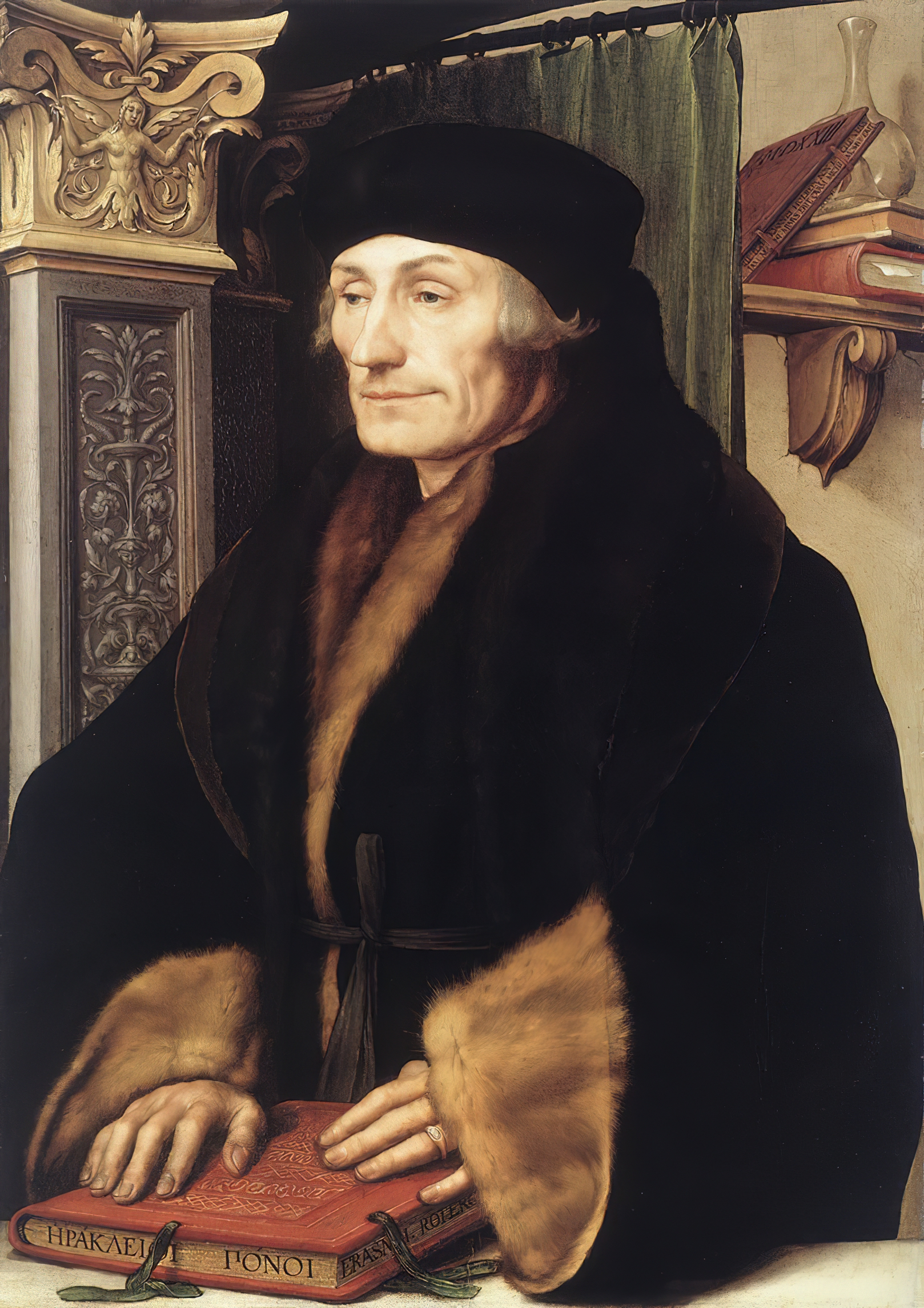
Showing posts with label Erasmus. Show all posts

Tuesday, February 3, 2015

Contrast and Causes

The Renaissance really wasn't that awesome. 

Maybe I'm sabotaging my grade by thinking that way, but hear me out. 

The main underpinnings of the Renaissance and Reformation really weren't 'new'. The Greek's had celebrated the individual thousands of years before, Humanism wasn't a groundbreaking concept. Exploration had occurred previously - heck, the Vikings had found the 'new world' hundreds of years before. The Reformation was an outright attempt to return to the tenants spoken by Christ that had caused similar religious upheaval 1400 years before. What was Sprezzatura except an attempt to regain the intellectual culture fostered in the ancient civilizations. Even the printing press, while truly amazing, was simply an enabling tool, allowing for greater propagation of these rediscovered ideas. 

True, most of the buttresses of modern society can be traced to ideas that were rediscovered during the Renaissance - they were at best caretakers of the ideas. Why so much fuss? 

Well, as our good friend Erasmus liked to say:


"In regione caecorum rex est luscus."
"In the country of the blind the one-eyed man is king."
(Adagia, III, IV, 96)

Or, as I like to say:


"In a box of black crayons, even a gray one seems bright."

You see - the achievements of the renaissance weren't really groundbreaking when considered as part of history as a whole. But when considered against the backdrop of the Middle and Dark ages (though I maintain we give them a harder time than they deserve) the age really begins to shine. 

"In essence the Renaissance was simply the green end of one of civilization's hardest winters."
 (John Fowls, 1969)

It's when the ideas that make up the reformation - from Humanism to Sprezaturra - are considered against the backdrop of 14th century Europe that they truly begin to shine. The Bubonic Plague had swept Europe, leaving a third of the populous dead in it's wake. Centuries endured in the uncertainty and insecurity of the feudal system proved a stark background for rediscovered concepts of individual worth and achievement. The slowly tightening hand of catholic oppression and corruption made the reformation shine as few other religious upheavals do in our history books today. 

It was the severity of the winter that made the spring so sweet, when in reality the spring was not terribly remarkable in and of itself. 

When I think on the renaissance I think of that one-eyed man. That these men were brilliant - but no more brilliant than we are today. It was simply that, when cast against the proper backdrop, the ordinary becomes extraordinary. 


"How far that little candle throws its beams!"
(Merchant of Venice, Act V, Scene I) 


The Renaissance of the Butterfly and the Human Spirit

    Quoth Erasmus, in contemplating the role of free will, “If you keep thinking about what you want to do, or what you hope to do, you don’t do it and it won’t happen.”
    I find something very reassuring in the fact that God can create a butterfly out of a caterpillar. Think about it for a minute. There’s this squiggly, ugly, hairy thing—very unattractive in form and outward appearance—that wraps itself up, goes to sleep for awhile, and poof! Magical transformation, right? Wrong, at least on some counts. The actual science behind it is a bit more…well, messy, shall we say. Sparing the details, the point is that the potential contained in that ugly caterpillar is not something we can easily recognize, no matter how closely we examine it. Aren’t humans much the same? There is a spark of the divine wrapped inside, and it may be necessary to shed some things, dissolve some others, and rebuild from the basics to regenerate and grow into what we can become. We become through a process.
    Erasmus had no priest at his bedside when he died, perhaps because he was able to intuit that if the inner man wasn’t aligned with God and His purpose for him, any outward manifestation wouldn’t matter. His relationship with God was a private matter; it was not dependent on a priest or a facilitator. It makes me pause and wonder what miracles of growth we miss by being passive, rather than being an active participant in our own lives? Humanism in the Renaissance period focused on the potential and value of the individual. Do we see ourselves more collectively than individually; do we become what others say we are, rather than what we feel we are, or should be?
    Can we become more than the caterpillar who spends most of his life ingesting material in a frenzy to survive and then wraps himself up in self-preservation? They may be necessary steps in his progression, but they are only that—steps. As we reflected in our “salon” conversation, it is the application of what we know that matters. Exploration is necessary--even desirable--in life. What strengths can we uncover through testing and trying? Why do we fear reaching beyond the known? Life has its mud puddle and rainstorm days; it gets messy. Mistakes aren’t generally fatal, although we often regard them as such.
    For all of his dogged, focused determination to foster reform and change, combined with a seemingly uncompromising attitude, Martin Luther has been quoted as saying, “If I am not allowed to laugh in heaven, I don’t want to go there.” I agree! I know of no other way to survive—to enjoy—life than by employing what I call “battle humor.” I am happiest when I can laugh at myself and not take offense when others laugh with me. I am evolution in front of your eyes. The master isn’t finished with me yet; I am still finding my wings.


Wednesday, January 21, 2015

Tuesday, January 20, 2015

Scriptures as Evidence

When I was a freshman in high school, an upperclassman on my swim team started a conversation that left me perplexed, given that she was citing scriptural reasons why, in her opinion, my faith did not qualify to reside under the umbrella label of Christianity as hers did.  While this particular incident left me hurt and confused (especially considering my knowledge of the scripture at the time was more focused on the broad details than the specific) what happened was a small example of a common theme in Christian history—utilizing the scriptures to form a personal opinion on how gospel principles should be played out in a church.

From One Humanist to Another

As we were asked to write this week’s blog post on our response to Erasmus’ and Luther’s Discourse of Free Will, to be honest, my first initial response was, “I don’t get it.” I had a hard time following the two men’s points of view. But I did do some research and looked at some outsides commentary on the book that hopefully helped me understand the reading better.

Even if I didn’t fully understand what the two debaters were saying, I did try to pay attention to their rhetorical devices. Both seemed to have an excellent awareness of their audience and their opponent, and a good sense of decorum. Erasmus starts out his very first 
section by acknowledging that he is looked at as much more        
insignificant in comparison to Luther. He understands that his 
audience could be the general public and he recognizes their 
thoughts and feelings. Throughout his writing, Erasmus, also 
seems to write a lot of comparisons and analogies so that more 
people will understand what he is trying to say.

While they are both of the same day and age, Erasmus and Luther have different opinions of free will and different ways of examining the will of man. Erasmus is rejecting the Reformation’s version of man and explains that man is capable of doing good and this good can lead to his salvation. He talks a lot about grace and how man can receive different types of grace to be saved. He offers a lot of examples from history and the Bible, but as a humanist, he puts a lot of human reason and philosophy on his interpretation of the Bible. He also tries to acknowledge many different sides to his theories. But his human reasoning seems to weaken and muddle his position as he tries to argue this Christian doctrine, but doesn’t exactly take a strong enough stance.

Luther, on the other hand, becomes more sure of his position as he responds to Erasmus. And while he debates against Erasmus, he wants to bring him to an understanding of the truth, as well. Luther’s main source to his argument is solely the scriptures. He comes much more strictly from the Reformation philosophy and mindset, to where he believes the Spirit is what is necessary to interpret the scriptures and not as much human reasoning. Based on his interpretation and methods of arguing, Luther believes man is not capable of doing good, but that he is evil in nature and is brought down by sin, but is unaware of his own corruption. Man is not free to choose grace.


Both men do a good job of acknowledging who their audience and opponent is, but differ in their opinions of man’s sin and free will. They also have different ways of arguing this as Erasmus gives a more humanist thinking approach to scripture, and Luther sticks to a Protestant Reformation approach and goes off of scripture alone.

Haters Gonna Hate: Why Audience Is Important

The hate group, the swing group, and the love group; these are how modern companies classify customers’ opinions of their products. Because it is hard for a company to switch someone from the hate group to the love group, companies tend to have their advertising directed at the swing group. We could consider the customers to be the company’s audience.
 
People are classified by their opinion into these 3 categories
In reading the debate between Erasmus and Luther, it is easy to see who the intended audience is. Erasmus is targeting the swing group, and Luther is targeting the hate group (at least the head of the hate group).

A Great Debate!

Both Erasmus and Luther implored rhetoric using the scriptures in a similar way. They would introduce a topic and then go straight to the bible to add validity to their words. Expounding upon the scripture they had just referenced, they would attempt to make their point by stating their interpretation of what had been said. This style reminded me of the Montaigne style essay we recently did where we started with a quote and then talked about or thoughts on it.

Although they did not agree with one another they did show outward respect to each other. One aspect I think is important to note is that they had tolerance for the others belief an opinion even if they didn't agree with it. This freedom to express a belief that is different to the norm and not be punished impacted the protestant reformation. It allowed more and more people to stand up for what they thought to be right and live according to it.

Desiderius Erasmus argued his perspective on free will from a Christian humanistic point of view. He pointed out how the bible tells us and shows us what we should do and the way we should do things. The Church also aids us in knowing what we should do in this life. Erasmus illustrates how we need to act in order to fulfill what we have been instructed to do. The responsibility to act rests with man and God has given us the power to act and fulfill all the commandments that God has given us.


Based on the amount of logical persuasion Erasmus used, I would have to say that I think his argument was much more influential. He had a plethora of proof from the scriptures that he brought to the argument and effectively explained it.

The Difference in Rhetorical Discourse


“Brutus was an honorable man” – Antony, “Julius Caesar”

As I was reading the Erasmus and Luther arguments, that line from Antony kept coming into my head. Here were two men, each trying to undermine the other, yet treating each other with respect that was, in some places, over the top. Eventually, readers of “Julius Caesar” come to see the honorable line in an ironic light, and I also came to see Erasmus and Luther’s praise for each other as ironic. They used phrases like “literary prowess and intellectuality” to build the other up while in the same breath they tore the others argument apart.

Although they each had different ideals, they both attempted to persuade—one of the pillars of rhetoric. However, in their modes of persuasion they highlight a difference between rhetorical theory of the Renaissance and current rhetorical theory.

Monday, January 19, 2015

Is There Free Will or Not?

The discourse between Erasmus and Martin Luther on free will is a fascinating discussion.  Both men used some strong language and rhetoric to argue with each other, and it was awesome to see an in depth discussion about something that is so important to those of us who are Christians today, since the debate over free will isn't entirely settled among all Christian faiths.

Despite the combative and maybe even offensive rhetoric that both Erasmus and Luther used, both still remained respectful of each other.  For example, Luther says to Erasmus “… artfully you debate this matter with wonderful and continuous restraint, preventing thereby my becoming angry with you.”  It’s a great example to me to see two men with very different and opposing viewpoints argue peacefully and civilly with each other.

While remaining respectful of each other, it was a thought-provoking debate.  Luther clearly starts his arguing from the belief that everything comes about because of God’s grace, or whatever God wills to happen.  For example, Luther states “But tell me this:  was anyone of them made a saint, did anyone of them receive the Spirit or work miracles in the name of the free will, or by the power of the free will, or to confirm the free will?  Far from it, you will say, but in the name and by the power of Jesus Christ were all those things done, and for the confirmation of the doctrine of Christ …”  Before Luther stated this, Erasmus had said “But you fail to define the limits within which we should think of the will as acting and as being acted upon.”  Erasmus clearly was attacking Luther by pointing out that Luther would speak of free will as being free and as being acted upon, but then state that free will is a lie.  Erasmus’ view was obviously the belief in free will.


I believe that Erasmus was much more convincing than Luther.  Luther seemed to come off as if to say that Erasmus was ridiculous because he wasn’t going along with what was clearly the truth, but then Luther didn’t seem to have any real evidence to back himself up.  Also, coming from an LDS perspective, I agree with Erasmus, so I’m sure I have a bias J.

Obscurity vs Certainty: Erasmus & Martin Luther on Free-Will

           With topics of religion it is my personal opinion that the delivery and invention of one’s argument is often far more important than the truths or content therein. Erasmus & Martin Luther both take very different angles when making their arguments on free-will.

Erasmus

            Erasmus’s mode of argumentation, not even to mention his actual view on what he is arguing, is that of reason before scripture or doctrine. Erasmus uses his own to reason and logic to rationalize his arguments. Instead of scriptural references, he uses powerful analogies, such as the boy who can’t reach an apple without his father’s help, to really drive home his ideas… but he wouldn't let the untrained audience know that. There were loads of scriptures throughout Erasmus arguments, but their inclusion was primarily a tool used to balance Erasmus arguments of “man meriting salvation” and “God’s grace”. Martin Luther would later argue “Erasmus speaks out of both sides of his mouth”, which I think is a valid observation, although I feel that Erasmus did it quite effectively. Erasmus further used the scriptures for their uncertainty rather than to back up doctrinal truths. This uncertainty of the scriptures is another effective invention by Erasmus in building his two sided argument on the existence of free-will and God’s grace.
A key scripture argued/used by both Erasmus & Luther

Luther

            Because Martin Luther’s Bondage of The Will is in direct response to Erasmus’s argument his approach is quite different in many ways. Martin Luther focused wholly on divine truths back by the scriptures, counter arguing Erasmus use of scriptures. Luther focused on what he believed to be the certainty of scriptures, which he argued that if any verse seemed obscure it was due to the weakness of the reader, not the Word itself. He continues to use the scriptures as a foundation of certainty to back up his arguments and attack Erasmus’s. This method of Luther’s was clear when he said that Erasmus argues “like a man drunk or asleep” blurting out things here and there.

So who won the debate?


            As a Mormon I was able to see a little of truth in both arguments. Interestingly I felt more apt to side with Erasmus because of his rhetorical style, using both the scriptures and reason to back the duality of his argument. For Christian humanists & people of the reformation however might have sided more with Martin Luther as his argument was a little more “happy” or easier on the ears than Erasmus’s.  

The Road Less Traveled

    "...Pleading for the light is what opened this dispensation. It is what keeps it going, and it is what will keep you going." So spoke Elder Jeffrey R. Holland in a 1999 BYU Devotional entitled, "Cast Not Away Therefore Your Confidence". In it, he addresses the issue of coming unto God with our questions with faith that they will be answered, although opposition may rage. I couldn't help but think of this in relation to the reading of the treatises of Desiderio Erasmus and Martin Luther. There opposing views gave much for men of the 16th century to think about, and in many ways, the debate still rages. While I honor the study, pondering and forethought that must have gone into Luther's impassioned writing citing corruption within the Roman Catholic Church, and his subsequent call for reformation therein, I was disappointed at his seeming lack of understanding on the subject of free will. This was tempered, however, by further reasoning on my part that inspiration and revelation come line upon line, and are generally suited to the time period in which they occur. There must always be trailblazers in every dispensation, and one builds upon another, until the light can be fully developed and new understanding dawns.
    In that light, I was intrigued with the depth of understanding which Erasmus exhibited in his thoughtful view and treatment of sacred scripture. His consideration of it in the light of reason--a faculty with which I believe man is endowed for divine purpose--was likely ahead of most of the thinking of his time, and doubtless provoked much continued thought and debate; perhaps the reason it was granted in the first place. Both men played an integral role in promoting the thought and inquiry that fanned the flames of the Protestant Reformation, as the Roman Catholic Church began to lose its ability to dictate, the publication of treatises sparked debate among classes, and Christian Humanism celebrated man's individual rights, freedom and will.
    For my part, I am grateful for those who sought enlightenment and were brave enough to take the road less traveled. I am the beneficiary, though generations removed, of their questions, study and pondering. I have walked in solitude down the path which runs through the Sacred Grove, and pondered the path of the feet of a young boy who sought answers to his quest, first by study, and then by faith. I am grateful to know that I, too, can pose questions and seek answers, resting in the knowledge that He hears me.


Christian is the New Greek

Though Erasmus of Rotterdam and Martin Luther disagreed on the issue of free will, they both demonstrated the Renaissance theme of Ad Fontes. Each returned to and recognized the value of Greek tradition in his treatise.

Erasmus compares the battle of Achilles and Hector to the fight between religious sides (location 1615), emphasizing the intensity and utterly unyielding nature of the conflict. Doing so, he characterizes the adamant war between himself and Luther--and we see more evidence of that adamancy in Luther's rebuttal. 

Erasmus then alludes to Scylla and Charybdis (location 1631). These two sea monsters from Homer's The Odyssey express Erasmus' feelings about giving credit to free will as well as to the grace of God: saying that man's free will does it all in life would be sailing straight into the hungry mouths of six-headed Scylla; saying that the grace of God is solely responsible would be flushing yourself down the Charybdis toilet. Interestingly enough, this latter subscription was Luther's, and Erasmus' comparison suggests that Luther opted to sink his argument's whole ship rather than lose on just a few points of doctrine. (Odysseus' decision in The Odyssey was much the wiser.) 

Luther likewise uses Scylla and Charybdis in his treatise at location 1789, and in the same way, too. Only he is not as subtle as Erasmus. Instead, he openly criticizes Erasmus for "escap[ing] safely through" the two opinions, finding refuge in the middle ground instead of defending an extreme.

Ironically, Luther had just alluded to another famous Greek by Aristotle in a spirit of 'friendly criticism' (location 1776): "Plato is my friend, but truth must be honored above all." We see from the rest of Luther's treatise that he did indeed honor every truth he could find, but would certainly not consider Erasmus a friend.

Through these citations of Greek people and ideas, Erasmus and Luther showed their intellectual prowess and thus increased their ethos. They also created powerful mind-candy metaphors with which to enhance their arguments.

Rhetoric at its Finest: Erasmus vs Luther

Erasmus and Luther blossomed out of the Renaissance with evidence of the class theme: What a Piece of Work is Man: Humanism and Rhetoric.They attempted to argue/persuade each other and others in their time and beyond how free will takes role in one’s life. 

 “I think there to be a certain power of free choice…by free choice in this place we mean a power of the human will by which a man can apply himself to the things which lead to eternal salvation, or turn away from them.” - Erasmus

Erasmus believed that all human beings possessed free will, and that the idea of predestination was not in sync with the teachings of the Bible. He believed the principles of the gospel depended on the existence of free will, and that grace only helped one to come to a knowledge of God.

"The essence of Christianity which you (Erasmus) describe -- is without Christ, without the Spirit, and chillier than ice ---" – Martin Luther

Luther responded that we are unable to bring ourselves to God alone; that sin disables us to do so. Therefore, there is no free will for humanity because any free will they might have is taken over by the influence of sin. He argued that people do not choose between good or evil, because they are naturally dominated by evil, and salvation is the product of God changing a person's heart. He held that arguing otherwise was insulting God, and would not make one Christian.

Looking at the two points of views, I can understand where each one is coming from. Erasmus tends to rely more on humanist principles, and Luther tends to rely more on Christian faith. These principles together create a bond called Christian Humanism. We do have free agency, which was a gift from God. We also have the gift of repentance, which we can use if we do choose sin and decide to change. We do need to choose good, but we can’t do it alone because everyone chooses evil at some point in their lives, and we need that extra help called the Atonement. Tying back to theme, this interaction and communication between the two is a great example of how rhetoric and humanism was used during the reformation.

Thursday, January 8, 2015

Renaissance Swag: Why Desiderius Erasmus Was Called the "Prince of Humanists"

“Happiness is reached when a man is ready to be what he is.” (Desiderius Erasmus, 1466-1536)

As we browse the various Colleges within any major University we are sure to see one labeled Humanities. These Colleges developed directly from the rich historical philosophies and traditions within Humanism—a branch of classical philosophy called, in Latin, “humanitas”—which was reintroduced in Italy during the early European Renaissance by the scholar Petrarch (as explained by Joseph Pearson in his blog post, “Reborn from the ashes”). Why then, if Petrarch helped facilitate the rebirth of Humanism, was Desiderius Erasmus called the “Prince of Humanism”? Well, it boils down to the following: When it came to Humanism, Erasmus was a man that practiced what he preached; we rarely find those two actions in congruence.
            
Though he educated himself at many renowned Universities, Erasmus considered himself an independent and nonpartisan scholar. He embraced a system of thought that gave primacy to human beings rather than the divine (though he expressed deep respect for the Catholic Magisterium). With correspondences to more than five-hundred men involved in politics and philosophy, Erasmus was at the center of the literary movement in his generation. He was an example that we can emulate in 2015 by speaking up and speaking on important issues.

Erasmus challenged the medieval views of Academia and the Catholic Church with his satirical writing by addressing the innate value and potential of human beings as well as the issues we all face. To top it off, Erasmus accomplished his influence—entering many discussions with serious religious topics and political figures—without taking sides or being marginalized by political leaders. The scholars that he corresponded with respected the way he expressed his humanist ideals. That, my friends, is Humanitarian Swag—when we can persuasively argue yet still be agreeable.