Showing posts with label stasis. Show all posts

Friday, October 31, 2014

Conflict Issues and Special Topics of Invention in Elementary Education

A point of conflict in Elementary Education
Politics and Elementary Education frequently come into conflict and one point is that of classroom size.  The schools aren't receiving enough funding from the government to hire more teachers and some schools are even letting go of teachers.  This leads to fewer teachers and more students so class sizes are increasing rapidly.  

Topics of invention in Elementary Education
Speaking a community forum a teacher or group of teachers may try to address the need for smaller class sizes to benefit the learning of the individual students and help funding for this to occur. A teacher could say something of the following:
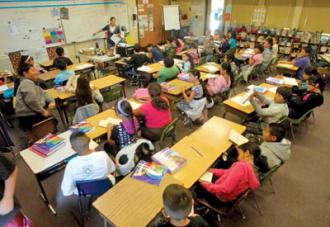
A crowded classroom in California
"We are here to discuss the future of our children, our community and our country.  Have you ever been in a large group and something had been discussed that you didn't quite understand but because of the size of the group you felt your voice had been lost?  Children today are getting lost in these large class sizes.  They are entering a different community with different rules and often they get lost and left behind.  Isn't this contradictory with the No Child Left Behind Policy?  Your children and community need your help.  It is possible to make a difference in our community by donating and helping to fund the schools so that class sizes can be smaller and your children can have their voice heard and their needs met.  This is how real learning will occur.  The benefits are enormous for not only your family, but also our community and country.  Please stop and think of the future and make a difference today."

Analysis
A special topic of invention that was used is that of The Advantageous/The Disadvantageous where the disadvantages of large classroom size was emphasized and the advantages of small classroom was also emphasized.  The teacher wants to move the community to action so he/she will use the special topics of invention for a deliberative speech.  Some other common topics of invention can be used like Law (No Child Left Behind), Antecedent and Consequence (consequences of large classroom size), and the Possible/Impossible (show the difference that is possible when action is taken).  

Thursday, October 30, 2014

Conflict Issues and Special Topics of Invention in English Teaching


English Teaching can often be quite stressful!
            Every day of the week, English teachers are constantly in some sort of conflict where they must convince others.  An extremely common point of conflict, or stasis, in English teaching is how to best teach the students.  Disagreements often arise between English teachers and other English teachers or, more likely, between English teachers and administrators on how to best teach and engage the children. 

           
Take this common scenario of conflict.  


Principal Collins, fuming, burst into Mr. Rice’s classroom early last Friday.  In a rage, she demanded to know why he refused to teach Shakespeare’s Romeo and Juliet to his 9th grade class this semester and taught them the more “mature” Othello instead.  “This violates the state and the board’s educational laws and outlines!  There will be a standardized test at the end of this year, and you haven’t taught them the necessary material!” she seethed.  Mr. Rice sighed.  He hated teaching Romeo and Juliet.  The class consistently became much more engaged in Othello than in Romeo and Juliet, and he had looked at the test objectives.  They required perhaps a small summary of the play and nothing more.  Why, he wondered, did he have to teach his class anything but what he wanted to teach them?  They would get everything covered that they needed to cover.  Grammar, essay writing, literature, everything needed would be taught.  Mr. Rice stated slowly, “Ms. Collins, I take great pride in teaching my class and helping them learn and grow in English.  My students’ standardized test results consistently have been 20% higher than the state’s average, and I see no reason to deviate from my proven method no matter how much the state or board changes the requirements or curriculum.”  “Your job is a good reason, Mr. Rice,” Ms. Collins simpered. 


English teachers may not want to teach the
standardized curriculum for their class.
            Here we see a special topic of invention common to public school English teachers.  The idea of the law vs. personal desire occurs quite a bit.  Mr. Rice wants to teach what he wants to teach in English.  However, the state dictates that he teach a certain curriculum to his students.  Mr. Rice might be a better English teacher without the restrictions of the curriculum, but he, by law, must teach a certain way or he will lose his job.  The common topics of invention of law and cause and effect also occur with this special topic.  Law or at least school board doctrine must always be taken into account in Mr. Rice’s teaching.  Furthermore,  Principal  
Collins thinks that if Mr. Rice fails to teach his students the proper curriculum, the students will fail the standardized tests.

Another special topic of invention seen in this scenario is learning vs. curriculum.  Sometimes learning does not occur even with approved curriculum.  Mr. Rice must struggle between teaching approved curriculum and teaching what he feels is best conducive to learning.  Reconciliation can occur with the style he teaches.

Engagement’s relationship to learning is yet an additional special topic.  Mr. Rice thinks that the more engaged a class is in a topic, the more they will learn.  I do not think anyone doubts this fact, but trying to engage students is a classic problem for all teachers everywhere.
Tuesday, October 28, 2014

Cicero's Farewell and Homecoming

Macey’s concept that Cicero’s De Inventione was more related because of the similarity in age I found intriguing.  Although I found it insightful, I disagree that De inventione was “more helpful in developing one’s own cognitive reasoning” about the art of rhetoric.  I found De oratore to be much more insightful and because it was formed out a dialogue it showed that anyone can add to it and help establish the concept whereas in De inventione Cicero only stated what was to be understood as correct.
                In De inventione, Cicero discussed terms and their uses in the legal court.  He was studying to be a lawyer so this information was best understood by those in that field.  In De oratore, Cicero, after much experience in the field, uses a dialogue format to discuss when it is appropriate to use such terms.  It reminded me a lot of serving a mission.  In the MTC we discussed ideas for teaching and inviting the Spirit.  You think you understand a lot about missionary work, until you go into the mission field.  It is in the mission field that you really become to understand the practical uses rather than the hypothetical or supposed uses of these techniques.  I can’t speak for others but I felt that I was just becoming to understand missionary work when I was ending my mission. 

                I think this can be seen in Cicero’s De inventione and De oratore.  He knew the potential uses of the rhetorical devices but after years of practicing law he could expound upon them and give examples for when certain terms were to be used.  I thought it was interesting how he expanded upon his idea of stasis.  He wrote of the importance of stasis in De inventione and discusses the conjectural stasis in the question of whether or not something occurred.  In De oratore he expounds by discussing the questions asked to decide which type of stasis is being discussed, “Conjecture involves four questions: What exists? What is its origin? What is its cause?  What can change?”  I think that Cicero’s experience served him well in explaining rhetorical terms and how they should be used.