Showing posts with label posted by Ryan W. Show all posts

Wednesday, January 28, 2015

Savonarola's self-identification


It is difficult to imagine a rhetorical situation in which one’s own life is at stake. I can only wonder if Savonarola had any regrets as he was tortured, and then hanged, and then burned at the stake. That’s literally overkill. This isn’t trivializing the situation, either; this is trying to make sense of the kairos: a world where people are not only willing to kill other people for heretical disagreement, people are seemingly equally willing to die defending their disagreement.

The genre, as designated by the introduction to the sermon, is that of a “Feast of Ascension.” The holiday commemorates the 40th day after the resurrection of Jesus Christ, to mark the day he ascended back into heaven after his resurrected ministry. It appears that this holiday was marked by some level of frivolous extravagance, to where Savonarola felt the need to speak on that day, at that time.

When Savonarola starts: “I am oppressed in all things,” he intends to appeal to the senses of similarly minded people. He anticipates an audience who can relate to that situation, and say: “Wow, you know what? I feel pretty oppressed, myself. Let’s hear this out.”


An additional insight into Savonarola’s rhetorical stance is demonstrated by his self-identification to the story of Balaam and the ass.  This biblical reference not only reflects Savonarola’s ethos as a preacher of the Word, but he is giving theological context to his plight to evoke pathos from his audience. It is quite evident that he is appealing to a Catholic audience, people of religious circumstance. It is quite an evocative setting, then, to identify himself as a sort of humble servant, the metaphorical ass as the parallel to Biblical text. He seeks to identify himself as a very apparent opposite to the decadence that he so openly condemns before him.

Tuesday, January 20, 2015

Religious Authoritarianism and Relative Truth

On the topic of religious authoritarianism I find myself conceptually somewhat divided. I have met plenty of people who don’t think organized religion has the best answers, or all of the answers. My best friend, in fact, feels exactly this way. I can remember him coming to church with me so many times, and so many LDS core doctrines resonated within him. And yet, he was never baptized, and I couldn’t figure out why. During my mission, I wrote to him often, seeking to see some sort of change in him, that if somehow I could ask the right questions, or provide the right answers, he would have that lightbulb moment and come around to my way of seeing the world. It never happened, and a year after being home from my mission, I recall we had the conversation again. I just wanted to know, honestly and sincerely why he couldn’t accept baptism into the LDS faith. He explained to me, clearly and plainly, “I find so much truth with LDS people, but I don’t see all of it. I don’t think it’s untrue, necessarily, I just don’t think it’s all of the truth.” I was dumbfounded. I had nothing else to say but that I respected his views on it, and would seek to understand it better in the future.


I relate this experience because I feel like it was all I could think about while reading Erasmus and Luther. Truth is a difficult concept to capture in these rhetorical terms. As I read Erasmus, I found myself nodding my head, feeling some form of wisdom in his words. Then, reading Luther I thought, wow what was Erasmus, and myself by association, thinking?! I find truth to be whatever resonates within one’s own soul, and I think the contradiction of interpretation in the scriptural proofs to be evident of that, just as I found in my discussions with this old friend. I think that is a large part of what I have felt in the Renaissance and the Reformation. Man, being unwilling to follow a course in which his soul finds no comfort, reaches out for something else. Some would use the term, he is reaching higher, but I can’t willingly associate this with a vertical plane. It is not higher or lower, simply different.

Saturday, January 17, 2015

Of Men and Rivers

"But Rivers alter their course, sometimes beating against the one side, and sometimes the other, and some times quietly keeping the channel." 

I love this. It reflects the spectrum of the human experience. It reflects an aspect of the Renaissance themes from class, this idea of a river being capable of altering its own course. The interesting thing to me is how accustomed we are to this idea. We are so oversaturated with experiences from our culture that affirm our human potential. Everyone loves hearing a good miracle story – the boy or girl who pushes past respective circumstances to reach out to something greater.

I wonder then, if we have found ourselves in the category of ‘quietly keeping the channel’. I also am curious at the implication, as well as the connotation, of this phrase. First, I’d like to treat the connotation of this idea. It is difficult, even within the context of the text, to find Montaigne’s true intent; I’d like to believe that it is not a negative connotation. It seems quite ambivalent: a statement of perceived truth.

That being said, how do we connote it ourselves? I think it’s a somewhat negative thing in our culture today. ‘Quietly keeping the channel’ can easily be interpreted as a sort of crowd-following blindness. There doesn’t appear to be anything exciting about it, and if everyone always kept that channel, we wouldn’t have any sort of progression as a race. So, it becomes an interesting implication: Is humanity defined by the potential to truly alter a respective course, beating against the sides of our channel?

In the face of this question, I’d like to assert that there is a purpose for Montaigne’s ambivalence. I think there is a true sense of nobility in ‘quietly keeping the channel’. I think of the honor code. We live a set of rules that govern our lives, and it is this channel that directs us. So where does this leave us, in regards to the previous question. Is humanity defined by the potential to alter a respective course, or by the principles of quietly keeping the channel? I think Montaigne’s ambivalence points us to the answer. It is defined by the balance of both.


Tuesday, January 13, 2015

Dante the Champion


Dante is one of the most compelling figures in my mind. Amidst a sort of divided political civil war, with a significantly oppressive Catholic presence at the time, Mr. Alighieri decided to go and write one of the most religiously polarizing texts. This guy was a champion on so many fronts: religious expressionism, personal transcendence, common language (il volgare fiorentino, as it was known at the time). I mean, wow. This guy was bold. And he paid for it. Excommunication and exile from Florence were probably not on his bucket list. What amuses me perhaps even more is how the Catholic Church, I believe, post-humously re-instated Dante’s religious status.
As I ponder my personal relationship to this man, I think of the complexity of religious expressionism. I mean, are these ‘Women for the Priesthood’ groups the ‘Dante’s of our generation, willing to challenge the foundational ideas of their day, despite the inevitability of excommunication? I can hardly imagine so. It is a complex issue, and I think it is quite emotionally charged by members of the LDS community. I don’t know if I can really approach that one with a 10-foot pole.

On a deeper level I can find resonance with the principles that his actions demonstrate, rather than the actions themselves. Free thinking is so important, and yet so underrated, even at a university level. Dante challenged his circumstances, from theology to linguistics, and shaped the world in a way that will never be forgotten. He was willing to have a vision of a language of the common man, and didn’t waste his time trying to convince people to start using it – he just went for it. He wrote something that shaped humanity, and it could not be ignored. This is notably different from Petrarch, who advocated the use of ‘il volgare’, but somewhat ironically advocated it in Latin.

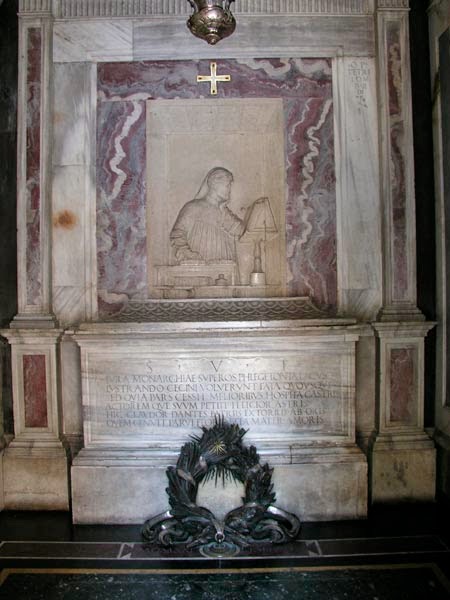
*The picture is of Dante's Ravenna tomb.

The Road to Self

In the summer after high school, I was a part of a group that rode bicycles from Monterey to Santa Barbara in California. It was a trip that lasted more than 200 miles, over the course of 3 days. I remember training for that trip. It was brutal. Our training rides started at 10 miles. I could do 10. Then we did 20. I thought, okay, I can barely survive 20. Then, one day we went out riding, and it felt like we were never going to turn around. I started getting more and more nervous, the longer we rode, and instead of hoping to turn around, I started hoping for a car to be waiting for us around the next bend to take us back home. After approximately 20 miles, our leader, who happened to be my father, told us it was time to turn around.
My legs were screaming. My brain was screaming. I thought that if I had to turn my legs another revolution, they might just fall off. But I couldn’t just stop. So my legs kept turning. Next thing I knew, another hour passed. I somehow stopped thinking about it. I had some sort of moment where my brain felt like it detached from my body, and it no longer felt the pain. After the 40-something miles ended, I remember riding back up to my house, stumbling to get off my bike, and I collapsed in the front yard. It was one of the most blissful moments of my life. My perception of physical limits was shattered. I felt like I could do anything. Of course, I couldn’t even walk the next day, but I was not the same person anymore. On the third day of that biking trip, I rode over 100 miles in a single day. Those 100 miles were far easier than the 40. This illustrates the principle I can relate back to Petrarch. I had a sort of experience where I was able to discover something about myself. And needless to say, Highway 1 is gorgeous. 200 miles along that coast is phenomenal. I highly recommend it.

Children of The Mist

            We swim in a sea of history. Our present is a point in time that has an endless past, and an endless future. It is at some point in the 17th century that my tale exists. This tale is of a people called “The Children of the Mist.” Thinking of a family connection to history, I can recall a story my Grandmother once told me. It feels necessary to state that it’s been a few years since I’ve heard it; she also explained at the time that dealing with centuries of past ancestry is a pretty inaccurate sort of science. So I cannot guarantee that this story is perfectly valid. In the same way, I’d like to think of my recollection of this experience as a sort of folklore of my family that my Grandmother started: it is not necessarily 100% accurate, but is rich in myth and lore.

            So, the story of the Children of the Mist is one of the MacGregor clan. The MacGregors were supposedly one of the oldest clans in Scotland, but politics were never quite favorable to this family. My Grandmother claims a distant relation to one of these MacGregors, specifically Rob Roy MacGregor. The abridged version of this story is that in the 16th and 17th centuries, the MacGregor clan fell into disfavor with the monarchy of the era, and were deprived of their lands and wealth. It went so far as an extermination order being created. Being deposed of class and position, the clan found their way into the hills and countryside, continuing to live off of the livestock and crops from random farms. The MacGregor clan gained notoriety, and the name “The Children of the Mist” because they used the fog as a cover to hide them as they stole what they used to survive.