Showing posts with label post assignment 2. Show all posts

Tuesday, January 13, 2015

Dante the Champion


Dante is one of the most compelling figures in my mind. Amidst a sort of divided political civil war, with a significantly oppressive Catholic presence at the time, Mr. Alighieri decided to go and write one of the most religiously polarizing texts. This guy was a champion on so many fronts: religious expressionism, personal transcendence, common language (il volgare fiorentino, as it was known at the time). I mean, wow. This guy was bold. And he paid for it. Excommunication and exile from Florence were probably not on his bucket list. What amuses me perhaps even more is how the Catholic Church, I believe, post-humously re-instated Dante’s religious status.
As I ponder my personal relationship to this man, I think of the complexity of religious expressionism. I mean, are these ‘Women for the Priesthood’ groups the ‘Dante’s of our generation, willing to challenge the foundational ideas of their day, despite the inevitability of excommunication? I can hardly imagine so. It is a complex issue, and I think it is quite emotionally charged by members of the LDS community. I don’t know if I can really approach that one with a 10-foot pole.
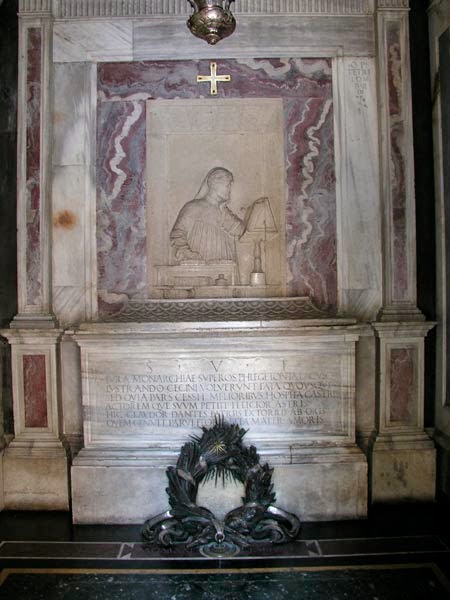
On a deeper level I can find resonance with the principles that his actions demonstrate, rather than the actions themselves. Free thinking is so important, and yet so underrated, even at a university level. Dante challenged his circumstances, from theology to linguistics, and shaped the world in a way that will never be forgotten. He was willing to have a vision of a language of the common man, and didn’t waste his time trying to convince people to start using it – he just went for it. He wrote something that shaped humanity, and it could not be ignored. This is notably different from Petrarch, who advocated the use of ‘il volgare’, but somewhat ironically advocated it in Latin.

*The picture is of Dante's Ravenna tomb.

Friday, January 9, 2015

Cervantes Syndrome

Miguel de Cervantes was an interesting, seemingly flighty character, who worked for the government in Spain (between jail visits) and wrote one of the foundational works for modern, western literature.

"The Ingenious Gentleman Don Quixote of La Mancha" often truncated to simply "Don Quixote" was one of the later renaissance works and one of few produced by Cervantes. It was published as two separate parts, the first released in 1605 and second ten years later and is the caricaturized story of a man, disenchanted with his modern life who dons a new identity and sets out on a quest to restore chivalry (much to the dismay of his friends and family who assume he has gone mad). The inspiration for this quest however is not madness as his family suggests, but the content of many books he has read that highlight chivalrous acts.


In fact, our hero was quite the bookworm. Even our narrator admits, "finally, from so little sleeping and so much reading, his brain dried up and he went completely out of his mind." This is significant personally, as I can relate to family chastisement for book-worminess, but is also significant in the larger context of the renaissance. This novel comes near the end of the period, and centers a new medium at the heart of the story: physical novels. The printed word had recently begun to permeate European life, and the novels of chivalry and brainless romance that were popular in previous periods are mocked in Cervantes' brilliant satire. I recognized my own unrelated follies in the endearing naiveté of Quixote, and can only imagine the reception of those who were openly mocked.

The clever style and subject of Cervantes' novel absolutely holds in our day. The poignancy of the meta-narrative is applicable to each new creative outlet, and as I scroll through my Twitter feed appreciating users who joke about people who use Twitter, I laugh as I suffer from rasin-brain also known as dried brain also known as Cervantes Syndrome.

Thursday, January 8, 2015

Father of the Spanish Language

Somewhere in the packed filing cabinets of my mother’s office are several small books that where made out of printing paper by my second grade self. These books contain colorful drawing and incoherent story-lines filled with characters from my imagination (and the movie Tarzan, because the elephant was my favorite character at the time) and peppered with the silly made-up words that my friends and I used in our everyday conversations. Likewise, in the works of Spanish writer Cervantes you could find many colorful characters and made up words.

The primary difference between the books written by Cervantes and myself (besides the literary merit, as needless to say nothing I wrote was near as good as Don Quixote) was that while my words slipped out memory after a few weeks the words that Cervantes created are not only still remembered, but are part of a regular Spanish vocabulary. In fact, Cervantes is to Spanish what Shakespeare is to English, buoying up the vocabulary of the infant Spanish language like the plays of Shakespeare contributed to the English language. He might have had even more of an impact, given that his works where published in the early 1600s, and where therefore in circulation longer. With the established dictionaries of today words created by an individual are less likely to catch on, but the brilliance of writers like Cervantes makes it easy to see why their words have endured and are still used today.

Where are the Renaissance Men of Today?


Think of the great leaders of the Renaissance. Galileo, Copernicus, and Leonardo Da Vinci. Michelangelo and Raphael. Don't forget Donatello, Machiavelli, and the rest. They all possessed great gifts. Galileo was a physicist, astronomer, and philosopher. Michelangelo, known so well for his paintings and sculptures, was also a poet and engineer. Machiavelli was a politician, writer, and philosopher. These men of the Renaissance had a diversity of gifts. In fact, they had more than merely a diversity; they had mastery of each of the gifts in that diversity.


The Unsung Hero of the Renaissance

When one speaks of the renaissance we picture the art, music, and architecture that are so familiar to us. From the Mona Lisa, Creation of Adam, and other famous pieces of art to the soaring buttresses that support the great cathedrals of Europe. We're well aware of Leonardo's fantastic machines and Machiavelli's Machiavellian views. But we often overlook the strides made in the field that has come to dominate our society today.  

Technology.
  
Not just mechanical, but logical, educational, and theoretical breakthroughs would serve as springboards for giants like Newton, Descartes, and Cotes.  

The arrival of the Hindu-Arabic numbering system in the High Middle Ages, coupled with the invention of the printing press and relative freedom to reexamine the familiar would set the stage for breakthroughs in mathematics, astronomy, chemistry and anatomy- as well as the first western attempts at formal computation.  

The works of men like Galileo, Copernicus, and Da Vinci would help establish what we know of as the scientific method. The resurgence of humanism and realism in art lead to learning from observation, precluding the great advances of the following centuries.  

When I am asked why I choose to study theoretical computer science, rather than something that can be applied to 'actually do something' I think of these men. Most of the luxuries of life that we enjoy today can be traced to theoretical methods developed during the renaissance. Imagine if Copernicus had not published his work because it wasn't practical. I study theoretical sciences because somewhere, someday, someone will be grateful that we figured out what seems like a useless piece of knowledge. Just like we are for the Cartesian Coordinate System, or the Heliocentric Model, or countless other scientific and technological advances that resulted from the Renaissance.  

Humanism and the Nobodies

In class we briefly discussed humanism during the Renaissance. We discussed that during this time people became more aware of and concerned with individual accomplishments. Individuals became more important as individuals, and not as part of larger whole. I thought to myself about how, outside of characters from the Bible, I know the names of very few individuals who lived before the Renaissance who were not royalty. This may be simply because the farther back we go in history the less we know about the people then, but I wonder if it has to do with this trend of humanism during the Renaissance. It almost seems strange or out of place when I read details about regular folks who lived b.c.e. Is this just me, or does anyone else think similarly?

@GutenbergHumanist


I don't know about you, but I love social media. Whether it's Facebook, Twitter, blogs, or Instagram, I love how easy it is to hear and be heard. Nowadays, social media has become a buzzword of sorts. But what would you say if I told you this buzz started over 550 years ago? Thanks to Johannes Gutenberg, the ways we spread our thoughts around in the western world have been changing more and more since 1450.

In his post “From Gutenberg to Facebook?”, Sean M. argues that Facebook (and I’ll take the liberty here of applying his argument to all forms of social media) follows the legacy of the printing press in its spread of information. I couldn’t agree more. He then goes on to discuss how the development of social media has led to both greater connection and disconnection from those around us, asking the question “What would Gutenberg think?” I however, want to focus on the question of “why has the spread of information led to greater connectedness and disconnectedness simultaneously?”


Humans Are Great

 For many years, especially during the dark ages, human worth was not very highly regarded. In the medieval times, artists solely created works that dealt with religion, and creations outside of this genre were not well accepted. However, during the renaissance this all changed thanks to men like Francesco Petrarch who challenged this way of thinking. 


Petrarch lived in Italy during the commencement of the renaissance. He was a scholar, a philosopher, a poet and most importantly he is considered the father of humanism. Humanism challenged the idea that art should strictly be about religion and it dared artist to create more realistic depictions of humans. Humanism also brought forth a thirst for deeper knowledge and to know more about the earth and how it functions. 

Satan often uses lies to make us feel that God does not love us and that our worth is minimal. I believe that this was one of Satan's many lies that was used during the dark ages. By diminishing the value of ourselves, education, art, poetry and other creative works, important things became unimportant and the humans of this time remained stagnant and lost. But thankfully because of Petrarch and other great men we can now see the value in others and most importantly in ourselves. 


Be Bold

Christopher Columbus had a very significant impact on the history of the world because he was willing to try what no one else had done before.  The consequences of his boldness are apparent in virtually every society today as we have new goods and foods introduced from the New World, completely different countries, and cultures.  His voyage wasn't without difficulty; because even for him to begin he had to go to a couple royal families for funding.  When he was rejected, he did not give up either - he continued.  We can take a leaf from Columbus’ book and be bold.

A Star is BORN!

"Raphael incorporated well-known people of his time into [his renowned School of Athens], such as Leonardo, Michelangelo--and even himself; perhaps he is suggesting that artists are the true stars of his era." - Drogin

Part of the Renaissance was indeed the celebration of art--but more important than the art was the arteests. As we discussed in class, and as Jennifer talked about in her post, the individual was the big star of the Renaissance. And what better way to honor a star than what Raphael did? There is something very worshipful in nestling a person into the beauty of a popular medium of art. People did this throughout time, and they do this now.

Think about Moroni naming the Book of Mormon in honor of his dad.

What about Dante putting Virgil in his The Inferno?

We've all seen animated characters who look like their voice actors.

And of course, people like Peter Jackson slip themselves into the movies they produce.


Doing things like this suggests that these people deserved it. Moroni loved his dad and had watched him pore over the plates of scripture all his life--why not name the completed abridgement after him? And Peter Jackson did a heck of a lot of work in New Zealand for his film trilogy. Shouldn't there be a shot of him eating a carrot in Bree? Of course, those two examples are on opposite ends of the spectrum, but they both represent the same idea. People in the Renaissance believed--and apparently we believe--that the creators, the artists, the stars, deserve to be recognized. 

...But do they? Should we still do what Raphael did? Because in my life, I've found that when I do something "worthy" of praise, that I like the praise to be directed to me, not just to my work. Is this not a common pursuit--to be the creator of something glorious, and then to get the glory for it?

And I know that the Renaissance was about turning from religion...but in the meantime, don't we forget the Creator who gave us these marvelous abilities in the first place?

An Artist and an Anatomist

When I think of the word Renaissance, one of the first names that comes to my mind is Michelangelo, a name that nowadays is practically "synonymous with the word, 'masterpiece.'"

To me, what makes Michelangelo's work so striking is his beauty and exactness in replicating the human body. The brawny shoulders, legs, and buttocks of David are smooth and flawless. Michelangelo paid such close attention to detail that even the veins on David's hands are anatomically accurate. Raw human emotion emanates from the mother Mary's facial expressions as she holds her crucified son in the Pieta. Only Michelangelo could make marble seem that alive.


How could human hands create art work that was so exact in resembling the body. Unbeknownst to most, Michelangelo was not only an artist, but also an anatomist. He began studying anatomy in the Garden of San Marco. After years of this, he resulted to studying actual corpses (which was forbidden by the Church, mind you.) Michelangelo used pure science to influence his artwork. By studying anatomy and the human body, this master sculptor and painter idealized what the Renaissance was truly all about. This time period pushed the bounds of science and art. Michelangelo was relating the two and recognized that science within itself is an art form. By studying anatomy, he recognized the importance and the beauty and the value that was now being place on the human body and human life. Through science, Michelangelo was better able to portray the new ideal of the "Renaissance Man" in his artwork.

In my own life, I have been able to see personally how science influences art. I am not a science person by any sense of the word, but when I joined the Dance major program here at BYU, I found myself being required to take science classes such as Human Anatomy and Kinesiology. At first I grumbled and complained. Anatomy was just too hard. But I soon started to see the value this knowledge gave me as a dancer. I was able to use the study of bone and muscle structure to better visualize the way my body moved in dance. I learned that this muscle connected to that muscle, so by stretching this muscle, I would indirectly be strengthening the other. These connections were what made me realize the value of science in my own art form. I too, was able to become artist, and anatomist.

Tyndale and the Internet

Possibly the greatest invention of the Renaissance, the printing press helped the printing of texts become more feasible.  Because of the printing press, William Tyndale was able to publish his English version of the Bible and distribute it to many people. The English version, as opposed to the Vulgate (Latin version), was comprehensible to people outside of the Catholic clergy. Tyndale translated the Bible, even under threats to his livelihood, because he understood the importance of that accessibility.

During class on Wednesday, Dr. Burton discussed how experimenting with new media can be analogous to publishing in the Renaissance period.

Petrarch, Griffey, Bublé, and more

From: Seattle Sports Net
On October 8, 1995, Edgar Martinez hit a line drive double to left field. This wouldn’t have been that big of a deal if star center fielder Ken Griffey Jr. hadn’t scored from second to win the division title against the Yankees. It was in that moment that my favorite number changed from 1 to 24 and, even though I’m right handed, I started batting from the right side of the plate. Griffey became one of my first heroes and people that I would try to emulate in my own life.

While fumbling through a library in Liege, Francesco Petrarch encountered a collection of letters written by Marcus Tullius Cicero. As the story goes, Petrarch was impressed by the letters and began to emulate the ideas from the letters in his own works and life. He saw Cicero as a sort of hero, kind of like what Griffey was to me. As Petrarch continued to draw from stories of the past he inspired the humanism movement. Focus turned from the great works God had done to the great works that man had done. 

Thanks to Petrarch’s inspiration to emulate the past, Machiavelli tried to perfect leadership based on kings and emperors from the past, Sir Thomas More created his Utopia based on the greatest civilizations to exist, and musicians like Michael Bublé and Bruno Mars are emulating the great musicians from recent history like Frank Sinatra and Michael Jackson. 

The humanism movement became much larger than the Italian poet, but Petrarch inspired, not just one but several generations of dreamers who, through a little narcissism with a dash of optimism, are creating, inventing, and doing great things.

Fearlessly Pressing Forward

Leonardo da Vinci was well known for a multiple array of arts. He was an inventor, painter, sculptor, draftsman and much more. But what is most impressive to me is not one single act or invention that he did, but rather the fact that he never allowed anything to prevent him from trying to succeed. Leonardo applied the principle of humanism effectively into his life because he truly believed that he could accomplish just about anything he set his mind to. As a result of this belief he never stopped trying and was free to experiment with new ideas. This freedom allowed Leonardo da Vinci and many others to follow their curiosity and bring about great changes.

Renaissance Men are a Big Deal

“Its just Shakespeare’s house, no big deal.”

I’ve actually heard that phrase, if you can believe it. My friend and I were in Stratford-Upon-Avon, and we were slightly lost—we found a nice park, a church, and the theatre, but we couldn’t find the house the Shakespeares lived in. She was ready to give up and go sit in a warm coffee shop, which sounded like a great way to get out of the drizzle. 

I convinced her that it would be worth our time (I may have promised something important in return, like a first born child or something), and after a little more wandering, we found the house. Then she had the privilege of being present for my English Major fan-girl moment.

Reborn from the ashes

“What if I told you insane was working 50 hours a week in some office for 50 years at the end of which they tell you to [leave], ending up at some retirement village hoping to die before suffering the indignity of trying to make it to the toilet on time” -Steve Buscemi’s character in Con Air.

The Renaissance Man

While visiting a traveling museum about Leonardo da Vinci, I learned how diverse this man really was. I had only known about his paintings before seeing his other talents in the museum. Interestingly, my mom had only heard about da Vinci the painter, and my dad had only heard about da Vinci the inventor. We learned, however, that he was even more than just an artist and inventor and embodied the idea of the "Renaissance Man".

The idea of the "Renaissance Man" came about because certain people began investigating many different areas of interest and excelled in them. Da Vinci's areas of expertise included painting, sculpting, architecture, music, mathematics, engineering, inventing, anatomy, geology, cartography, botany, and writing. I've always admired men like da Vinci because of their ability to not only become involved in many different subjects but to contribute in various areas of science and art. His Mona Lisa and The Last Supper are widely recognized as pivotal paintings in art history, but he also invented an automated bobbin winder as well as a machine that tests the tensile strength of wire that contributed to industry.

It seems that these "Renaissance People" do not exist in the same number as before. To even get a job in any area, one has to dedicate himself with years of study and practice. To do so, he has to sacrifice his other interests or put them on the side as "hobbies that I would like to do when I have time" knowing that it probably won't happen. Sadly, this seems to negatively impact our lives and we may not enjoy the feeling of exploration and discovery as much as those of da Vinci's time.

The Positive Side to Being an Evil Politician: Machiavellianism

Truth is there probably isn't any. However, this is something that Niccolo Machiavelli might have argued with. Machiavelli believed that leaders should do whatever is necessary to accomplish political or leadership driven tasks. In his book The Prince Machiavelli said “it is better to be feared than be loved; for, in general, men are ungrateful, inconstant, hypocritical … and covetous of gain.” This mirrors some of my own characteristics when I served as a leader during my LDS mission. Although it isn't okay to lie, cheat, or do anything immoral to accomplish any task at hand, sometimes you must make the task at hand the first priority, ahead of being friends with your fellow missionaries, coworkers, or employees to be sure that it is completed successfully. Much of my leadership experience during my LDS mission tippy-toed close to some of the aspects of being a “Machiavellian”, which some might argue isn't the best approach, but given the successful work that took place during these efforts it is fair to say that Niccolo Machiavelli had a point in his political ideas.

            Machiavelli also brought forth main stream Renaissance ideas into the political sphere. His book The Prince, which focuses on what it takes to be a strong leader, had the intent to help unite the Italian city states because they were weak compared to surrounding countries that had a more unified state set up. In a political way this continued the celebration of individualism which was a recurring theme of the Renaissance. Although Machiavelli wanted the city states to be united it was not so much a communal idea as it was a unifying of Italian states from the rest of the world. This is the same type of individualism that is more easily present with the art and poetry of the time.

Wednesday, January 7, 2015

Sometimes You Need to Look at Life From a Different Perspective

The Renaissance period was full of important figures who “embraced the idea of humanism, i.e., a renewed belief in the worth and dignity of the individual and on the importance of this life in this world, rather than in the next” (Drogin Location 858). Giotto was a figure that stuck out to me in a sense that he was basically a pioneer for the artists to shine through during this era. His technique of foreshortening or when an object in the distance appears smaller than an object in the foreground, helped convey to his viewer the perspective they should look on certain things.

Foreshortening is used in my life today. I like to show close up and personal those things I want others to know about me most. Things such as my testimony would be in the foreground of my “life painting.” Things in the background that are harder to notice would include smaller accomplishments or maybe even things I’m not proud of that I've done in my life. Giotto showed through his art pieces how we can see the good in people and the importance of focusing on that good.


I am not an artist, writer, etc. myself, but the lessons that are taught through these figures in the Renaissance are key to connecting the past to the present. I barely knew who Giotto was before this class. After learning a bit about what he contributed during his lifetime, it has allowed me to see the parallels to my life today. Perspective is important; how we look upon certain things can bias how we feel about it. My goal this year is to be more positive and see the good in others. Giotto has helped me verify this is a good way to live.