Showing posts with label sprezzatura. Show all posts

Tuesday, February 3, 2015

Advancement?

“There’s a dichotomy of simplicity and complexity that is embodied in the Renaissance.” –Stephanie Roberts

           
            As Stephanie, Jacob, Devan, Kevin, Sean and I sat talking, discussing the various aspects of the Renaissance, I was struck by the dual personality that this era seems to have. On one hand there seems to be this emphasis on making things simple, clearer. The Protestant Reformation sought to make religion more accessible to the common man. Sola scriptura, Sola fide—only scripture and only faith were necessary for salvation. Gone were the Catholic sacraments.
            But on the other hand, some things seemed to get increasingly more complex. The list of expected qualities in a courtier began expanding. Not only was one expected to be sociable, wellborn, and smart, but they also needed to be a master of fencing, horseback riding, bull fighting, hunting, etc. And to top it all off, they had to make it look effortless.
            That need to make it seem effortless is perhaps the truest symptom of this split. When both simplicity and complexity are valued, the complex must be made to appear simple.

Will the Stars Control Your Destiny?

It was so great discussing the various Renaissance themes with everyone in our "salon" yesterday.  In our second group, Susan quoted Shakespeare, who said, "The stars do not control our destiny, we do." It made me question what I am proactively doing with what I am learning/have learned here at BYU. All of our knowledge depends on what we do with it. What propelled humans forward in the Renaissance was their ability to connect [and implement] everything they had learned. They didn't let the stars control their destiny. 

Take Da Vinci and Machiavelli, for example. Their ability to follow Ad Fontes gave them greater humanistic understanding. They went back (quite literally) to the sources when they explored and studied cadavers to better understand the human body. Their Ad Fontes allowed them to see "what a piece of work" man was. Martin Luther also used Ad Fontes in his persuasive appeals to his audiences. He turned to the faithful examples of the Apostles to give his followers the strength and hope they'd need in the face of such horrific opposition.

The Gutenberg press also allowed for people to implement their knowledge because the Bible was available to everyone. This giant distribution armed the masses with knowledge, or as Thomas Carlyle said, it "was disbanding hired armies, and cashiering most kings and senates, and creating a whole new democratic world."  

I suppose you could say they just allowed the reformers to decide their religion for them; were it not for reformers' sprettzatura and their ability to preach with so much emotion, people may have never converted. Did all those "normal folk" just learn to read and instantly comprehend the Bible enough to understand it and question the Catholic church on their own? I'd like to think that followers took charge of their own destiny, but it'd be hard for an impressionable follower to resist Calvin's boldness or Luther's bravery. Much harder in fact to resist Erasmus' logic.

Shakespeare did say that we control our destiny, but in whose "stars" was it to control the black plague? Maybe the stars do play some role without our permission. If it hadn't been for that deathly disease, it's quite possible the royals wouldn't have devoided the royals of their power. And if it weren't for that change in demographic, the Renaissance and Reformation wouldn't have come when they did. 

I think there are some aspects of our destiny that are out of our control, but it is true that it is up to us--not the stars--to decide what we do with what we are given. Da Vinci and Michelangelo discovered artistic techniques and scientific theories; the masses took what they had studied and decided for themselves what their religion would be. And I, I have so much knowledge yet to obtain, and I understand more clearly that it will be up to me what I do with it. 

Connecting the Past and the Future


Socrates said, “The unexamined life is not worth living.”

That really makes you want to start examining your life, doesn’t it? While you examine your own life, it is probably helpful to examine the lives of the people who came before you as well. You can learn from their mistakes and successes and then move forward with your own life.

One of the most important themes of the renaissance is the idea of looking back to the past and applying it to the present. The best part of that is that it all connects together is ways we couldn’t imagine at first. The people of the renaissance looked back to the ancients—the Greeks and the Romans—to learn from them and to make advances based off what they knew.

The Language of the Press

"What gunpowder did for war, the printing press has done for the mind."

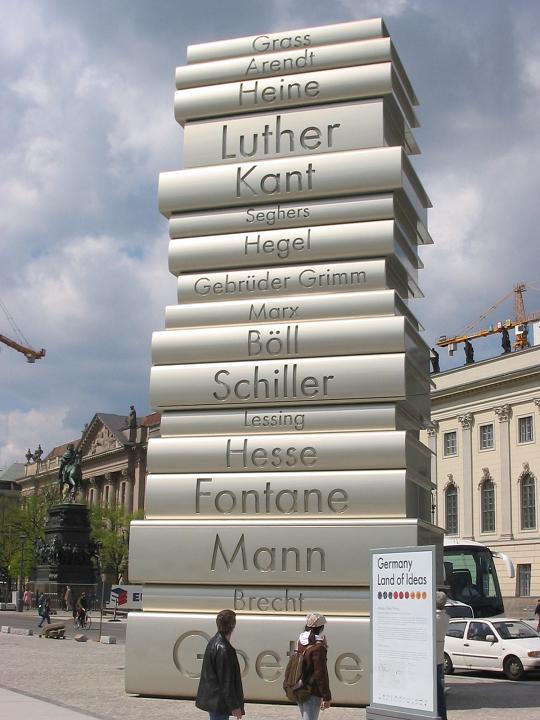
The Walk of Ideas designed by
Scholtz & Friends to celebrate
the invention of modern printing.
Wendell Phillips lived during the 1800's so he saw the outcomes of this Renaissance technology. The ability to communicate had always been essential to the influential people of any time period. Even more important, however, was the ability to immortalize their words. Painstaking methods, such as carving into solid rock, were employed so that a ruler could "live on" beyond his death. How else would we know of the great deeds they performed? When Gutenberg developed his printing press, suddenly it was easy to not only immortalize, but also spread one's ideas. Without it, the extent of a great mind's sprezzatura in speech and writing would have been lost or limited, as mentioned by Kekoa in our salon discussion.

On the other hand, maybe some ideas should have been lost. Violent revolutions and reformations grew out of humanistic ideas that spread quickly with the ability to mass produce writings. Dictators and despots controlled the masses with propaganda. Many lives were lost and countries were left in shambles, such as France after its revolution.

Gutenberg the Sprezzaturist


“He who first shortened the labor of copyists by device of movable types was disbanding hired armies, and cashiering most kings and senates, and creating a whole new democratic world: he had invented the art of printing.” – Thomas Carlyle, Sartor Resartus

In the spirit of sprezzatura, I submit that a quote discussing a major figure of the Renaissance, even if the quote comes from a novel published in 1836, is significant enough to be counted for the quote requirement. Plus, this quote, shared by Madison P during our groups on Monday, helped enlighten me to an aspect of the Renaissance that I previously hadn’t thought of before. As Petrarch said in his essay “To Homer,” “I am very eager for knowledge,” and the Carlyle quote provided me with some knowledge. 

Monday, February 2, 2015

That We May All Be A Part Of THE CENTAUR

“He who lives everywhere, lives nowhere” So said Charles J. He said this in response to my point that sprezzatura is in and through all things in the renaissance. It made me ponder as to the home for each concept, as well as which one is chiefest among them.

I now want to compare the renaissance to a centaur.